


Healthcare generates an extraordinary amount of real-world data every day. Across routine care, therapies are started, treatment changes are documented, scans reveal whether disease progressed, and hospitalizations capture outcomes that may never appear in a clinical trial. Too often, those signals remain disconnected.
Real-world data (RWD) are meant to close that gap. At their best, RWD help researchers to study healthcare as it is lived, not only as it is tested in controlled settings. They show who gets treated, who does not, what outcomes occur, where risks emerge, and how practice changes over time.
But RWD only become useful when they can support the decision at hand. That requires data that are clinically rich, current, representative, and transparent enough to generate reliable real-world evidence.
Truveta Data was built to make these questions easier to answer with confidence. Created in partnership with US health systems, Truveta Data provides a complete, real-time, representative view of patient care, including de-identified, daily refreshed electronic health record (EHR) data for more than 130 million patients, 8.8B clinical notes, 190M imaging studies, 1.4M+ mother-child pairs, and 155M+ device uses.
This guide explains what real-world data are, how they become real-world evidence, and how RWD is used across discovery, therapy adoption, safety, outcomes research, clinical trials, and healthcare optimization.
What are real-world data and real-world evidence?
The FDA defines real-world data as data relating to patient health status or healthcare delivery that are routinely collected from sources such as electronic health records (EHRs), claims, registries, and digital health technologies. Real-world evidence (RWE) is the clinical evidence generated from analyzing RWD to understand the use, benefits, or risks of medical therapy.
Put simply, RWD are the inputs, and RWE is what researchers generate when they use those data to answer a specific question with appropriate methods.
Clinical trials remain essential for evaluating safety and efficacy. RWD complements trials by showing how therapies, devices, and care pathways perform across broader populations and everyday care settings. These data can also support trial planning by helping teams assess feasibility, refine eligibility criteria, identify sites, and understand whether key endpoints are available in routine care.
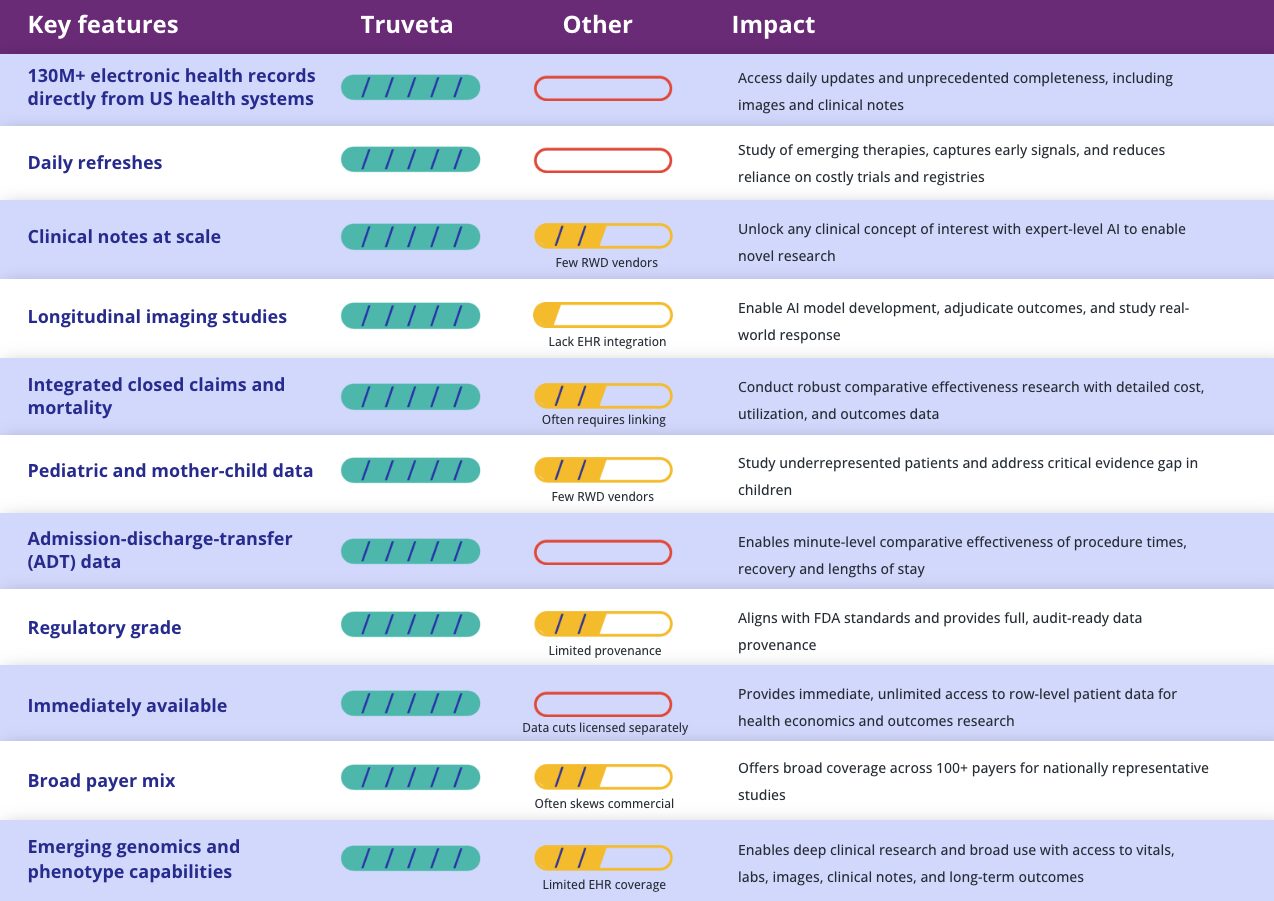
What high-value real-world data make possible
Many organizations have access to some form of real-world data. Fewer have data that are complete, current, clinically deep, and transparent enough to support high-stakes evidence generation.
Truveta Data brings together daily refreshed EHR data, clinical notes, imaging, closed claims, mortality, SDOH, mother-child pairs, and device data to help researchers study complete patient journeys with greater precision.
This depth can change the kinds of questions teams are able to ask:
- Daily refreshed data can support near real-time therapy adoption and safety monitoring.
- Clinical notes can add context on disease severity, symptoms, treatment rationale, and discontinuation.
- Imaging can help researchers study disease progression and outcomes that structured fields may miss.
- Claims and mortality can add longitudinal context across utilization, cost, and survival.
- Unique device identifiers can connect outcomes to specific devices used in care.
How real-world data is used across the healthcare lifecycle
Real-world data can support decisions before a therapy reaches patients and after it enters routine care. Across the healthcare lifecycle, RWD help teams understand disease, design better studies, monitor safety, evaluate outcomes, track adoption, and improve care delivery.
Discovery
Discovery teams use real-world data to understand disease earlier and more precisely. Clinically rich patient journeys can help researchers characterize disease progression, identify underdiagnosed populations, discover new targets, and train AI with more complete context.
Clinical trials
Clinical trial teams use real-world data to simulate studies, assess feasibility, refine eligibility criteria, identify eligible patients, and understand endpoint availability. Better feasibility can help teams design protocols around patients who actually exist in clinical practice.
Safety
Safety teams use real-world data to detect and evaluate potential risks after products enter routine use. Timely EHR data, clinical notes, labs, pregnancy data, and unique device identifiers can support pharmacovigilance, post-market surveillance, and regulatory commitments.
Outcomes research
Outcomes research teams use real-world data to understand effectiveness, disease burden, care pathways, utilization, and value across precise populations. Because care changes over time, real-time data can help teams update evidence strategies as new therapies, guidelines, and questions emerge.
Therapy adoption
Therapy adoption teams use real-world data to track how therapies reach patients in routine care. Real-time data can show how uptake changes, where access may lag, and whether treatment patterns differ across populations.
Healthcare optimization
Healthcare organizations use real-world data to benchmark care quality, understand variation, and improve operations. Detailed data on encounters, procedures, labs, vitals, imaging, notes, and outcomes can help teams identify where care delivery can improve.
Frequently asked questions (FAQ) about real-world data
What is real-world data?
Real-world data are data collected during routine healthcare delivery, including EHRs, claims, registries, clinical notes, imaging, device data, mortality data, SDOH, and digital health data.
What is the difference between RWD and RWE?
RWD are the data collected from routine care. RWE is the evidence generated by analyzing those data to answer a specific clinical, regulatory, commercial, or operational question.
How is real-world data used in life sciences?
Life science teams use RWD across discovery, clinical trials, safety, outcomes research, therapy adoption, and healthcare optimization.
What makes real-world data fit for purpose?
RWD are fit for purpose when they capture the population, exposure, outcome, covariates, and follow-up needed for the question being studied, with sufficient quality, timeliness, and transparency.
From real-world data to better evidence
The future of RWD will not be defined by data access alone. It will be defined by whether those data are complete, real-time, representative, and transparent enough to generate evidence teams can use.
When connected across the patient journey, real-world data can help researchers discover earlier, design better trials, monitor safety faster, update evidence strategies, understand therapy adoption, and improve care delivery.
Reach out for a custom demo or feasibility assessment today.