


Authors: Karen Gilbert Farrar, PhD ⊕Truveta, Inc, Bellevue, WA, Nina B Masters, PhD, MPH ⊕Truveta, Inc, Bellevue, WA, Duy Do, PhD ⊕Truveta, Inc, Bellevue, WA, Nicholas Stucky, MD, PhD ⊕Truveta, Inc, Bellevue, WA, Brianna M Cartwright, MS ⊕Truveta, Inc, Bellevue, WA
Adalimumab, originally sold as Humira, is a widely used biologic for autoimmune diseases. Biosimilars to adalimumab became available in 2023 and were expected to improve affordability and access, yet real-world evidence on switching after biosimilar initiation remains limited.
A new peer-reviewed study from Truveta Research assessed real-world adoption of adalimumab biosimilars and characterized how often, and how quickly, patients switched back to originator adalimumab after starting a biosimilar.
In this retrospective cohort study, researchers used de-identified electronic health record (EHR) data from Truveta. The study included adult patients with at least one outpatient or telehealth encounter between February 1, 2023, and August 31, 2025, and at least two originator adalimumab dispenses in the prior year. Switching was defined as the first biosimilar dispense following originator use. Switch-back was defined as a subsequent originator adalimumab dispense after biosimilar initiation.
Biosimilar switching increased after formulary changes
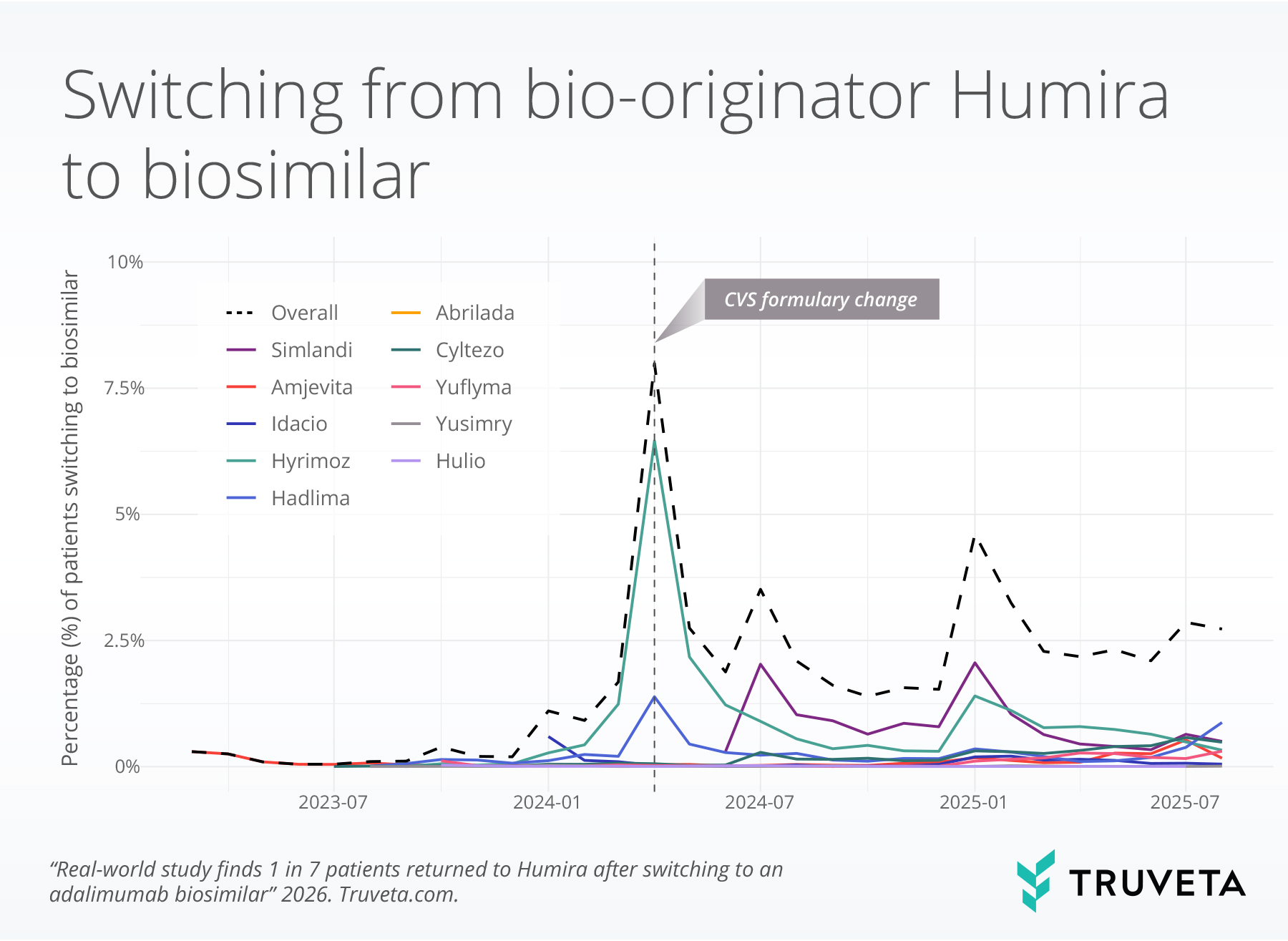
Among 67,594 patients treated with originator adalimumab, 17.7% switched to a biosimilar during the study period.
Switching peaked in April 2024, coinciding with formulary changes, then declined and stabilized by August 2025.
More than 1 in 7 biosimilar initiators switched back
Among 9,252 biosimilar initiators with at least one clinical encounter at least 90 days after a biosimilar dispense, 16.0% switched back to originator adalimumab.
Older adults had higher odds of switching back compared with adults aged 18–34 years. Patients aged 65 years and older had more than twice the odds of switching back. Women and patients with ankylosing spondylitis were also more likely to switch back.
Some patients switched back quickly
Among patients who switched back to originator adalimumab, more than one-third did so within 30 days of their first biosimilar dispense.
Rural residence was associated with higher odds of early switch-back. These early switch-backs should be interpreted with caution because they may reflect administrative issues, a biosimilar being dispensed but not taken, or rapid efforts by patients or clinicians to avoid the switch rather than true biosimilar use.
Why it matters
Formulary changes can accelerate biosimilar adoption, but returns to the originator product can offset cost savings and complicate continuity of care. In this study, switch-backs varied by age, sex, clinical indication, and rural residence, suggesting that formulary policy alone does not explain real-world treatment behavior.
These findings highlight the importance of monitoring biosimilar transitions after adoption and identifying where additional patient education, clinician guidance, or access support may help promote sustained biosimilar use.
Read the full study
You can also view the entire study, including data definitions, directly in the Truveta research environment.