


Authors: Brianna M Cartwright, MS ⊕ Truveta, Inc, Bellevue, WA, Karen Gilbert Farrar, PhD ⊕Truveta, Inc, Bellevue, WA, Duy Hoang, PhD ⊕Truveta, Inc, Bellevue, WA, Nina B Masters, PhD, MPH ⊕Truveta, Inc, Bellevue, WA
- Among linked mother–infant pairs, nutrition counseling following gestational diabetes diagnosis was associated with lower odds of delivering a large-for-gestational-age infant.
- These findings suggest that timely nutrition counseling may improve infant outcomes in pregnancies complicated by gestational diabetes.
This report is an extension of our poster presented at ISPOR 2026, titled Association of gestational diabetes treatment with maternal weight change and newborn birthweight.
Gestational diabetes mellitus (GDM) is diabetes first diagnosed during pregnancy. GDM affects 5-9% of all pregnancies in the US (1, 2). GDM is associated with increased risks for both mothers and infants (3). Infants born to mothers with GDM are more likely to experience macrosomia and large-for-gestational-age (LGA) birthweight, outcomes that can increase the risk of birth injury, cesarean delivery, neonatal hypoglycemia, and mothers increased risk for metabolic disease later in life (4, 5). Because fetal growth accelerates during the late second and third trimesters, timely interventions to improve maternal glucose control may play an important role in reducing infant complications associated with GDM.
Current clinical guidelines recommend nutrition counseling as the first-line therapy for GDM management, with insulin or metformin considered when lifestyle modifications are insufficient to control blood sugar (6, 7). While prior studies have demonstrated that nutrition therapy can improve maternal blood sugar levels and reduce excessive maternal weight gain, less is known about how these interventions impact infant birthweight outcomes in real-world clinical practice (8, 9).
In prior analyses, we have described patterns in glucose tolerance testing and examined factors associated with maternal weight gain following the 1-hour glucose tolerance test. We found lower maternal weight gain associated with both nutrition counselling and use of metformin. In this analysis, we build upon that work specifically looking at infant outcomes among linked mother–child pairs to evaluate whether nutrition counseling, insulin initiation, or metformin use following GDM diagnosis were associated with the likelihood of delivering an LGA infant.
Methods
We used a subset of Truveta’s electronic health record (EHR) Data linked with closed pharmacy and medical claims. Within this linked data, we identified deterministically linked mother-child pairs from the data, where the mothers were aged 16–50 years at pregnancy and underwent a one-hour glucose tolerance test (GTT) between January 2018 and March 2026 during their first pregnancy. Gestational age was inferred using diagnostic codes, and patients were required to have continuous linked medical claims coverage between 24 and 42 weeks gestation. Mothers were required to have a valid starting weight (80 to 600 lbs) and BMI measurement between 37 and 65 weeks prior to delivery to be used as the pre-pregnancy weight and BMI. Mothers were also required to have a weight measurement taken 23 to 29 weeks prior to delivery, roughly corresponding to the end of the first trimester for those with term pregnancies, and a weight taken within one week prior to delivery (to be used as the final weight). Additional descriptions of the maternal weight data can be found in a prior analysis. Linked babies were required to have a weight measurement within one day of delivery. Mothers with prior type 1 or type 2 diabetes, a prior prescription or pharmacy fill of insulin or metformin, or evidence of prior glucose monitoring were excluded.
Gestational diabetes was defined as either two elevated values on the 3-hour GTT or the presence of a GDM diagnosis code. We evaluated three interventions occurring within 45 days of diagnosis or confirmatory testing: nutrition counseling, insulin initiation, and metformin initiation.
For the infant-focused analysis, we included a subset of pregnancies with deterministically linked infant records. Large for gestational age (LGA) was defined as infant birthweight >4,000 grams recorded within one day of delivery. We used multivariable logistic regression models to evaluate associations between GDM treatments and odds of LGA birthweight, adjusting for maternal age, race, ethnicity, and pre-pregnancy body mass index (BMI). Results of the model are presented as odds ratios, where values over one indicate a higher likelihood of having a large for gestation infant and values lower than one indicate a lower likelihood of having a large for gestation infant.
Results
The study included 35,870 mothers with linked infant records available for analysis.
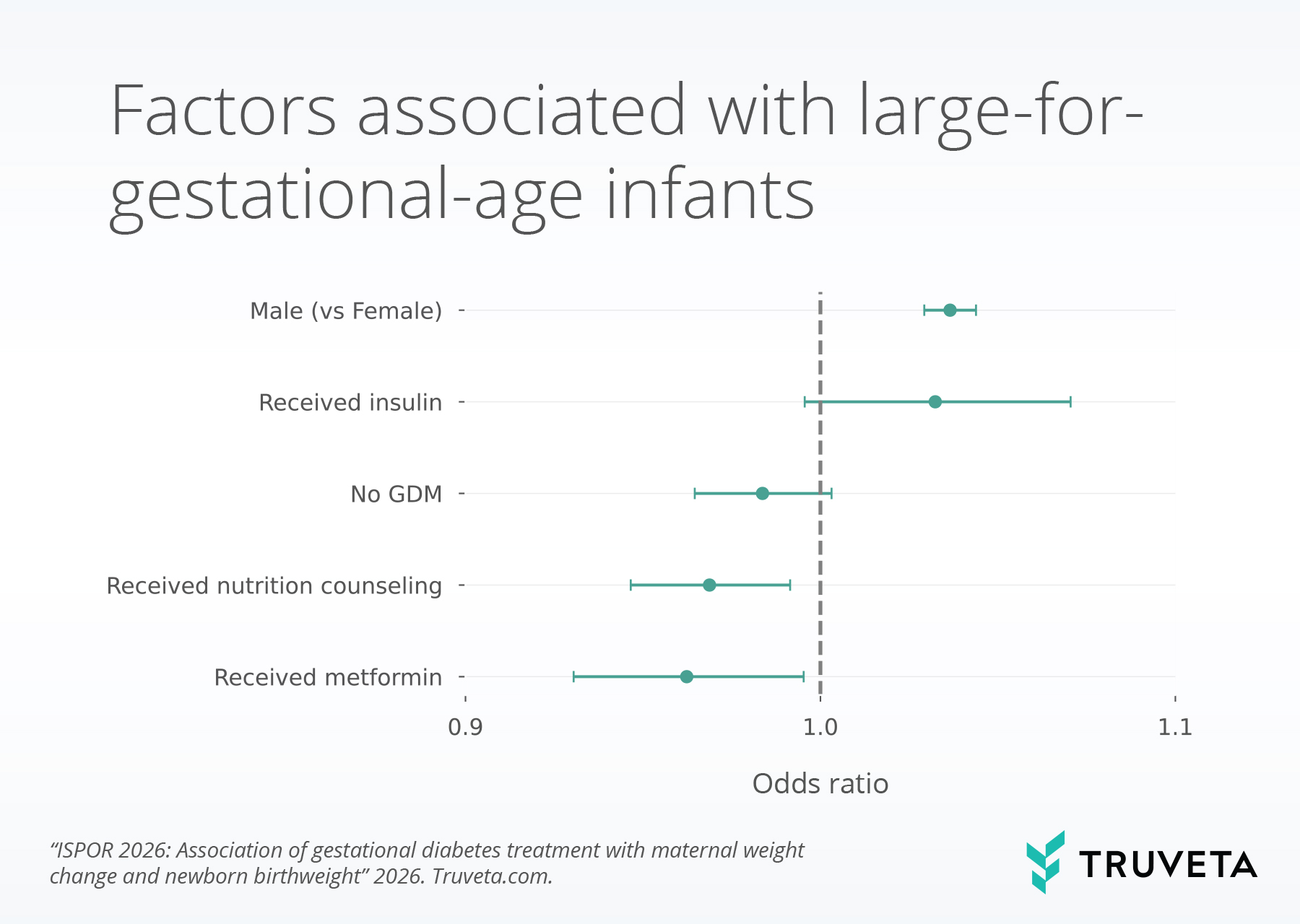
Nutrition counseling was associated with significantly lower odds of delivering a large-for-gestational-age infant. In adjusted analyses, mothers who received nutrition counseling had a 3% reduction in the odds of LGA birthweight compared with those who did not receive counseling (OR: 0.97; 95% CI: 0.95–0.99; p=0.007). Metformin use was also associated with lower odds of large-for-gestational-age birthweight (OR: 0.97; 95% CI: 0.93–0.99; p=0.02). In contrast, insulin use was not associated with significantly lower odds of LGA birthweight in adjusted analyses shown in the poster.
Discussion
In this large real-world cohort of linked mother–infant pairs, we built upon a previous analysis to show that nutrition counseling and metformin use were associated not only with lower maternal weight gain, but also with lower odds of delivering a large-for-gestational-age infant.
These findings are clinically important because large infant size at birth is one of the most common and consequential complications of gestational diabetes. Large-for-gestational-age infants face increased risks of shoulder dystocia, neonatal intensive care admission, hypoglycemia, and later-life obesity and metabolic disease (4, 5). Identifying interventions that may reduce excessive fetal growth therefore has implications for both short- and long-term child and maternal health.
Our findings are consistent with prior studies demonstrating that maternal glucose control and dietary management can improve infant outcomes in pregnancies complicated by GDM (8–10). Given that nutrition counseling is a non-pharmacologic intervention and is recommended as first-line management, these results reinforce the importance of timely dietary intervention after abnormal glucose testing.
Importantly, this analysis leveraged linked mother–infant data from routine clinical practice, providing insight into how GDM management is implemented outside tightly controlled clinical trial settings. The ability to deterministically link maternal and infant records also represents a unique strength of Truveta Data and enables evaluation of pregnancy interventions alongside downstream child outcomes.
Several limitations should be considered. Nutrition counseling was identified through claims and encounter documentation, which may underestimate counseling delivered informally during routine prenatal care. We also could not assess adherence to counseling recommendations or medication regimens. Additional confounding is possible, as patients receiving nutrition counseling or pharmacotherapy may systematically differ in ways not fully captured by EHR data.
Despite these limitations, this study provides real-world evidence that nutrition counseling after gestational diabetes diagnosis may benefit infant outcomes in addition to maternal outcomes. Expanding access to timely nutrition counseling may represent an important opportunity to reduce rates of large-for-gestational-age birthweight infants and improve outcomes for children born to mothers with gestational diabetes.
These findings are consistent with data accessed on March 23, 2026.
Citations
- American Diabetes Association Professional Practice Committee for Diabetes*, M. Bajaj, R. G. McCoy, K. Balapattabi, R. R. Bannuru, N. J. Bellini, A. K. Bennett, E. A. Beverly, K. Briggs Early, S. ChallaSivaKanaka, J. B. Echouffo-Tcheugui, B. M. Everett, R. Garg, L. M. Laffel, R. Lal, G. Matfin, N. Pandya, E. J. Pekas, A. L. Peters, S. J. Pilla, G. R. Romeo, S. E. Rosas, A. R. Segal, K. M. Simmons, E. D. Szmuilowicz, N. A. ElSayed, 2. Diagnosis and Classification of Diabetes: Standards of Care in Diabetes—2026. Diabetes Care 49, S27–S49 (2026).
- Centers for Disease Control and Prevention, Gestational Diabetes (2024). https://www.cdc.gov/diabetes/about/gestational-diabetes.html.
- T. A. Buchanan, A. H. Xiang, K. A. Page, Gestational diabetes mellitus: risks and management during and after pregnancy. Nat. Rev. Endocrinol. 8, 639–649 (2012).
- The HAPO Study Cooperative Research Group, Hyperglycemia and Adverse Pregnancy Outcomes. N. Engl. J. Med. 358, 1991–2002 (2008).
- L. Bellamy, J.-P. Casas, A. D. Hingorani, D. Williams, Type 2 diabetes mellitus after gestational diabetes: a systematic review and meta-analysis. The Lancet 373, 1773–1779 (2009).
- American Diabetes Association Professional Practice Committee, N. A. ElSayed, R. G. McCoy, G. Aleppo, K. Balapattabi, E. A. Beverly, K. Briggs Early, D. Bruemmer, J. B. Echouffo-Tcheugui, L. Ekhlaspour, R. Garg, K. Khunti, R. Lal, I. Lingvay, G. Matfin, N. Pandya, E. J. Pekas, S. J. Pilla, S. Polsky, A. R. Segal, J. J. Seley, R. C. Stanton, R. R. Bannuru, 15. Management of Diabetes in Pregnancy: Standards of Care in Diabetes—2025. Diabetes Care 48, S306–S320 (2025).
- ACOG Practice Bulletin No. 190: Gestational Diabetes Mellitus. Obstet. Gynecol. 131, e49–e64 (2018).
- S. Thangaratinam, E. Rogozinska, K. Jolly, S. Glinkowski, T. Roseboom, J. W. Tomlinson, R. Kunz, B. W. Mol, A. Coomarasamy, K. S. Khan, Effects of interventions in pregnancy on maternal weight and obstetric outcomes: meta-analysis of randomised evidence. BMJ 344, e2088–e2088 (2012).
- K. Kapur, A. Kapur, M. Hod, Nutrition Management of Gestational Diabetes Mellitus. Ann. Nutr. Metab. 76, 17–29 (2020).
- R. Wu, Q. Zhang, Z. Li, A meta-analysis of metformin and insulin on maternal outcome and neonatal outcome in patients with gestational diabetes mellitus. J. Matern. Fetal Neonatal Med. 37, 2295809 (2024).