


Authors: Xiaofan Liu, MPH, ⊕University of Southern California, Los Angeles, CA, Duy Hoang, PhD, ⊕Truveta, Inc, Bellevue, WA, Rebecca Horn, PhD, ⊕Edwards Lifesciences, Irvine, CA, Mary Imboden, PhD, ⊕Center for Cardiovascular Analytics, Research and Data Science (CARDS), Providence Heart Institute, Providence Health System, Portland, OR, Chloe Zeng, MISM,⊕ Lumbrita, Los Gatos, CA, Nina B Masters, PhD, MPH, ⊕Truveta, Inc, Bellevue, WA, Karen Gilbert Farrar, PhD, ⊕Truveta, Inc, Bellevue, WA, Angela Winegar, PhD, ⊕Truveta, Inc, Bellevue, WA, Brianna M Cartwright, MS, ⊕Truveta, Inc, Bellevue, WA, Tyler J Gluckman, MD, MHA ⊕ Center for Cardiovascular Analytics, Research and Data Science (CARDS), Providence Heart Institute, Providence Health System, Portland, OR

- Among adults with heart failure with reduced ejection fraction (HFrEF), prescribing and dispensing of all four guideline-directed medical therapy (GDMT) medication classes increased from 2020 to 2024.
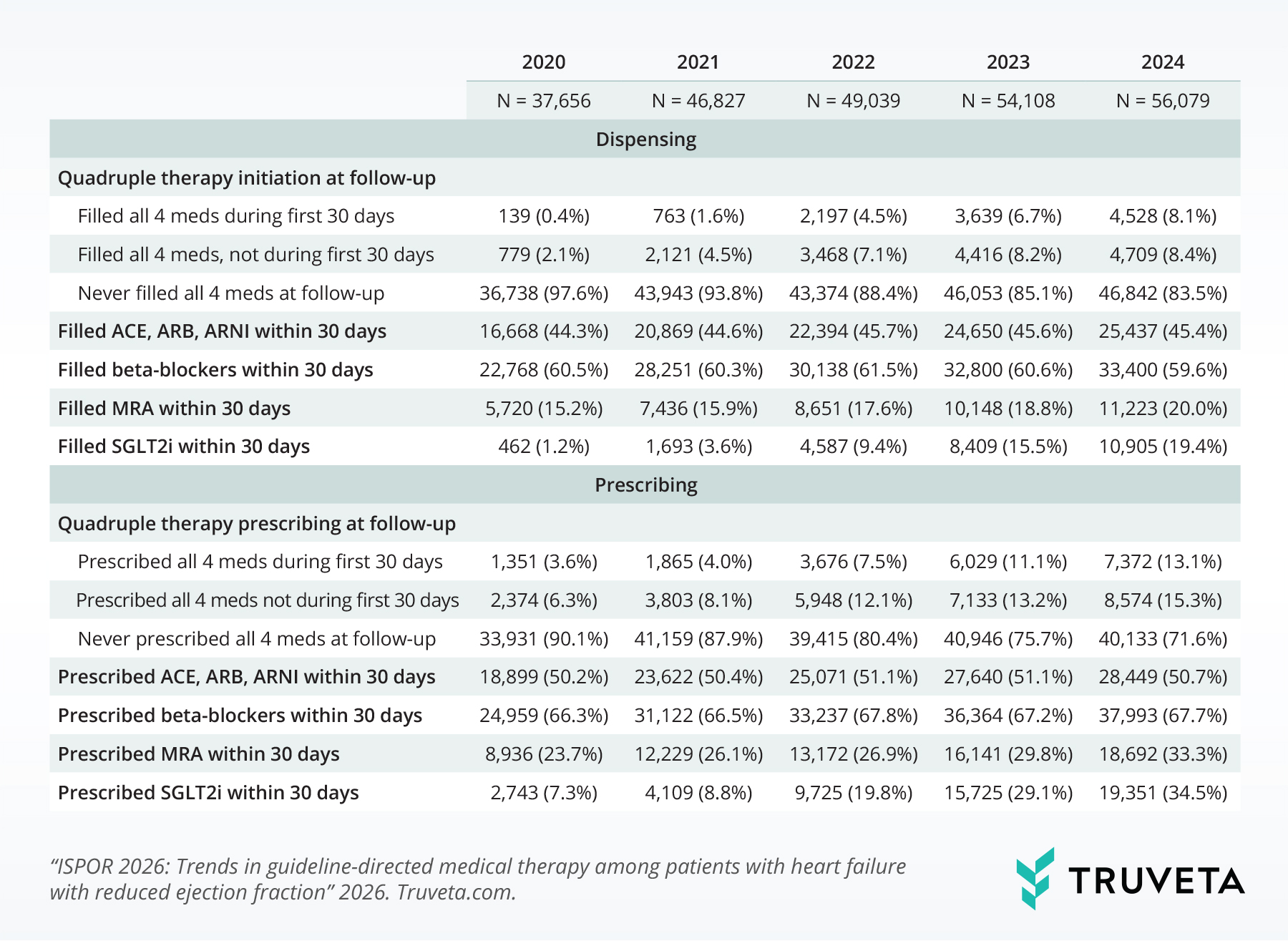
- Annualized prescribing of all four GDMT classes increased from 9.9% in 2020 to 28.4% in 2024, while dispensing increased from 2.5% to 16.5%.
- Rapid dispensing of all four medication classes within 30 days remained low but improved, rising from 0.4% in 2020 to 8.1% in 2024.
This blog is an extension of our poster presented at ISPOR 2026, titled Trends in guideline-directed medical therapy among patients with heart failure with reduced ejection fraction.
Heart failure with reduced ejection fraction (HFrEF) is a chronic condition in which the heart does not pump blood as effectively as it should. Clinicians measure this using the left ventricular ejection fraction (LVEF), or the percentage of blood pumped out of the heart with each beat. HFrEF is defined as LVEF <40% (1). Guideline-directed medical therapy (GDMT) is central to HFrEF care because multiple medication classes have been shown to reduce death, heart failure hospitalization, or both, in patients with this condition (1–8).
Treatment options for HFrEF have expanded over time. Earlier trials established the benefits of angiotensin-converting enzyme (ACE) inhibitors, beta-blockers, and mineralocorticoid receptor antagonists (MRAs) (2–5). More recently, angiotensin receptor-neprilysin inhibitors (ARNIs) and sodium-glucose cotransporter-2 inhibitors (SGLT2i) became key components of therapy after trials showed improved outcomes in patients with HFrEF (6–8). The 2022 American College of Cardiology/American Heart Association guidelines now recommend four core evidence-based GDMT medication classes for HFrEF: 1) beta-blocker; 2) ACE inhibitor, angiotensin receptor blocker (ARB), or ARNI; 3) MRA; and 4) SGLT2i (1).
Because the benefits of GDMT depend not only on whether therapies are used but also how quickly they are started, timely initiation is an important aspect of high-quality HFrEF care. Recent evidence suggests that rapid adjusting and intensifying of heart failure medications when patients’ symptoms worsen can improve outcomes, underscoring the importance of early treatment optimization (9). We assessed trends in GDMT prescribing and dispensing among patients with HFrEF from 2020-2024, including rapid initiation of all four medication classes within 30 days of the first LVEF.
Methods
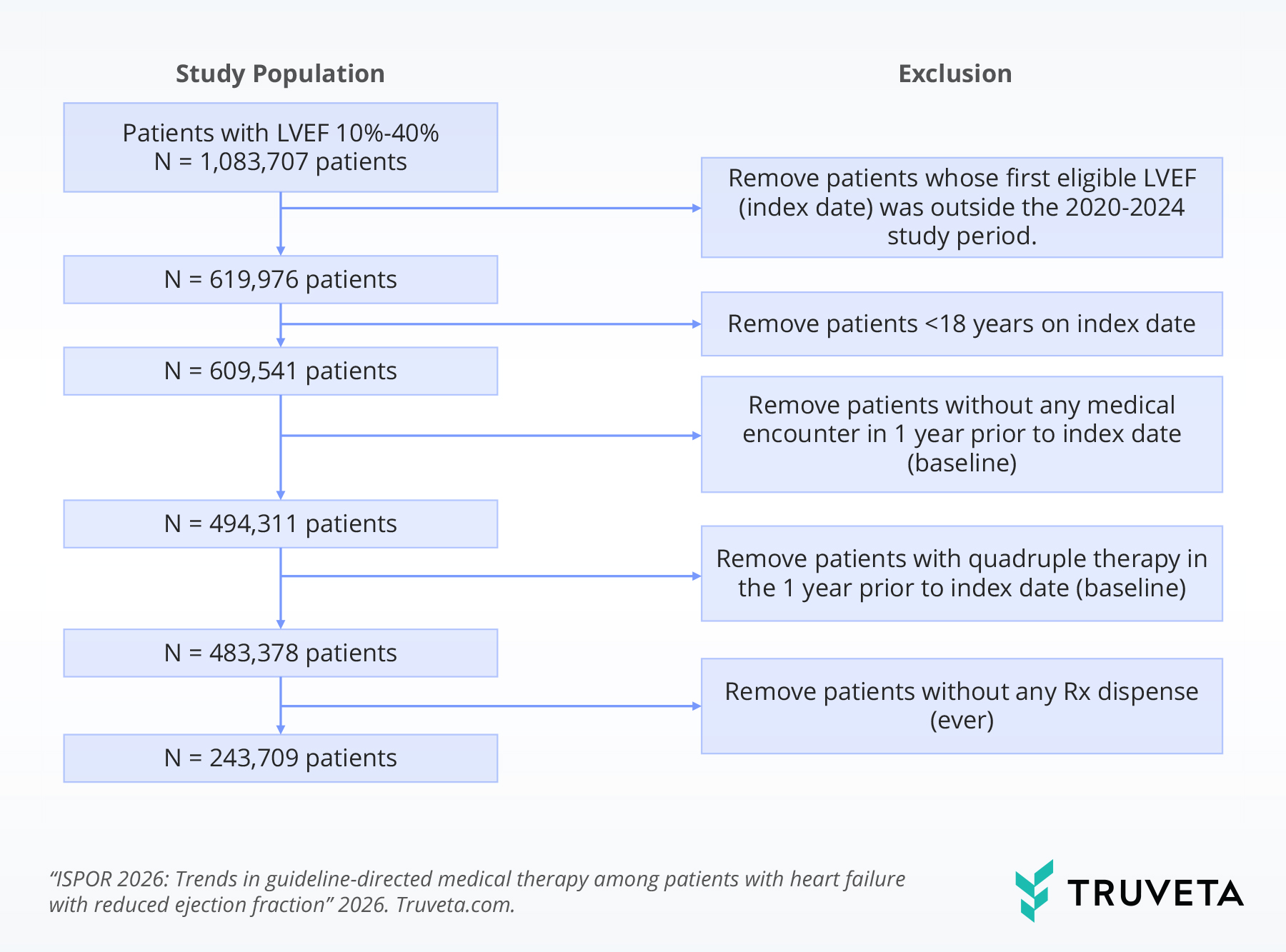
We conducted a retrospective cohort study using a subset of Truveta’s EHR data. We identified adults with an LVEF of 10-40% from 2020 to 2024. The date of first LVEF measurement meeting study criteria was defined as the index date. Patients were required to have at least one encounter in the year before the index date and at least one medication dispense recorded at any time. We excluded patients who received quadruple therapy during the one-year baseline period before the index date.
Adherence to GDMT was defined as receiving all four medication classes: 1) an evidence-based beta-blocker; 2) an ACE inhibitor, ARB, or ARNI; 3) an MRA; and 4) an SGLT2i. We assessed both prescribing and dispensing. Rapid prescribing (ordered by a clinician) or dispensing (filled by a pharmacy) was defined as evidence of all four medication classes within 30 days of the index LVEF date. We examined annual trends in prescribing and dispensing and evaluated which patient characteristics were associated with rapid initiation using a multivariable logistic regression, where odds ratios (ORs) greater than one indicated a higher likelihood of starting treatment within 30 days.
Results
We included 243,709 adult patients who met the inclusion criteria of having HFrEF.
Prescribing and dispensing of all four GDMT classes increased
Annualized prescribing of all four GDMT classes increased from 9.9% in 2020 to 28.4% in 2024. Dispensing of all four classes also increased, rising from 2.5% in 2020 to 16.5% in 2024.
Rapid initiation of all four GDMT classes within 30 days also increased. Rapid prescribing rose from 3.6% in 2020 to 13.1% in 2024. Rapid dispensing increased from 0.4% to 8.1% over the same period. Rapid prescribing and dispensing of beta-blockers; ACE inhibitors, ARBs, or ARNIs; and MRAs were largely unchanged over time. In contrast, SGLT2i use increased substantially. Rapid prescribing of SGLT2is rose from 7.3% in 2020 to 34.5% in 2024.
Inpatient LVEF assessment was associated with more rapid dispensing
Rapid dispensing was more common when the index LVEF was assessed in an inpatient setting rather than an outpatient setting. In 2024, 12.3% of patients whose index LVEF was assessed during an inpatient encounter had rapid dispensing of all four GDMT classes, compared with 3.2% of patients whose index LVEF was assessed in an outpatient setting.
Rapid dispensing varied by patient characteristics
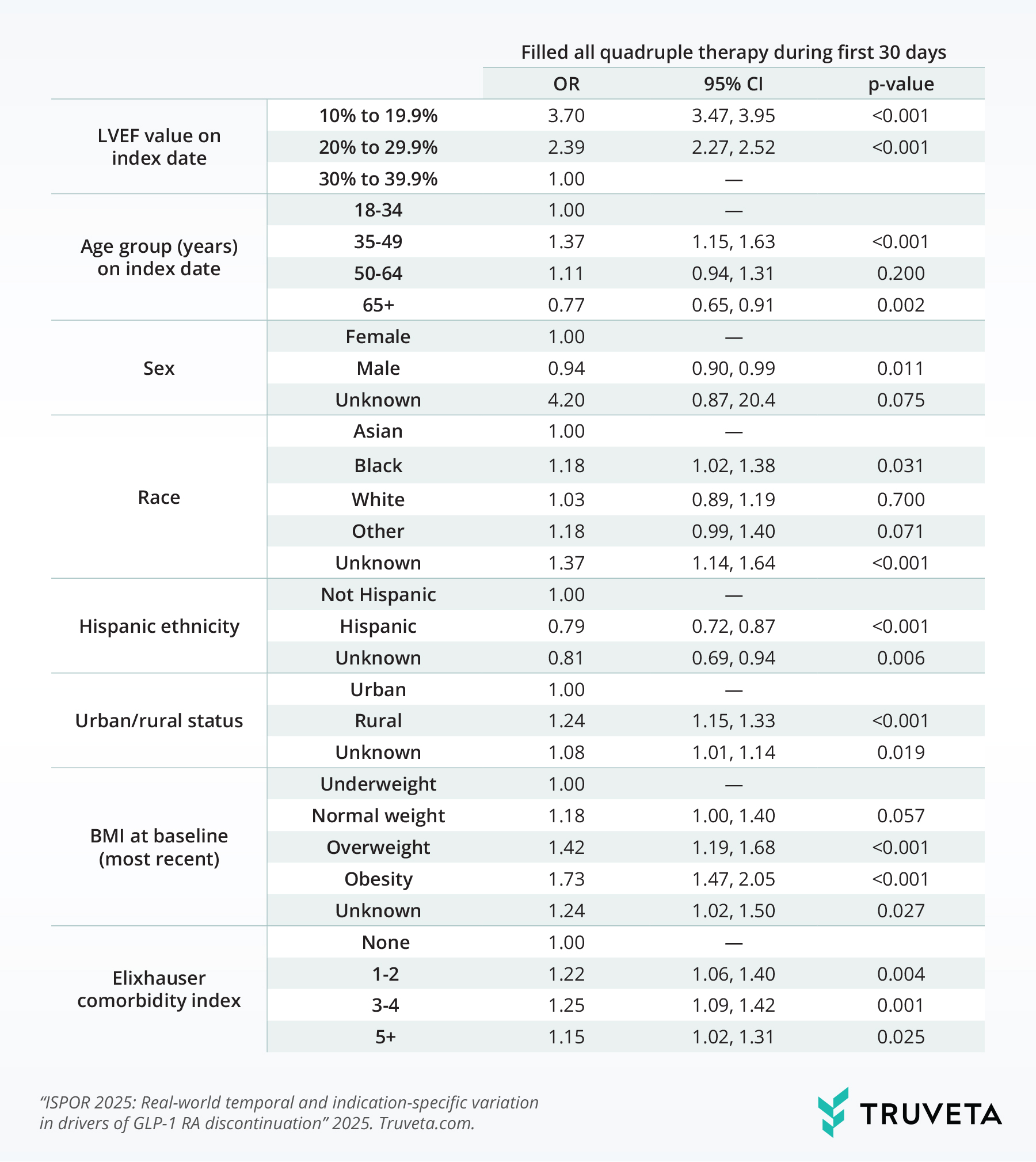
In a logistic regression analysis, rapid dispensing was more likely among patients living in rural areas (OR 1.25; 95% CI 1.15–1.33) and for patients with obesity (OR 1.73; 95% CI 1.47–2.05). Within the HFrEF range, patients with lower LVEF values were more likely to receive rapid dispensing. Patients with an LVEF of 20–29.9% and 10-19.9% had 2.4 and 3.7 times the odds of rapid dispensing compared with those with an LVEF of 30–39.9%, respectively.
Discussion
In this large cohort of 243,709 adults with HFrEF, rapid prescribing and dispensing of all four GDMT classes increased from 2020 through 2024. This increase was highest for SGLT2is, reflecting the rapid integration of newer evidence into clinical practice (9). However, in 2024, fewer than one in three patients had evidence of all four classes being prescribed, and fewer than one in five had evidence of all four classes being dispensed.
These findings highlight a gap between guideline recommendations and real-world medication use. The 2022 American College of Cardiology/American Heart Association guidelines recommend four foundational medication classes for HFrEF, including SGLT2is, and emphasizes GDMT as central to improving outcomes (1). Clinical trials supporting SGLT2i use showed lower rates of worsening heart failure, heart failure hospitalization, or cardiovascular death, helping explain why SGLT2i prescribing and dispensing increased during the study period (1,4,7).
The timing of GDMT initiation also matters. Rapid prescribing and dispensing increased over time but remained uncommon, with only 8.1% of patients having all four classes dispensed within 30 days in 2024. These findings suggest that clinicians are increasingly initiating comprehensive GDMT earlier after HFrEF identification. Prior trial evidence has suggested that intensive, early optimization of heart failure therapy after acute heart failure hospitalization can improve outcomes compared with usual care, reinforcing the importance of rapid treatment initiation and follow-up (9).
We observed higher rates of rapid dispensing when the index LVEF was assessed during inpatient care. This may reflect greater clinical urgency, more frequent medication review, or better coordinated treatment planning before hospital discharge. The lower rapid dispensing rate after outpatient LVEF assessment highlights a potential opportunity to improve outpatient processes, such as automatically identifying patients with reduced LVEF, prompting clinicians to start medications, involving pharmacists in treatment initiation, and scheduling earlier follow-up visits.
This study has several limitations. First, this was an observational analysis, the results show associations but cannot prove that one factor caused another. Second, prescribing does not guarantee that a medication was filled or taken, and dispensing does not confirm that the medication was taken as directed. Third, some prescriptions or dispenses may have occurred outside observed data sources.
Despite these limitations, this analysis shows meaningful improvement in GDMT use among patients with HFrEF from 2020 through 2024, while also showing that many patients still did not receive comprehensive or rapid treatment. Greater effort is needed to ensure timely initiation of all four foundational GDMT classes for patients with HFrEF.
These findings are consistent with data accessed on December 7, 2025.
Citations
- Heidenreich PA, Bozkurt B, Aguilar D, Allen LA, Byun JJ, Colvin MM, et al. 2022 AHA/ACC/HFSA Guideline for the Management of Heart Failure. J Am Coll Cardiol. 2022 May;79(17):e263–421. doi:10.1016/j.jacc.2021.12.012
- The SOLVD Investigators*. Effect of Enalapril on Survival in Patients with Reduced Left Ventricular Ejection Fractions and Congestive Heart Failure. N Engl J Med. 1991 Aug;325(5):293–302. doi:10.1056/NEJM199108013250501
- Effect of metoprolol CR/XL in chronic heart failure: Metoprolol CR/XL Randomised Intervention Trial in-Congestive Heart Failure (MERIT-HF). The Lancet. 1999 Jun;353(9169):2001–7. doi:10.1016/S0140-6736(99)04440-2
- Packer M, Coats AJS, Fowler MB, Katus HA, Krum H, Mohacsi P, et al. Effect of Carvedilol on Survival in Severe Chronic Heart Failure. N Engl J Med. 2001 May 31;344(22):1651–8. doi:10.1056/NEJM200105313442201
- Pitt B, Zannad F, Remme WJ, Cody R, Castaigne A, Perez A, et al. The Effect of Spironolactone on Morbidity and Mortality in Patients with Severe Heart Failure. N Engl J Med. 1999 Sep 2;341(10):709–17. doi:10.1056/NEJM199909023411001
- McMurray JJV, Packer M, Desai AS, Gong J, Lefkowitz MP, Rizkala AR, et al. Angiotensin–Neprilysin Inhibition versus Enalapril in Heart Failure. N Engl J Med. 2014 Sep 11;371(11):993–1004. doi:10.1056/NEJMoa1409077
- McMurray JJV, Solomon SD, Inzucchi SE, Køber L, Kosiborod MN, Martinez FA, et al. Dapagliflozin in Patients with Heart Failure and Reduced Ejection Fraction. N Engl J Med. 2019 Nov 21;381(21):1995–2008. doi:10.1056/NEJMoa1911303
- Packer M, Anker SD, Butler J, Filippatos G, Pocock SJ, Carson P, et al. Cardiovascular and Renal Outcomes with Empagliflozin in Heart Failure. N Engl J Med. 2020 Oct 8;383(15):1413–24. doi:10.1056/NEJMoa2022190
- Mebazaa A, Davison B, Chioncel O, Cohen-Solal A, Diaz R, Filippatos G, et al. Safety, tolerability and efficacy of up-titration of guideline-directed medical therapies for acute heart failure (STRONG-HF): a multinational, open-label, randomised, trial. The Lancet. 2022 Dec;400(10367):1938–52. doi:10.1016/S0140-6736(22)02076-1