


Authors: Wilson Lau, PhD ⊕, Truveta, Inc, Bellevue, WA, Ehsan Alipour, MD, PhD ⊕,Truveta, Inc, Bellevue, WA, Youngwon Kim, PhD ⊕, Truveta, Inc, Bellevue, WA, Sihang Zeng ⊕, Truveta, Inc, Bellevue, WA, Anand Oka, PhD ⊕, Truveta, Inc, Bellevue, WA, Jay Nanduri, MBA, MS ⊕Truveta, Inc, Bellevue, WA

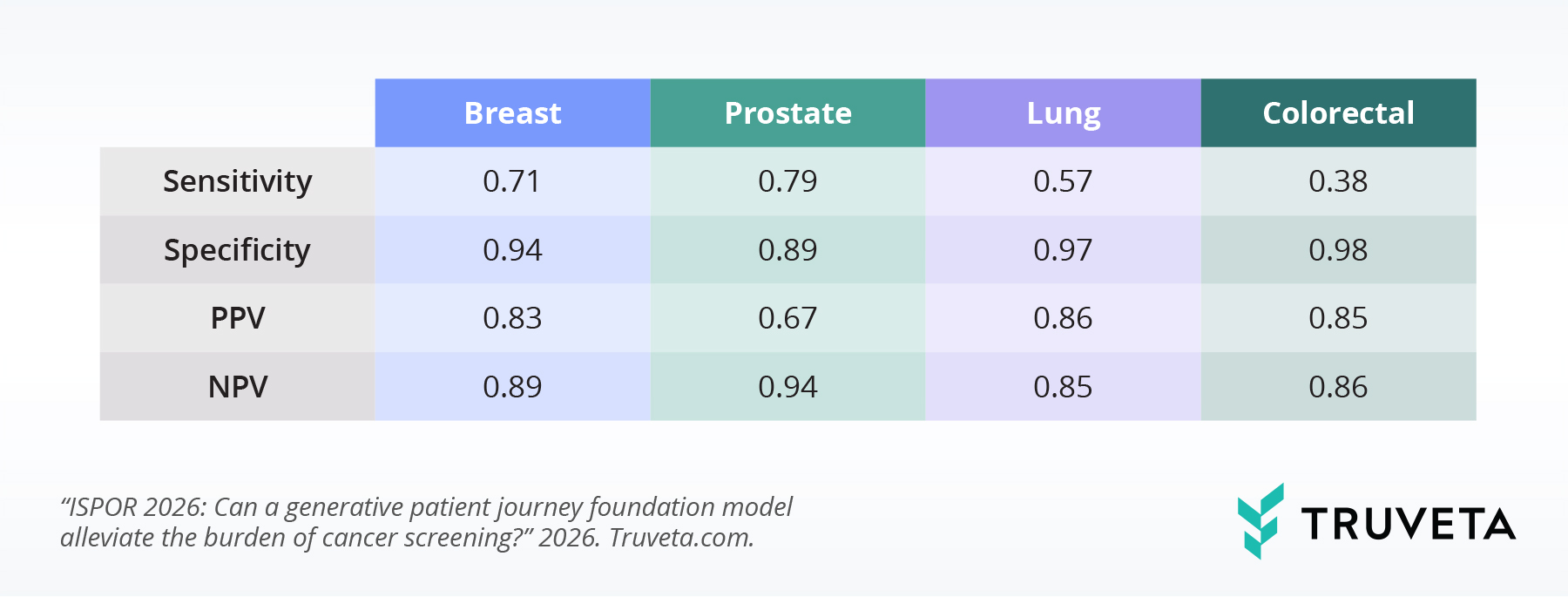
- High specificity and negative predictive value suggest the feasibility of applying the patient journey foundation model (PJFM) to predict negative cancer outcomes with high accuracy
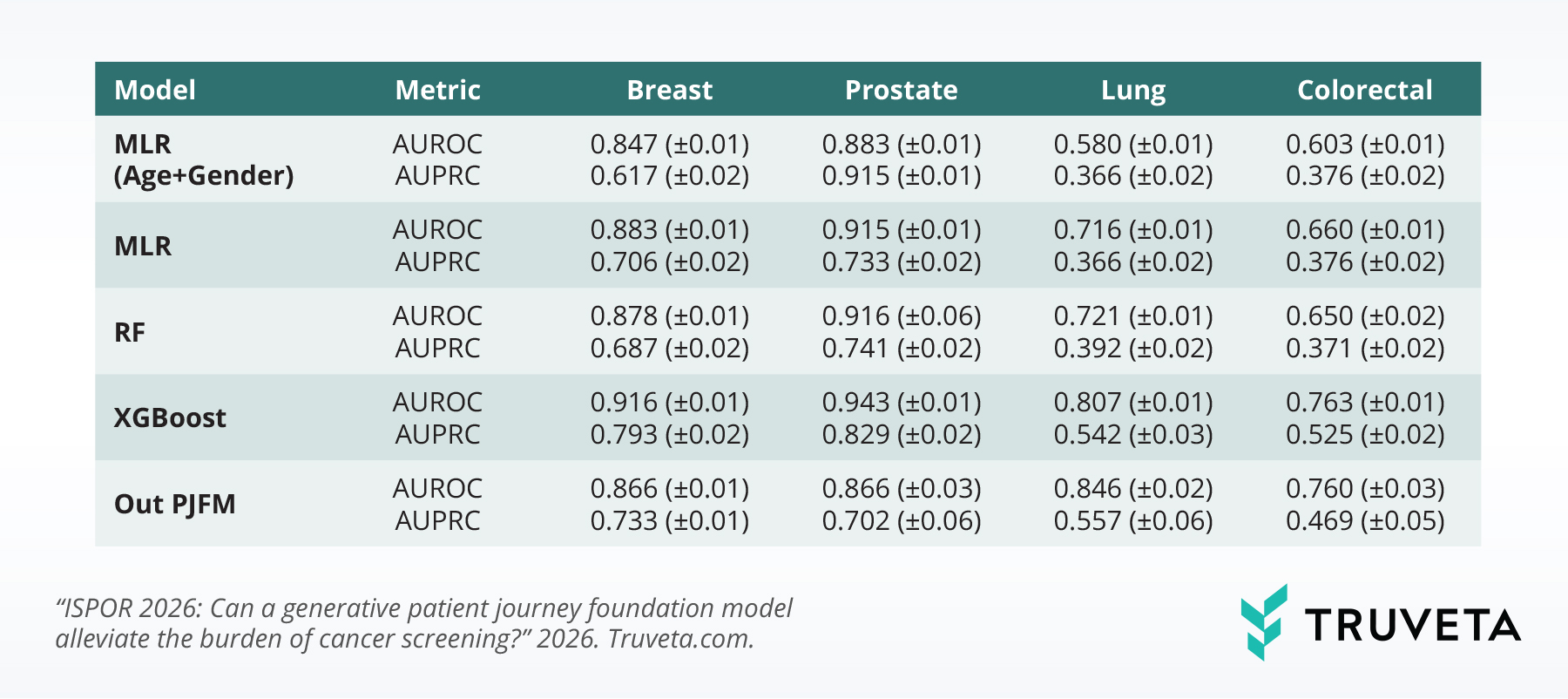
- Supervised machine learning (ML) models and PJFM show generally comparable performance, while no labelling data are needed for training PJFM
- Tree-based ML models can be biased by confounding features, such as gender, when predicting gender specific diseases
This report is an extension of our poster presented at ISPOR 2026, titled Can a generative patient journey foundation model alleviate the burden of cancer screening?
The average cost of cancer screening, such as mammogram or colonoscopy, can range from hundreds to over a thousand dollars. This study explores the potential of building a cancer foundation model based on generative pre-trained transformers (GPT) in predicting cancer outcomes within one year. When pretrained on large-scale electronic health record (EHR) data, patient journey foundation models (PJFMs) learn joint event probabilities, and can generate plausible future patient journeys.
We assess the prediction accuracy and feasibility of leveraging the foundation model to inform when screening can be prioritized, thereby reducing the associated burden of unnecessary procedures.
Methods
A cohort of 1.42 million patient journeys was constructed from the four most prevalent cancers in the United States—breast, prostate, lung, and colorectal cancers—identified using curated SNOMED-CT diagnosis codes within the de-identified Truveta database. Each patient’s electronic health record (EHR) was presented as a chronologically ordered sequence of clinical events. Patient journeys began with demographic information such as age and gender, followed by time-ordered diagnoses and laboratory events encoded using SNOMED-CT and LOINC ontologies.
The foundation model was built on an autoregressive transformer architecture but extended to support multimodal clinical events by learning embeddings jointly over event type, code, value, unit, and time. To assess the pretrained model’s capability in predicting future cancer diagnoses, we used the model to generate one year of synthetic future journey prior to the cancer diagnosis and then compared the generated diagnoses against the ground-truth test data.
Two studies were conducted. In the first study, only diagnoses and conditions were included in the patient journeys. In the second study, lab results were also included with performance comparison against supervised machine learning models.
Results
In the results of the first study, high specificity and negative predictive value suggested the feasibility of applying the patient journey foundation model to predict negative cancer outcomes with high accuracy. Since the percentage of screening tests leading to positive cancer diagnosis is relatively low, the projected negative predictive outcomes offer valuable signals for clinicians, which they can use to complement their expert assessment to avoid unnecessary screening and subsequently reduce the burden of screening costs.
In the second study, 10,000 patients were evaluated. Overall, PJFM achieved competitive performance with the supervised ML baselines despite requiring no labeled data or task-specific training.
Discussion
This study demonstrated the potential of applying patient journey foundation model in cancer outcome prediction. By predicting the next clinical events, we can stratify patients by risk and provide early warning to support timely intervention. This practical advantage is particularly important given the high cost of obtaining labeled EHR data. In future work, we plan to extend the model to additional types of medical events, including procedures, and medication in a more general population.
Citations
- Doherty M, Thom B, Gardner DS. Administrative burden associated with cost-related delays in care in US cancer patients. Cancer Epidemiology, Biomarkers & Prevention. 2023;32(11):1583-90.
- National Cancer Institute. Common Cancer Types; 2025. Accessed: 2026-02-05. https://www.cancer.gov/types/common-cancers
- Radford A, Wu J, Child R, Luan D, Amodei D, Sutskever I, et al. Language models are unsupervised multitask learners. OpenAI blog. 2019;1(8):9.
- Radford A, Narasimhan K, Salimans T, Sutskever I, et al. Improving language understanding by generative pre-training. 2018.