



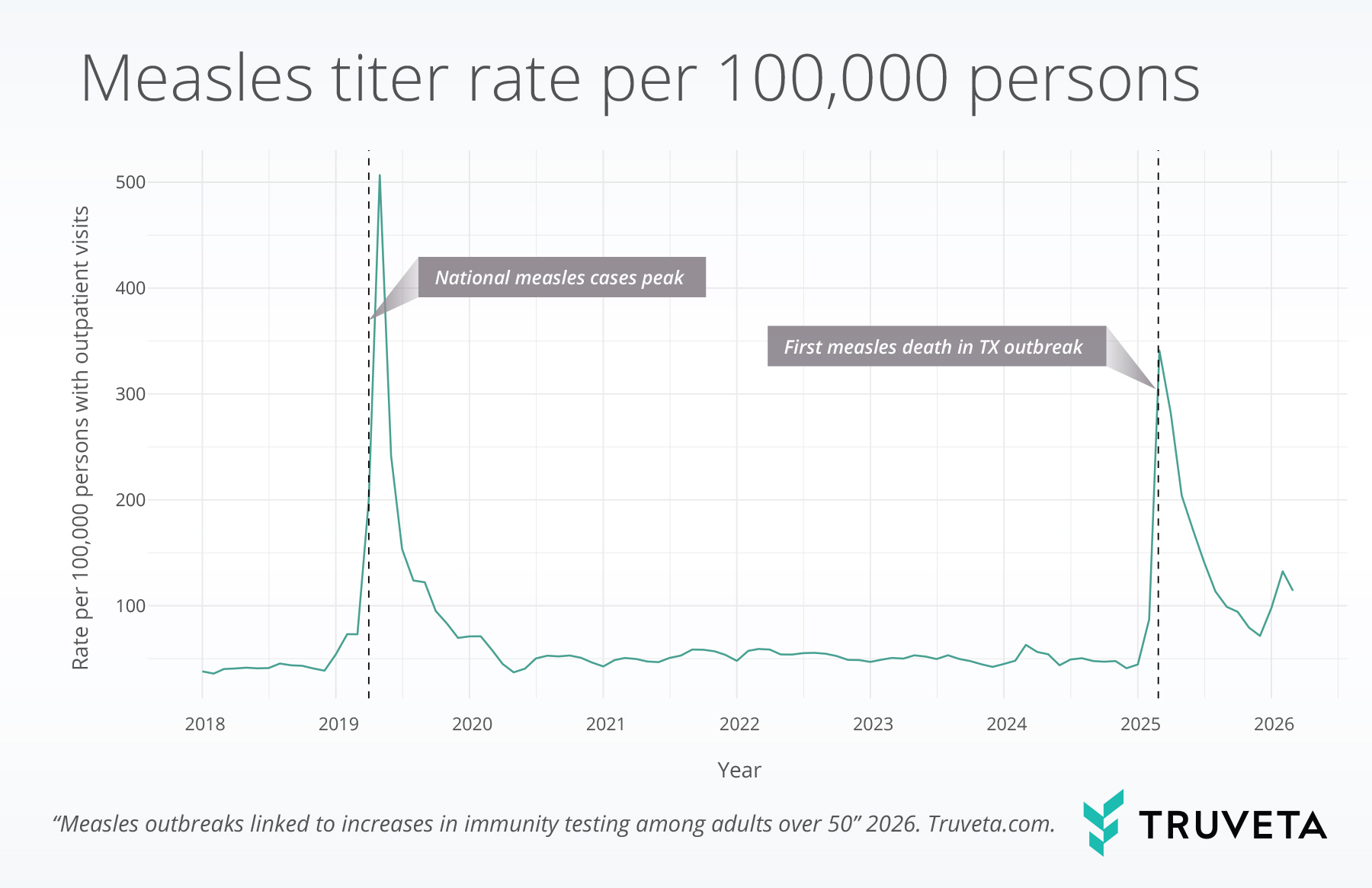
- Adults over 50 showed two clear increases in measles titer testing in 2019 and 2025, concurrent with large outbreaks.
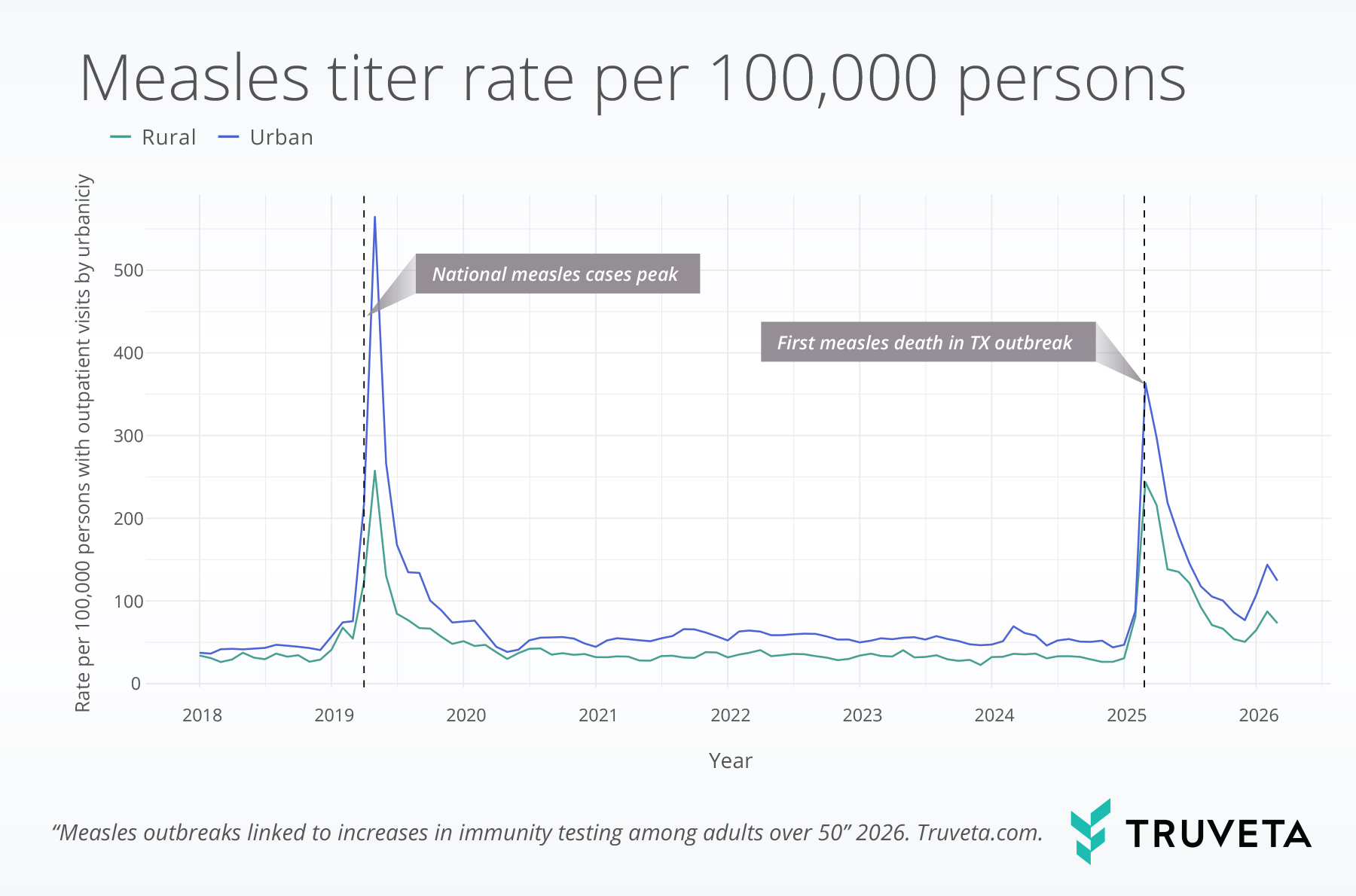
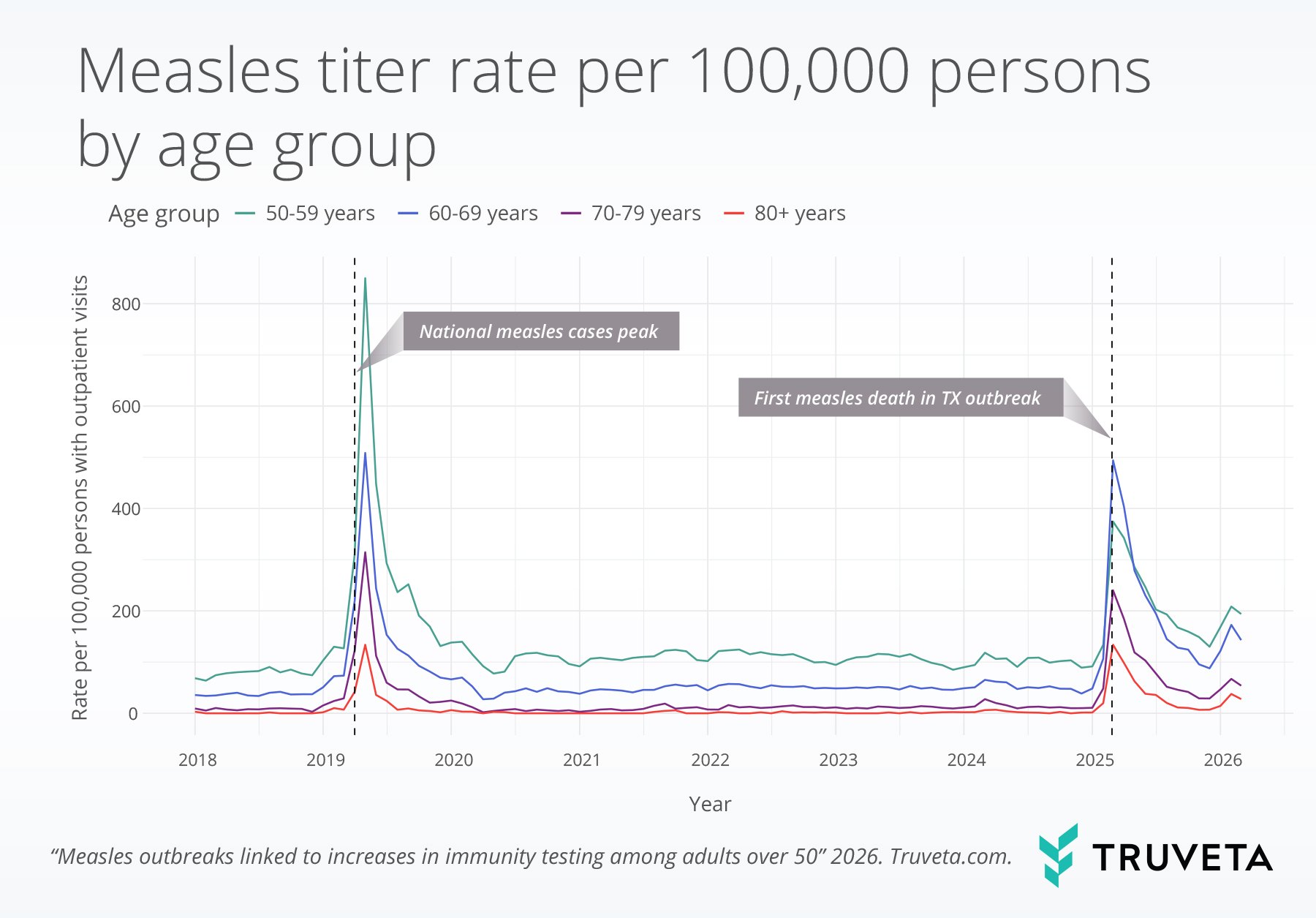
- Testing rates were generally higher in residents living in urban regions (compared to rural regions) and were highest among adults ages 50–59 for most of the study period.
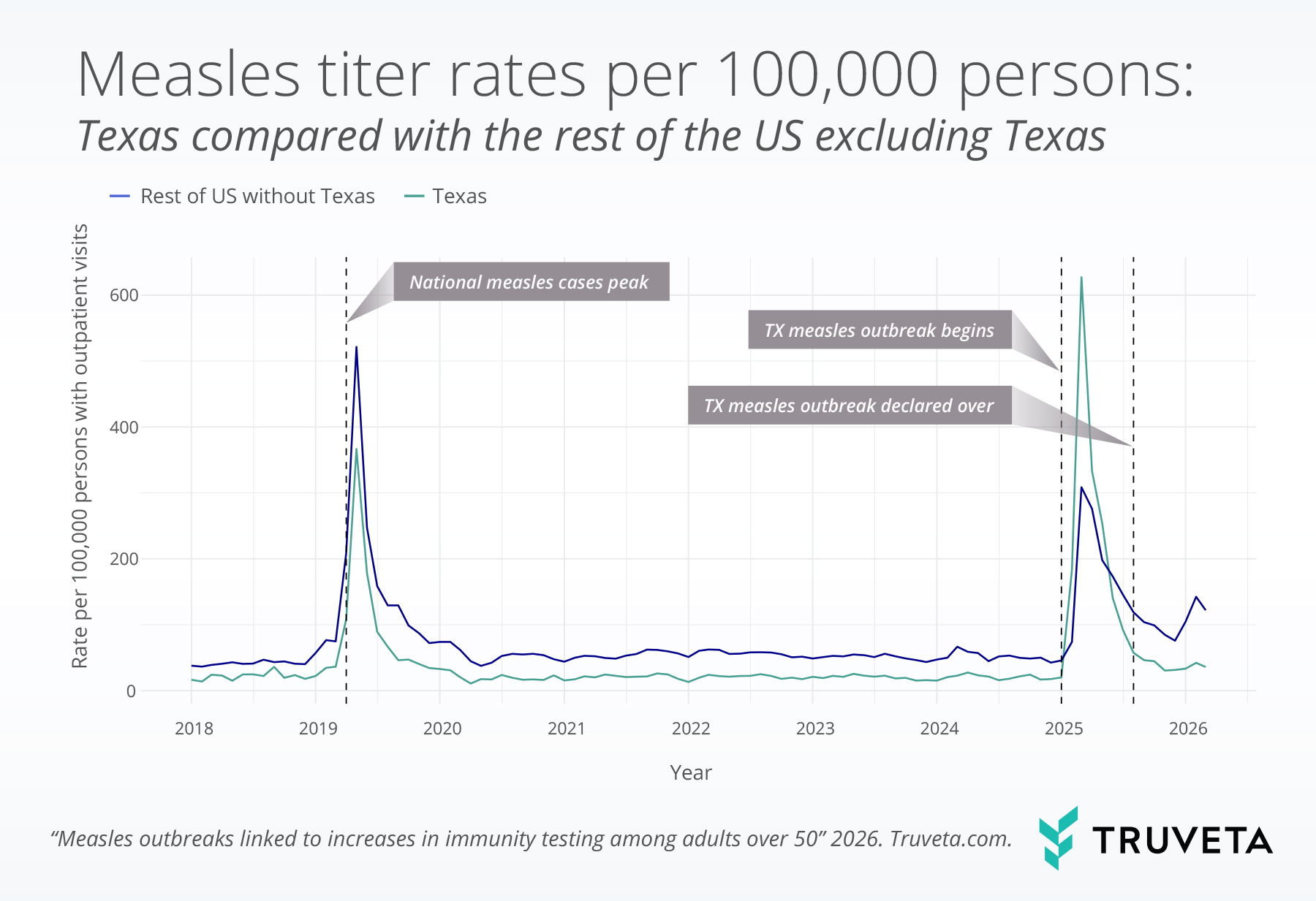
- In Texas, measles titer testing among adults over 50 rose sharply during the 2025 outbreak, exceeding the peak observed during 2019.
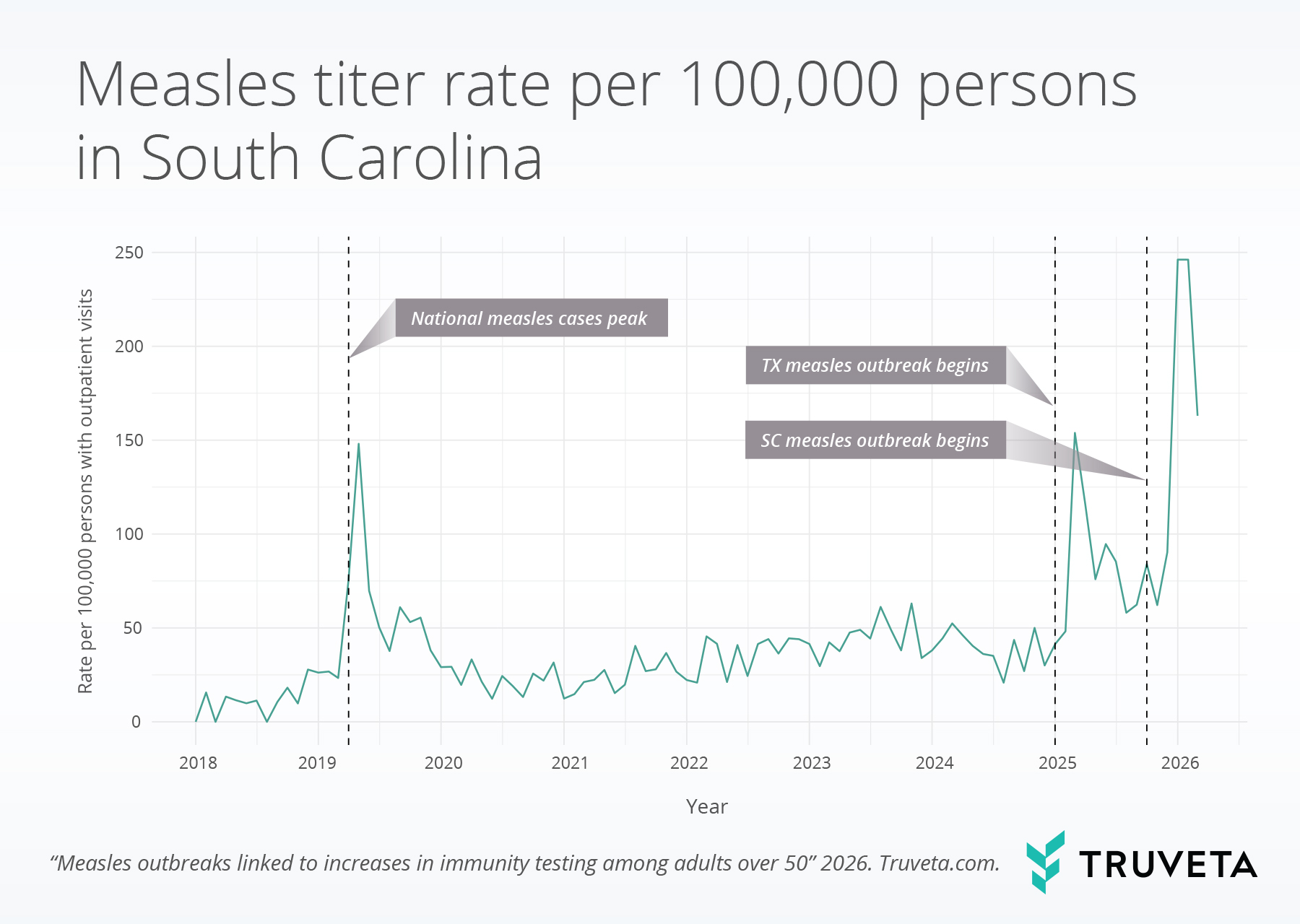
- In South Carolina, measles titer testing among adults over 50 rose sharply in 2026, concurrent with the largest outbreak in the US in 35 years.
Measles was declared eliminated in the United States in 2000, but outbreaks continue to occur in communities with low vaccination rates (1,2). In 2019, the US experienced its highest number of measles cases since elimination, driven by several large outbreaks (1,3). More recently, measles activity rose again during 2025, including a major outbreak in West Texas that began in late January and was associated with the first reported US measles deaths in more than a decade (4-7). Some of our prior work has demonstrated an increase in early measles vaccination during this period (8-9).
While measles is a disease that primarily affects children, these outbreaks may also impact adults. While most adults are likely to have protection against measles virus from vaccination or natural infection, some aren’t sure, or don’t have confirmation of their vaccination or infection history. The CDC considers those who have evidence of two doses of measles, mumps, rubella (MMR) vaccine received after 12 months of age or who were born before 1957 to have evidence of immunity (8). However, not all adults have their immunization records available, and therefore may seek confirmation of immunity through bloodwork for measles antibody titers. This bloodwork can tell patients whether they have evidence of measles antibodies in their blood, which would indicate protection against the virus (10).
There could be many reasons why an adult might want to know their measles immunity status in the midst of increasing measles activity. For example, grandparents might want to ensure they are protected before interacting with infant grandchildren, or adults who don’t remember their own measles vaccination status could be worried about their own risk of infection if living in or traveling to a state experiencing outbreaks (11).
Measuring how often measles titers are ordered in routine care provides a useful signal of how public concern and outbreak activity shape healthcare-seeking behavior. Therefore, we examined national trends in measles titer testing among adults over 50 years of age from January 2018 through March 2026. We also assessed how testing patterns differed by rural versus urban residence, age group, and explored rates in Texas vs. the rest of the country excluding Texas and in South Carolina.
Methods
We used a subset of Truveta Data to identify adults over 50 years of age, who had an outpatient visit between January 2018 and March 2026. We focused on adults over 50 to reduce inclusion of prenatal-related measles, mumps, and rubella (MMR) immunity testing, primarily done for Rubella virus (12, 13) and to better capture a population seeking measles immunity testing long after childhood vaccination or infection.
Within this population, we identified individuals who received a measles titer or MMR titer. The primary outcome was the monthly rate of measles titer testing per 100,000 adults over 50 years of age with an outpatient visit. If a person had two or more outpatient visits or two or more titer tests within the same month, they were counted once in that month to deduplicate repeat or confirmatory testing. Results were stratified by age group (ages 50-59, 60-69, 70-79, and 80+), place of residence (urban or rural). We also explored rates in Texas, which experienced the largest outbreak in 2025, (2,6) and in South Carolina, where an outbreak declared in October 2025 caused 997 cases by April 2026—this was the largest measles outbreak in the US in 35 years (14,15).
Results
National trends
Among 29,803,941 adults over age 50 with evidence of an outpatient doctor’s visit from January 2018 – March 2026, we observed a sharp spike in measles titer testing from April through September 2019. This aligned with the 2019 measles resurgence, which at the time represented the highest number of US measles cases since elimination in 2000. A second, smaller national spike began in February 2025, shortly after the Texas measles outbreak began in late January 2025.
In 2018, the average rate of measles titers in adults over age 50 was 40.9 per 100,000 persons with an outpatient visit. From 2021 through 2024, the average monthly rate remained relatively low, from 51.4 to 49.5 per 100,000 in 2021 to 2024, respectively. The maximum monthly rate reached 506.7 per 100,000 in 2019, 340.9 per 100,000 in 2025, and 114.2 per 100,000 so far in 2026. Relative to the 2018 average, the 2025 peak represented a 734% increase, though it remained 33% lower than the 2019 peak. Antibody titer rates remained elevated in the first three months of 2026, and the 2026 peak rate was 179% higher than the baseline 2018 rate.
Rural and urban differences
When stratified by place of residence, residents living in urban areas consistently had higher rates of measles titer testing compared to residents living in rural areas. In 2019, the peak measles titer rate among urban residents was 564.4 per 100,000 persons with an outpatient visit, compared with 257.4 per 100,000 among rural residents, a 2.2-fold difference. From 2021 through 2024, urban residents continued to have higher testing rates. During the 2025 spike, the peak rate remained higher in urban areas, 363.2 per 100,000 versus 243.7 per 100,000 in rural areas.
Differences by age group
Testing rates also varied by age. Across most of the study period, adults ages 50–59 had the highest rate of measles titer testing, followed by those ages 60–69, 70–79, and 80 years and older. Specifically, during non-outbreak peaks, adults aged 50-59 had about twice the rate of titers as those aged 60-69, and about 10 times the rate of titers as those 70-79 years.
One notable exception occurred during the March 2025 peak, when adults ages 60–69 had the highest rate of titers. In that month, adults ages 60–69 had a rate of 494.1 titers per 100,000 persons with an outpatient visit, compared with 374.6 per 100,000 among adults ages 50–59, or about 1.3 times higher.
A focus on Texas and all US states excluding Texas
State-level analyses showed especially pronounced changes in Texas during the recent 2025 outbreak. In Texas, the average titer rate among adults over age 50 was 21.8 per 100,000 persons with an outpatient visit in 2018. This rose to a peak of 366.6 per 100,000 in 2019, then returned to a lower baseline level of 21.2 per 100,000 in 2021. In 2025, Texas experienced a much sharper rise. The peak monthly rate reached 627.1 per 100,000 persons with an outpatient visit, a 28.8-fold increase relative to the 2021 baseline and 1.7-fold increase over the peak observed in 2019. This increase coincided with the West Texas outbreak that began in January 2025. Looking at the entire US exclusive of Texas, we still see a peak in 2025, though it is half as high (308.5 per 100,000) as in Texas.
A focus on South Carolina
State-level analyses showed titer mates begin to increase in South Carolina in 2025 after the Texas measles outbreak began, increasing from a 2021 baseline rate of 24.4 per 100,000 persons to a maximum of 153.9 per 100,000 persons in 2025, a 6.3-fold increase. Titer rates rose further in 2026 as the outbreak in South Carolina continued to grow, becoming the largest outbreak in the US in 35 years, and reaching a maximum rate of 246.2 per 100,000 persons, a 10-fold increase from the 2021 baseline.
Discussion
In this analysis of adults over age 50, measles titer testing appeared to move in tandem with major outbreak activity. We observed a large spike during the 2019 measles resurgence and a second rise beginning in early 2025, suggesting that even local outbreaks like the one in West Texas may have shaped healthcare-seeking behavior nationally. It is notable that we even see this impact among older adults who are not the primary age group affected by measles infection itself. These patterns likely reflect a mix of patient concern, clinician vigilance, exposure-related evaluation, and uncertainty around immunity status.
We also found meaningful differences across subgroups. Residents living in urban settings had higher testing rates than residents living in rural settings throughout the study period, including during both outbreak-related surges. This may reflect differences in healthcare access, awareness, clinician ordering patterns, travel patterns, or outbreak-related media exposure. By age, adults ages 50–59 generally had the highest testing rates, though adults ages 60–69 briefly had the highest rate of measles antibody titers during the March 2025 peak. That pattern suggests demand for testing may not be uniform even within older adults and may shift depending on the perceived urgency of outbreak news. Additionally, this shift may reflect the fact that someone who was 55 in 2019 was 61 in 2025, and if that person got tested in 2019, they are unlikely to have been retested six years later.
Texas stood out as having a particularly increased rate of older adults receiving measles titers in 2025. After returning to a relatively low baseline level of titers following the 2019 spike, the rate of adults over 50 in Texas receiving titers in 2025 substantially exceeded the state’s earlier peak. This suggests that localized outbreak intensity can produce especially sharp increases in immunity-related testing behavior. However, when looking at the entire US excluding Texas, we still see a spike in 2025, highlighting that the Texas outbreak had an impact on behavior nationally.
South Carolina experienced a very large outbreak in 2025-2026 in a community with very low vaccination rates, reaching nearly 1,000 cases. While only 87 cases in this outbreak occurred in adults over the age of 18 (15), the increase in measles titers drawn among older adults highlights the impact these outbreaks can have on vigilance and concern among those who may not be directly sickened by the outbreak.
This study has several limitations. First, we measured titers only among adults over age 50 who had an outpatient visit, so these findings do not represent all older adults in the community. Second, the analysis captures testing behavior rather than immunity, vaccination status, exposure history, or clinical appropriateness of testing. Finally, temporal alignment with outbreaks does not establish causality; increases in testing likely also reflects a combination of factors including media coverage around measles outbreaks, institutional policies, travel requirements, or local clinical practice patterns.
Despite these limitations, this analysis highlights how real-world healthcare data can capture behavioral responses to public health events. Monitoring measles titer testing may offer a useful complementary lens on how outbreaks affect care-seeking and preventive evaluation, particularly among adults over 50 who may be uncertain about their protection.
These are preliminary research findings and not peer reviewed. Data are constantly changing and updating. These findings are consistent with data accessed on May 6, 2026.
Citations
- Centers for Disease Control and Prevention. Measles cases in the U.S. are highest since measles was eliminated in 2000. 2019. https://archive.cdc.gov/www_cdc_gov/media/releases/2019/s0424-highest-measles-cases-since-elimination.html
- Centers for Disease Control and Prevention. Measles cases and outbreaks. 2026. https://www.cdc.gov/measles/data-research/
- Centers for Disease Control and Prevention. U.S. measles cases in first five months of 2019 surpass total cases per year for past 25 years. 2019. https://archive.cdc.gov/www_cdc_gov/media/releases/2019/p0530-us-measles-2019.html
- Centers for Disease Control and Prevention. CDC statement on measles outbreak. February 27, 2025. https://www.cdc.gov/media/releases/2025/2025-cdc-statement-on-measles-outbreak.html
- Texas Department of State Health Services. Texas announces first death in measles outbreak. February 26, 2025. https://www.dshs.texas.gov/news-alerts/texas-announces-first-death-measles-outbreak?
- Texas Epidemic Public Health Institute. Measles outbreak overview. 2025. https://tephi.texas.gov/training/selected-outbreaks/measles
- Texas Department of State Health Services. Measles outbreak update. August 12, 2025. Measles Outbreak – August 12, 2025 | Texas DSHS
- Goodwin Cartwright BM, Masters NB, Gilbert KM et al. Early MMR Vaccine Adoption During the 2025 Texas Measles Outbreak. JAMA Netw Open. 2025;8(11):e2543002. doi:10.1001/jamanetworkopen.2025.43002
- Truveta Research. Evaluating recent trends in early measles vaccinations in Texas. 2025. https://www.truveta.com/blog/research/research-insights/2025-early-measles-vaccinations-in-texas/
- Centers for Disease Control and Prevention. Clinical Questions about Measles. September 10, 2025. https://www.cdc.gov/measles/hcp/clinical-overview/questions.html
- Pastula, Daniel. Do adults need a measles booster? An epidemiologist explains who is immune. PBS News. April 2, 2025. https://www.pbs.org/newshour/health/do-adults-need-a-measles-booster-an-epidemiologist-explains-who-is-immune
- American College of Obstetricians and Gynecologists. Measles, Mumps, Rubella (MMR) Vaccination and Management of Obstetric-Gynecologic Patients During a Measles Outbreak. March 2024. https://www.acog.org/clinical/clinical-guidance/practice-advisory/articles/2024/03/management-of-obstetric-gynecologic-patients-during-a-measles-outbreak
- Centers for Disease Control and Prevention. Serology Testing for Rubella. June 2024. https://www.cdc.gov/rubella/php/laboratories/serology-testing.html
- South Carolina Department of Public Health. DPH Confirms Measles Outbreak in Upstate Region. October 2, 2025. https://dph.sc.gov/news/dph-confirms-measles-outbreak-upstate-region
- South Carolina Department of Public Health. DPH Announces End to Measles Outbreak in Upstate at 997 Cases. https://dph.sc.gov/news/dph-announces-end-measles-outbreak-upstate-997-cases