



- Most patients (87.1%) with evidence of oral semaglutide for obesity had evidence of their first dose at 1.5 mg, consistent with the manufacturer-recommended starting dose.
- Timing of dose increases closely mirrored the recommended schedule, with dose increases occurring on average every 31–33 days.
Glucagon-like peptide-1 receptor agonists (GLP-1 RAs) have transformed obesity treatment for patients by providing clinically meaningful weight loss and improving cardiometabolic outcomes (1–3). As GLP-1 medications continue to see rapid growth in use (4), including increasing adoption of oral formulations (5), it is important to understand how they are prescribed and patients may increase their doses over time in real-world settings. Most GLP-1 medications are started at a low dose and gradually increased to help reduce side effects while allowing patients to reach the dose that provides the greatest benefit (6).
Similarly, oral semaglutide formulations approved for obesity treatment are typically started at a low dose and increased gradually, usually about once a month. This gradual increase helps reduce side effects such as nausea, vomiting, and diarrhea (6) and as a result, may help patients remain on the treatment and achieve long-term treatment success. While clinical trials establish recommended schedules for increasing doses, less is known about how closely these recommendations are followed in routine clinical care.
We studied how oral semaglutide for obesity is being used in everyday healthcare settings. We looked at the starting doses patients received and how much time passed before they were prescribed a higher dose. We then compared these real-world patterns with the manufacturer’s recommended dosing schedule to see how closely clinical practice aligns with treatment guidelines.
Methods
We used a subset of Truveta Data to identify people with evidence of oral semaglutide prescriptions or pharmacy dispenses where dose amounts could be inferred. The analysis focused on the oral semaglutide formulation labeled for obesity treatment.
We examined patterns of increasing dosage across four levels: 1.5 mg, 4 mg, 9 mg, and 25 mg. To study how doses increased over time, we focused on changes between levels. Records showing a lower dose prescribed after a higher dose had already been reached were excluded from the analysis.
We examined three dose increases: from 1.5 mg to 4 mg, from 4 mg to 9 mg, and from 9 mg to 25 mg. For each increase, we calculated the number of days between the lower and higher dose. We then summarized the average time to increased dose, the variation in timing across patients, and the number of patients who completed each dosing increase. Patients were included as having received an increased dose if they were prescribed the higher dose, even if information on earlier dose increases was not available.
We then compared our observed real-world dose increases with the manufacturer’s recommended dosing schedule: Start with 1.5 mg for the first 30 days, then increase to 4 mg during days 31-60, then to 9 mg during days 61-90, and then to 25 mg after 90 days.
You can also view the full study, including data definitions, directly in Truveta.
Results
We included 56,446 people with evidence of oral semaglutide prescription or dispense where a dose amount could be inferred. The population was primarily female (74.8%), >45 years old (70.5%), White (72.2%), non-Hispanic or Latino (77.4%), and living in urban areas (72.3%).
Initial dosing patterns
Most patients (87.1%) had evidence of their first dose starting at 1.5 mg, consistent with the recommended starting dose for oral semaglutide.
About a quarter of patients (23.1%) had evidence of receiving multiple dose levels during the observation period. Very few people (0.7%, N = 374) had evidence of all four dose levels.
Dose escalation timing
Real-world use of oral semaglutide closely followed the manufacturer’s recommended dosing schedule. Patients increased to the next dose level after an average of 31 to 33 days, which closely matched the recommended monthly increases. The figure below shows that dose increases occurred at about the expected times across all dose levels.
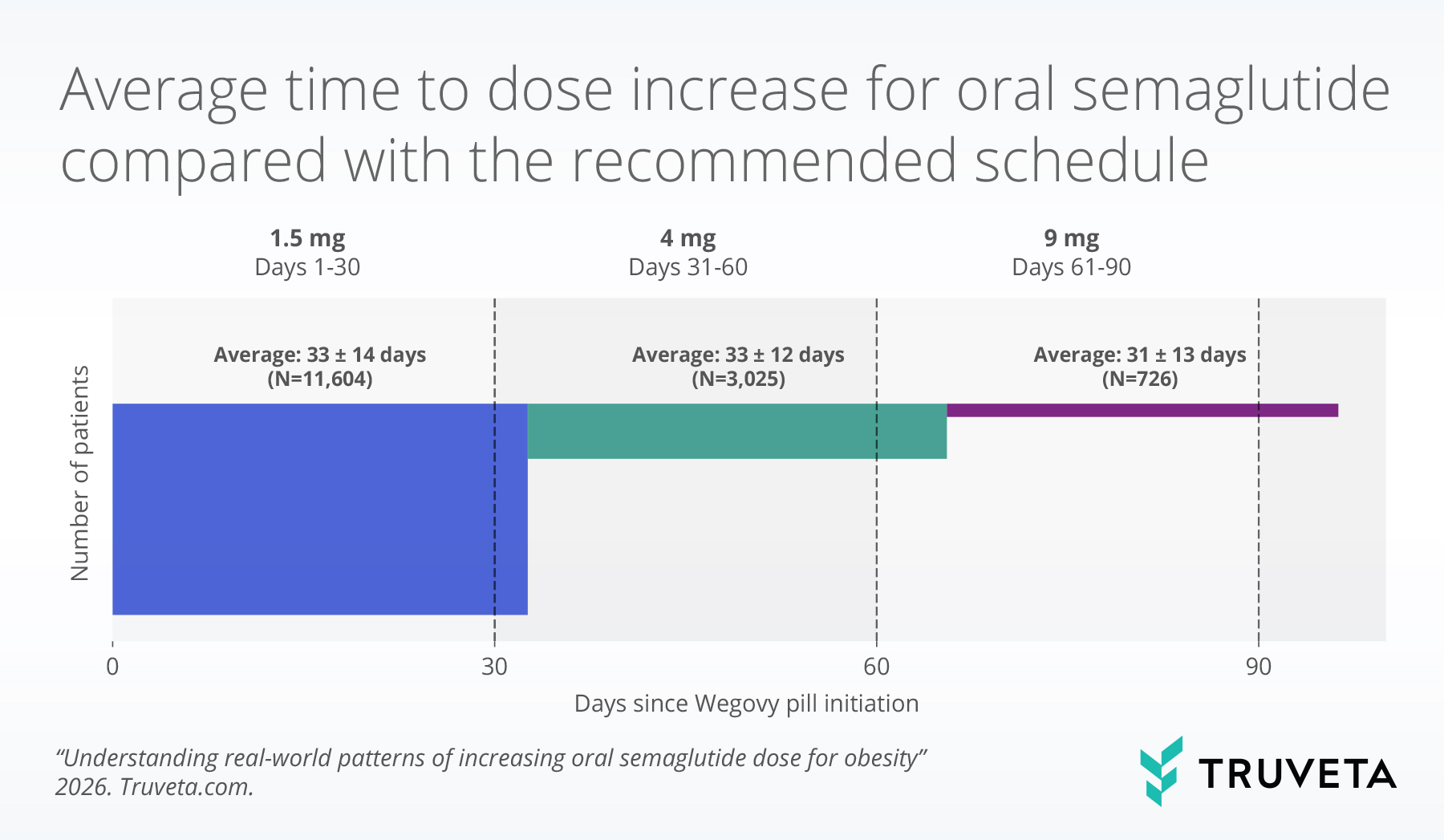
Patient counts decreased with each dose increase; however, this finding should be interpreted cautiously as oral semaglutide for obesity was only recently approved.
Discussion
In this real-world analysis of nearly 60,000 people with evidence of receiving oral semaglutide for obesity, we found that most patients started at the recommended 1.5 mg dose. Dose escalation timing closely followed manufacturer’s recommended schedule (6). These findings suggest that, in routine clinical practice, providers are generally following recommended dosing guidance designed to optimize treatment tolerability.
Gradually increasing the dose is a key component of GLP-1 RA therapy because adverse side effects are among the most common reasons for treatment discontinuation (7, 8). Increasing the dose approximately every 30 days may help patients adjust to therapy while continuing to progress to higher doses. Understanding how closely real-world prescribing aligns with these recommendations provides important context for interpreting treatment persistence and patient experience with oral semaglutide.
We also observed patient counts declined as doses increased. While this could indicate that some patients discontinued treatment or delayed moving to a higher dose, it is important to interpret these findings cautiously because many patients likely had insufficient observation time to complete all recommended dose increases following the medication’s recent approval in December 2025 (9). Future analyses should examine long-term persistence, dose reductions, discontinuation, and relationships between escalation timing and treatment outcomes.
This analysis has several limitations. First, dose amounts were inferred from prescribing and pharmacy dispense data and may not reflect actual medication use or adherence. Second, patients may have received care or prescriptions outside systems captured within Truveta Data. Third, this analysis focused specifically on timing of dose increases and did not evaluate clinical outcomes, side effects, treatment persistence, or discontinuation. Finally, because the medication was approved recently, follow-up time was limited for many patients.
Despite these limitations, this analysis provides an early real-world view into prescribing and dispensing dosage patterns for oral semaglutide for obesity treatment. The findings suggest that providers are generally adhering to recommended schedule for increases doses designed to improve tolerability and support long-term adherence, important considerations as oral GLP-1 therapies become increasingly integrated into obesity management.
These are preliminary research findings and not peer reviewed. Data are regularly updating. These findings are consistent with data accessed on May 19, 2026.
Citations
- J. P. H. Wilding, R. L. Batterham, S. Calanna, M. Davies, L. F. Van Gaal, I. Lingvay, B. M. McGowan, J. Rosenstock, M. T. D. Tran, T. A. Wadden, S. Wharton, K. Yokote, N. Zeuthen, R. F. Kushner, Once-Weekly Semaglutide in Adults with Overweight or Obesity. N Engl J Med 384, 989–1002 (2021).
- A. M. Jastreboff, L. J. Aronne, N. N. Ahmad, S. Wharton, L. Connery, B. Alves, A. Kiyosue, S. Zhang, B. Liu, M. C. Bunck, A. Stefanski, Tirzepatide Once Weekly for the Treatment of Obesity. N Engl J Med 387, 205–216 (2022).
- S. P. Marso, S. C. Bain, A. Consoli, F. G. Eliaschewitz, E. Jódar, L. A. Leiter, I. Lingvay, J. Rosenstock, J. Seufert, M. L. Warren, V. Woo, O. Hansen, A. G. Holst, J. Pettersson, T. Vilsbøll, Semaglutide and Cardiovascular Outcomes in Patients with Type 2 Diabetes. N Engl J Med 375, 1834–1844 (2016).
- S. Gratzl, K. Farrar, E. Holler, M. Vachon, N. Masters, B. Cartwright, Monitoring Report: GLP-1 RA Prescribing Trends – March 2026 Data | medRxiv (2026). https://www.medrxiv.org/content/10.1101/2025.03.06.25323524v6.
- Truveta, Early uptake of Wegovy pill, Truveta (2026). https://www.truveta.com/blog/research/featured-research/oral-semaglutide-for-obesity-wegovy-pill/.
- Wegovy® Pill Guide and Dosing Information | Wegovy® (semaglutide), Wegovy. https://www.wegovy.com/obesity/starting-wegovy/starting-wegovy-pill.html.
- B. Cartwright, P. Rodriguez, D. Do, N. Stucky, “Real-World Temporal and Indication-Specific Variation in Drivers of GLP-1 RA Discontinuation” (Montreal, 2025; https://www.ispor.org/heor-resources/presentations-database/presentation-cti/ispor-2025/poster-session-3/real-world-temporal-and-indication-specific-variation-in-drivers-of-glp-1-ra-discontinuation)vol. 28.
- A. Ceriello, F. Prattichizzo, A. R. Mastan Sheik Abdullah, R. La Grotta, C. C. Berra, B. McGowan, A. Jenkins, N. Cohen, M. A. Nauck, G. T. Russo, Causes and consequences of discontinuation of GLP1RAs or tirzepatide. Nat Rev Endocrinol, 1–13 (2026).
- FDA approves Novo Nordisk’s Wegovy® pill, the first and only oral GLP-1 for weight loss in adults. https://www.prnewswire.com/news-releases/fda-approves-novo-nordisks-wegovy-pill-the-first-and-only-oral-glp-1-for-weight-loss-in-adults-302648344.html.