


The good news: More adults are receiving Shingrix as soon as they can, and most early initiators are getting their second dose. Amid growing evidence linking shingles vaccination with lower dementia risk, it’s encouraging to see adults getting the shingles vaccine as soon as they can, hopefully paving the way for healthy aging.
I’m thrilled to see our new research on Shingrix vaccination among adults without immunocompromising conditions come out. Shingles is a painful and common disease that affects roughly one in three people in the US during their lifetime. In October 2017, a recombinant vaccine for Shingles, Shingrix, was approved in the US as a two-dose series, with the second dose 2-6 months after the first. But the vaccine may even protect against more than just Shingles, as evidence grows that shingles vaccination may have unexpected benefits including a possible reduction in dementia risk. (1,2)
Our study sought to find out whether healthy adults are getting Shingrix as soon as they become eligible at age 50. Increasingly, the answer is yes.
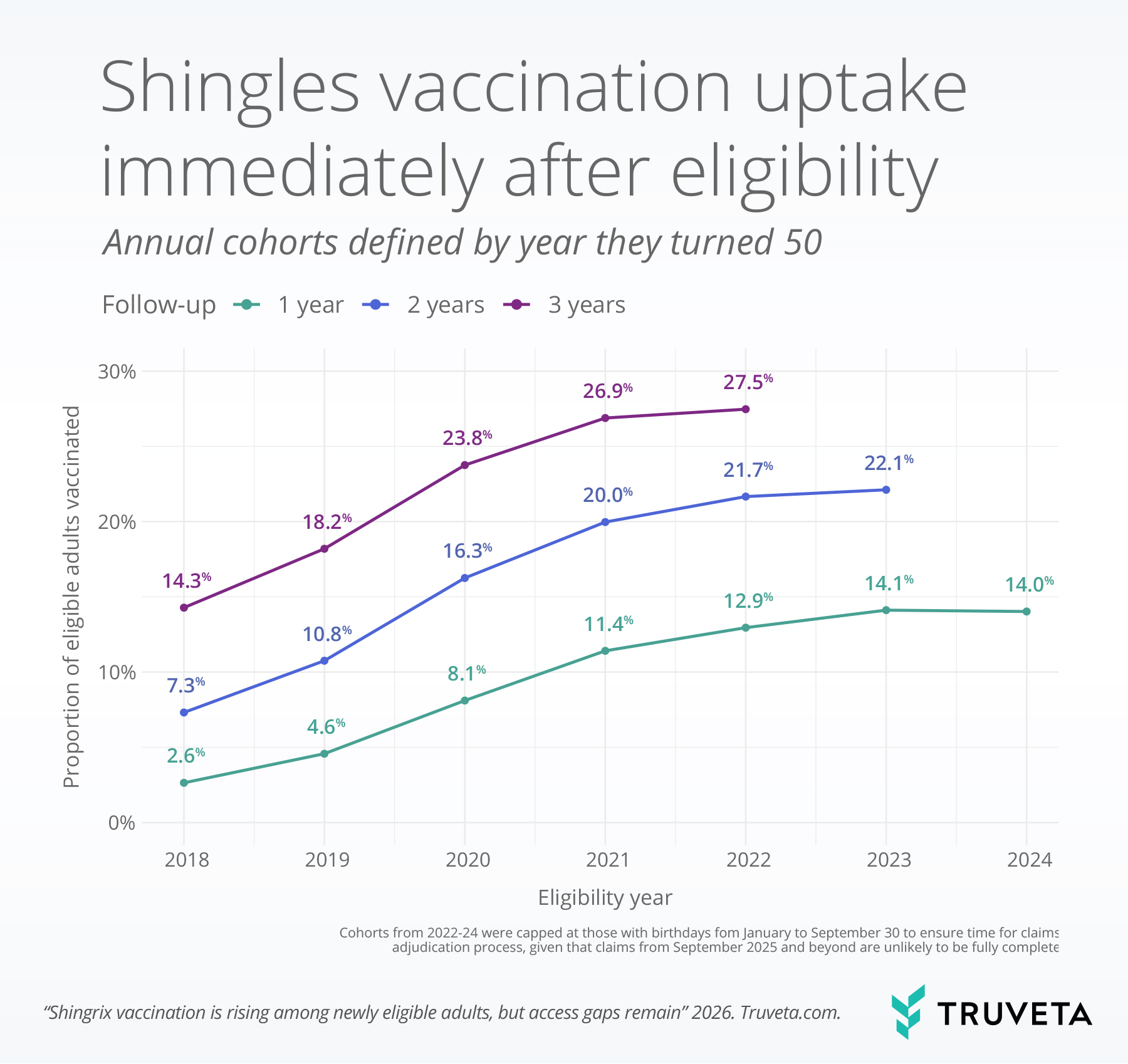
In a cohort of over 153,000 adults without immunocompromising conditions who turned 50 between 2018 and 2024, early Shingrix uptake increased substantially over time. Among adults who turned 50 in 2018, only 2.6% received Shingrix before their 51st birthday. Among those who turned 50 in 2024, that share rose to 14.0%—that’s one in seven adults.
We also looked at uptake over a longer window. Among adults who turned 50 in 2022, 27.5% —more than one in four adults—received Shingrix by their 53rd birthday. Among people who started the series in their first year of eligibility, 74.5% completed within one year. (3)
For me, the most exciting part of this study isn’t what we found, but the fact that we were able to study it. As a vaccine epidemiologist who has spent much of my career focused on pediatric vaccination, especially measles, a foray into adult vaccines brought with it some methodological challenges.
Pediatric immunizations are almost always administered in the office—usually by a child’s pediatrician. Adult vaccination is fundamentally different. Adults increasingly get vaccinated where it is convenient, which is most often the pharmacy. This change accelerated since the COVID-19 pandemic, with pharmacies now even more central to adult vaccine delivery.
That shift is great for access, but it makes research on adult immunizations challenging, because a vaccine received at a pharmacy may not appear in a patient’s electronic health record. EHR-only studies of adult vaccination can therefore be incomplete by design, missing the vaccinations that occur in one of the most common and convenient adult immunization settings. That makes it impossible to know if a vaccine is missing because the patient didn’t get the vaccine or if we just don’t have complete data.
We were able to navigate this challenge by using EHR data linked with medical and pharmacy claims. This gave us the best of both worlds: and the claims helped to capture vaccines delivered outside the health system, particularly in pharmacies. Together, these data gave us a more complete longitudinal picture of adult immunization than EHR data alone could provide.
This study is a proof point for doing adult vaccine epidemiology well in the real world, leveraging both clinical history data from the medical record and complete care trajectories from closed claims. With these linked data, we can explore who gets vaccinated and who doesn’t—and feel confident that we are capturing the complete patient story.
References
- Eyting, M., Xie, M., Michalik, F. et al.A natural experiment on the effect of herpes zoster vaccination on dementia. Nature 641, 438–446 (2025). https://doi.org/10.1038/s41586-025-08800-x
- Xie M, Eyting M, Bommer C, et al. The effect of shingles vaccination at different stages of the dementia disease course. Cell, 2025; 188, 7049-7064.e20. https://doi.org/10.1016/j.cell.2025.11.007
- Masters NB, Farrar KG, Do D, et al. Predictors of initiation and completion of Shingrix vaccination in immunocompetent adults newly eligible for vaccination from 2018-2024. Human Vaccines and Immunotherapeutics, 2026. http://dx.doi.org/10.1080/21645515.2026.2687231