


By Emily Webber, PhD, Senior Director of Partner Insights & Enablement at Truveta
One question I often hear from researchers is, “Should I use EHR data or claims data?”
The better question is often, “What am I trying to learn?”
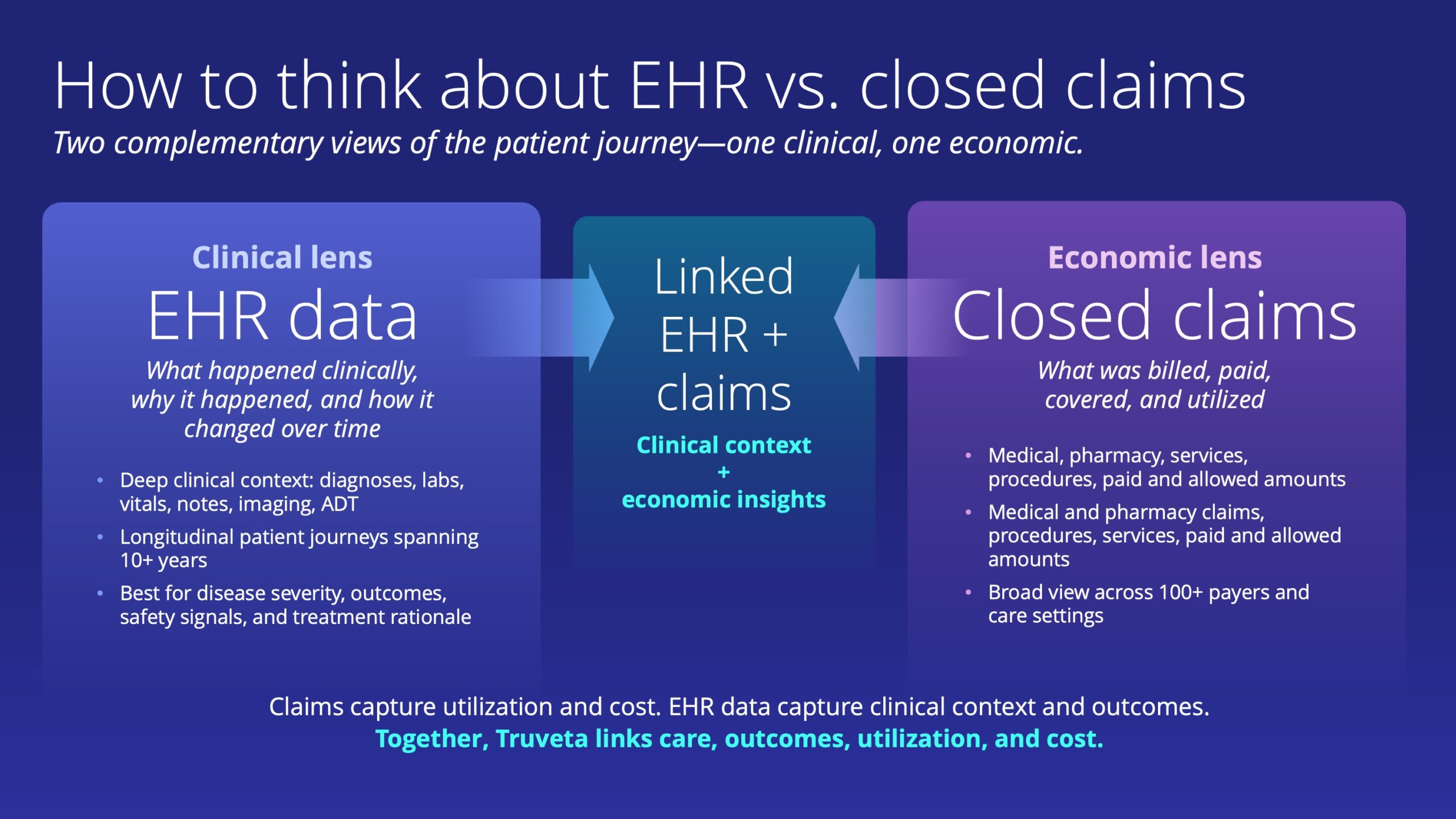
When you’re designing a study, one of the earliest decisions isn’t which dataset to use. It’s which lens you need. Electronic health record (EHR) and closed claims data were created for different purposes, and those purposes shape the kinds of research questions each can answer well.
Claims data offer an economic lens. EHR data offer a clinical lens. Neither is inherently better. The right choice depends on the decision your study needs to inform.
When closed claims are the right lens
If your goal is to understand cost, utilization, or burden of illness across payers and care settings, closed claims are often the right choice.
Claims data exist to support reimbursement. Before a claim is paid, it goes through adjudication, where the payer reviews the services provided and determines what will be covered. Through that process, healthcare encounters are transformed into standardized billing records and claim lines that can be analyzed consistently across providers and health plans.
For researchers, that standardization is incredibly valuable. Closed claims can help answer questions such as:
- What services were billed and paid for?
- Are there barriers to accessing treatment due to insurance coverage or out-of-pocket cost
- What was the cost of care across sites or payers?
- How did utilization change before or after a diagnosis, treatment, or policy change?
That makes closed claims especially useful for research focused on healthcare utilization, economic impact, adherence, and cost of care.
When EHR data are the right lens
If your research is focused on clinical effectiveness, disease severity, safety, treatment rationale, or patient outcomes, EHR data are often the better fit.
EHRs capture the details of care as it happens. They include diagnoses, laboratory results, vital signs, physician documentation, medication orders, imaging, admission-discharge-transfer data, procedure timing, and clinical notes. Those details provide the clinical context that is often necessary to answer more complex research questions.
For example, if you’re conducting a target trial emulation, evaluating comparative effectiveness, or supporting a post-authorization safety study, you usually need to know more than whether a patient received a treatment. You need to understand why they received it, how sick they were at baseline, what other clinical factors may have influenced treatment choice, and how their condition changed over time. Those details help researchers compare more clinically similar patients, reduce avoidable bias, and produce stronger real-world evidence.
Start with the question, not the data
One mistake I see researchers make is starting with the data they have available instead of the question they need to answer. That can lead to unnecessary work or, worse, a study design that is not well matched to the available data.
If you’re trying to understand the economic impact of healthcare, claims data will often give you the answers you need. But if the study depends on clinical severity, lab values, imaging results, physician rationale, or changes in patient status over time, claims alone may not provide enough context and EHR data is usually the better choice.
Why linked EHR and closed claims matter
The strongest answer is often not EHR or claims. It is EHR and claims together.
Claims tell us what was billed, paid, covered, and utilized. EHR data tell us what clinically happened and why. When linked, they can connect care, outcomes, utilization, and cost across the patient journey. Many important research questions sit at the intersection of clinical context and economic impact.
For example:
- Did a treatment improve outcomes, and did it change downstream utilization?
- Did patients who discontinued therapy have different clinical characteristics or cost patterns?
- Did a new device or therapy affect outcomes, length of stay, readmissions, or total cost of care?
These are questions that benefit from both lenses. Clinical context helps explain what happened. Claims help quantify the broader economic and utilization impact.
Choosing the right lens leads to stronger evidence
The most successful studies don’t begin with a dataset. They begin with a well-defined research question.
If you’re trying to understand the economic impact of healthcare, closed claims may give you the clearest lens. If you’re trying to understand the clinical experience of the patient, EHR data may be the better fit. If you need to understand both, linked EHR and closed claims can provide a more complete view.
Choosing the right lens at the beginning helps researchers ask better questions, use the right data, and produce evidence that is better aligned to the decision at hand.
The goal is not to choose the “best” dataset. The goal is to choose the lens that fits the question.