



- More than 2 in 5 patients (40.3%) initiating oral orforglipron (Foundayo pill) had no prior evidence of GLP-1-based medication use, suggesting early uptake extends beyond patients already receiving injectable therapies.
- Among patients with prior GLP-1-based medication use, most had most recently received an injectable anti-obesity medication, including injectable tirzepatide (sold as Zepbound) and injectable semaglutide (sold as Wegovy). In contrast, only 0.1% had oral semaglutide (Wegovy pill) as their most recent prior GLP-1-based medication.
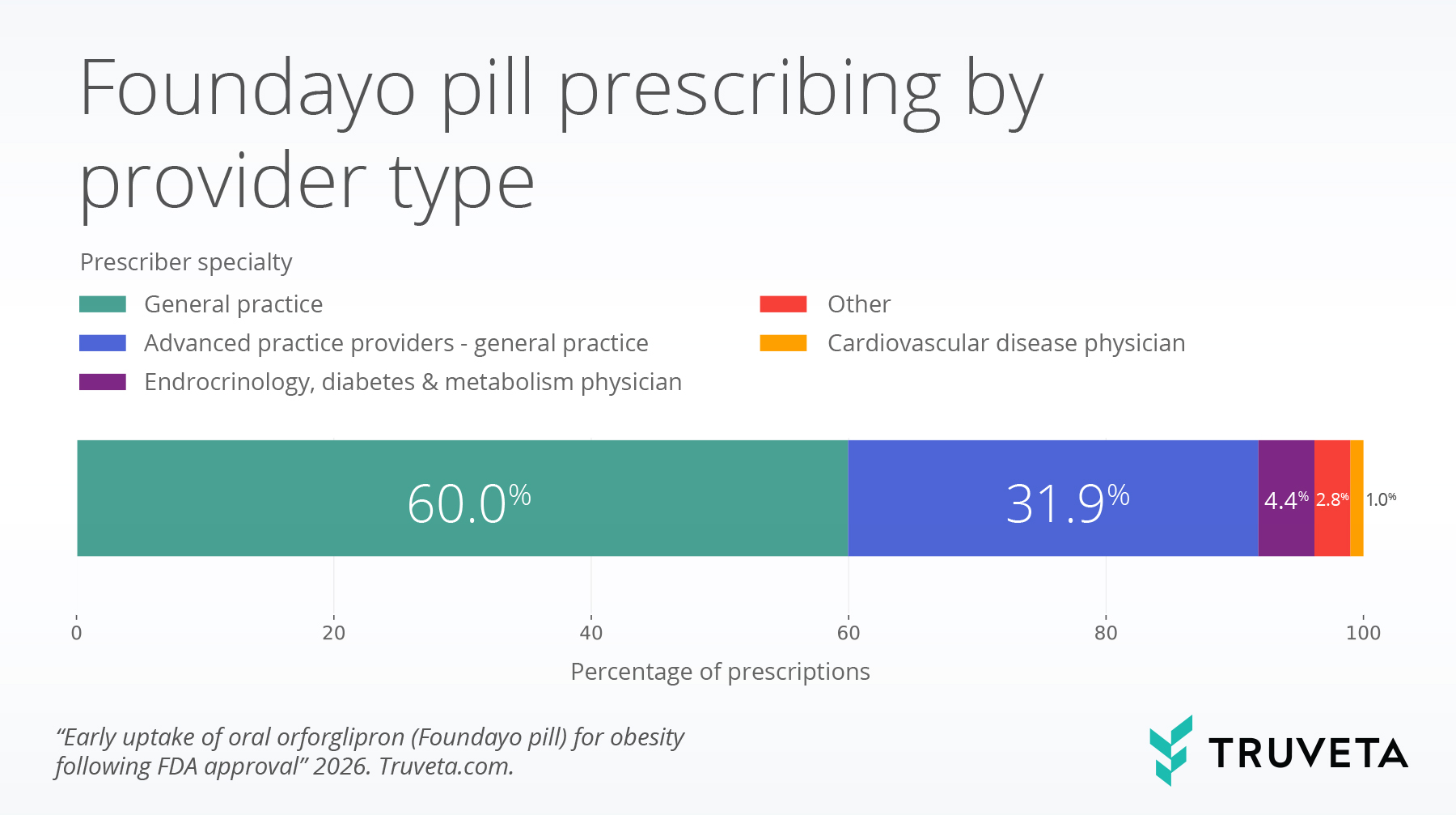
- General practice physicians accounted for most oral orforglipron prescriptions, highlighting early adoption in primary care.
Glucagon-like peptide-1 (GLP-1)-based medications have reshaped pharmacologic treatment for obesity by providing highly effective therapies for chronic weight management and reducing obesity-related cardiometabolic risk (1–3). Although an oral GLP-1-based medication has been available for the treatment of type 2 diabetes for several years, oral therapies for obesity have only recently emerged (4–6). The emergence of oral GLP-1-based medications represents an important evolution in obesity treatment, offering an additional route of administration that may influence patient acceptance, prescribing patterns, and treatment initiation (7, 8).
On December 22, 2025, the US Food and Drug Administration approved oral semaglutide (Wegovy pill), the first oral GLP-1-based medication indicated for chronic weight management (9). Less than four months later, on April 1, 2026, the FDA approved oral orforglipron (Foundayo pill) approved for obesity (10). Unlike oral semaglutide, which builds on an existing GLP-1-based medication by extending it to an oral formulation for obesity, oral orforglipron represents the approval of an entirely new GLP-1-based medication.
The approval of oral orforglipron raises important questions about how this new therapy is being integrated into obesity care. Early prescribing patterns can reveal whether the medication is reaching patients who are new to GLP-1-based treatment, being adopted by patients previously treated with injectable therapies, and which clinicians are leading its use. Using Truveta Data, we characterized the first months of oral orforglipron prescribing following FDA approval.
Methods
Using a subset of Truveta Data, we identified patients with a prescription or medication dispense for oral orforglipron between April 1, 2026, and July 6, 2026.
We summarized patient demographic characteristics, including age, sex, race, ethnicity, comorbidities, and rural versus urban residence. To assess treatment history before initiating oral orforglipron, we identified each patient’s most recent GLP-1-based medication and classified patients as having no prior GLP-1 medication use or by their most recent therapy. This analysis was restricted to patients with at least one outpatient encounter in the year before initiation. For patients with prescribing data, we also described the specialty of the prescribing clinician.
Results
We identified 5,723 patients with a prescription or medication dispense for oral orforglipron between April 1 and Approximately three-quarters of patients were female (74.6%), and most were between 45 and 59 years (34.6%) or 60 years and older (38.3%). The majority of patients identified as White (72.5%) and non-Hispanic or Latino (75.8%).
Prior GLP-1 use
Among patients with at least one outpatient encounter in the year before starting oral orforglipron, 40.3% had no evidence of prior GLP-1-based medication use.
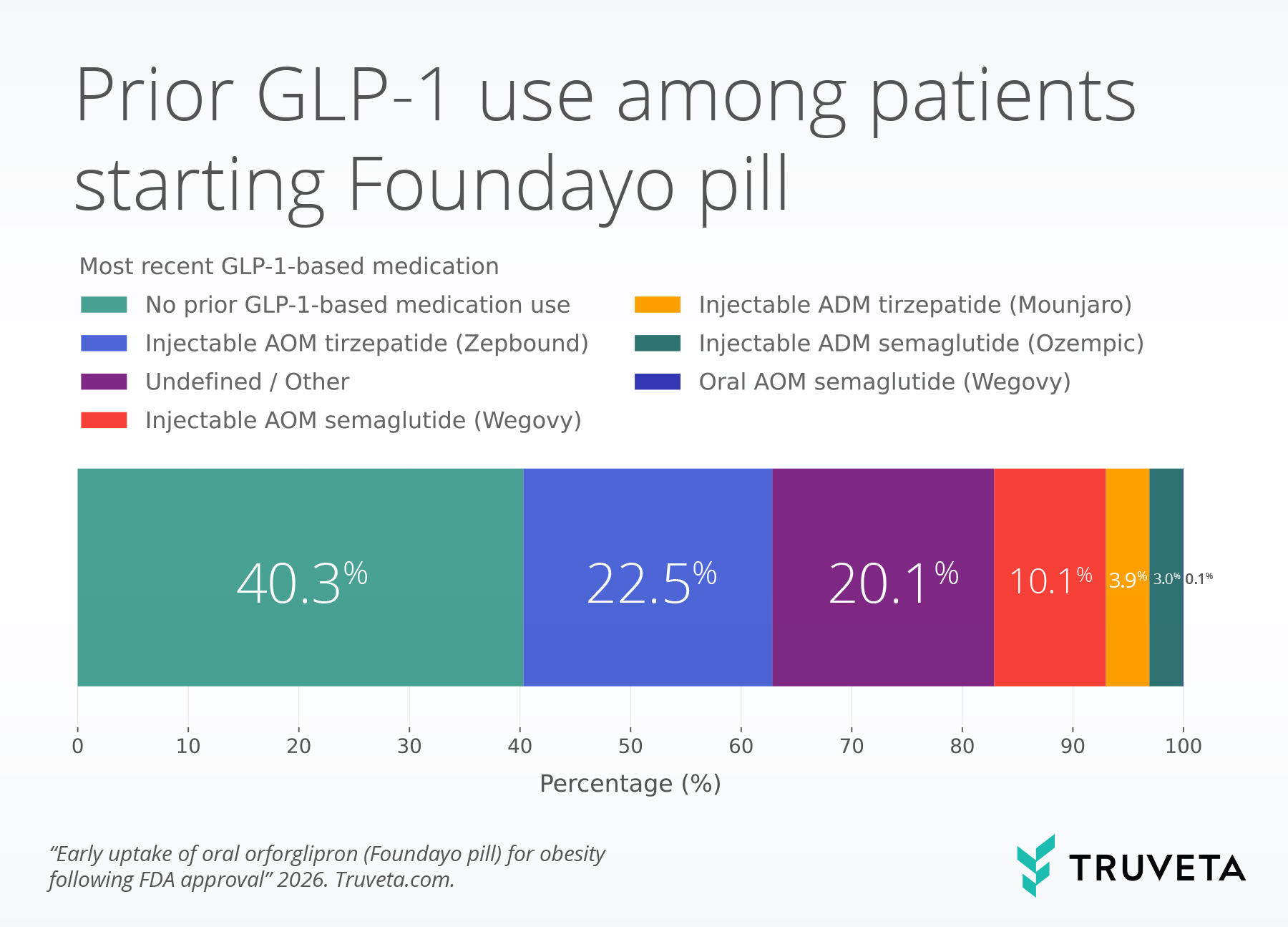
Among patients with previous GLP-1-based medication use, the most common prior medication was injectable anti-obesity tirzepatide (Zepbound), accounting for 22.5% of patients. An additional 10.1% had most recently used injectable anti-obesity semaglutide (Wegovy), followed by injectable anti-diabetic tirzepatide (Mounjaro; 3.9%), injectable anti-diabetic semaglutide (Ozempic; 3.0%), and oral anti-obesity semaglutide (Wegovy pill; 0.1%).
Prescriber specialty
Among patients with prescribing data, general practice clinicians accounted for 60.0% of oral orforglipron prescriptions, followed by advance practice providers in general practice (31.9%; which include nurse practitioners, physician assistants, etc.). Specialist providers represented relatively small proportions of prescribers: endocrinologists accounted for 4.4%, 2.8% from other specialties, and 1.0% from cardiovascular disease physicians.
Discussion
This early analysis provides one of the first real-world descriptions of patients receiving oral orforglipron following its FDA approval. Similar to our previous analysis of the oral semaglutide (Wegovy pill), we found that a substantial proportion of patients initiating oral orforglipron had no prior evidence of GLP-1-based medication use, suggesting that oral therapies continue to expand access beyond patients already receiving injectable GLP-1-based medications. At the same time, nearly one-quarter of patients transitioned from injectable anti-obesity tirzepatide, indicating that oral formulations are also being adopted by patients already familiar with GLP-1-based therapy. Almost no patients (0.1%) had evidence of recently receiving oral semaglutide, suggesting that in the first months of approval, we do not see a signal that patients are switching between oral GLP-1s for obesity.
Similar to our earlier report on oral semaglutide, prescribing patterns for oral orforglipron appear similarly concentrated in primary care. General practice physicians and advanced practice providers accounted for more than 90% of prescriptions, while endocrinologists represented a relatively small proportion of prescribers. These findings suggest that oral GLP-1-based medications are being incorporated primarily into routine primary care practice, potentially lowering barriers to obesity treatment by reducing reliance on injectable therapies and specialty care.
Several limitations should be considered. These findings represent an early snapshot of prescribing and dispensing during the first three months following FDA approval and may not reflect longer-term utilization as insurance coverage, clinician familiarity, and patient preferences mature. Medication history was limited to available longitudinal records, and patients without sufficient prior healthcare encounters were excluded from the prior GLP-1 medication analysis. Additionally, this descriptive analysis does not evaluate treatment persistence, adherence, clinical effectiveness, or reasons for switching from previous therapies.
Despite these limitations, this study demonstrates the ability of real-world data to rapidly characterize adoption of newly approved therapies shortly after market entry. As additional data become available, future analyses should examine persistence, switching over time, and clinical outcomes associated with oral orforglipron, providing further insight into the evolving role of oral GLP-1-based medications in obesity care.
These are preliminary research findings and not peer reviewed. Data are regularly updating. These findings are consistent with data accessed on July 6, 2026.
Citations
- J. P. H. Wilding, R. L. Batterham, S. Calanna, M. Davies, L. F. Van Gaal, I. Lingvay, B. M. McGowan, J. Rosenstock, M. T. D. Tran, T. A. Wadden, S. Wharton, K. Yokote, N. Zeuthen, R. F. Kushner, Once-Weekly Semaglutide in Adults with Overweight or Obesity. N Engl J Med 384, 989–1002 (2021).
- A. M. Jastreboff, L. J. Aronne, N. N. Ahmad, S. Wharton, L. Connery, B. Alves, A. Kiyosue, S. Zhang, B. Liu, M. C. Bunck, A. Stefanski, Tirzepatide Once Weekly for the Treatment of Obesity. N Engl J Med 387, 205–216 (2022).
- S. P. Marso, S. C. Bain, A. Consoli, F. G. Eliaschewitz, E. Jódar, L. A. Leiter, I. Lingvay, J. Rosenstock, J. Seufert, M. L. Warren, V. Woo, O. Hansen, A. G. Holst, J. Pettersson, T. Vilsbøll, Semaglutide and Cardiovascular Outcomes in Patients with Type 2 Diabetes. N Engl J Med 375, 1834–1844 (2016).
- A. Andersen, F. K. Knop, T. Vilsbøll, A Pharmacological and Clinical Overview of Oral Semaglutide for the Treatment of Type 2 Diabetes. Drugs 81, 1003–1030 (2021).
- B. T. Ojinna, S. Tariq, O. Agho, R. Channa, G. Singh, A Review of the Oral Semaglutide in Adults with Overweight or Obesity (OASIS) Trials Evaluating Oral Semaglutide (Wegovy) for Chronic Weight Management in Adults With Overweight or Obesity. Cureus 18 (2026).
- W. Zaman, A. Amin, Orforglipron and the emergence of oral GLP-1 therapy for obesity: efficacy, safety, and clinical positioning. Expert Opinion on Pharmacotherapy 27, 697–708 (2026).
- T. Research, Early uptake of Wegovy pill, Truveta (2026). https://www.truveta.com/blog/research/featured-research/oral-semaglutide-for-obesity-wegovy-pill/.
- P. J. Rodriguez, V. Zhang, S. Gratzl, D. Do, B. Goodwin Cartwright, C. Baker, T. J. Gluckman, N. Stucky, E. J. Emanuel, Discontinuation and Reinitiation of Dual-Labeled GLP-1 Receptor Agonists Among US Adults With Overweight or Obesity. JAMA Netw Open 8, e2457349 (2025).
- FDA Approves Oral Semaglutide as First GLP-1 Pill for Weight Loss | AJMC. https://www.ajmc.com/view/fda-approves-oral-semaglutide-as-first-glp-1-pill-for-weight-loss.
- FDA Approves First New Molecular Entity Under National Priority Voucher Program | FDA. https://www.fda.gov/news-events/press-announcements/fda-approves-first-new-molecular-entity-under-national-priority-voucher-program.