



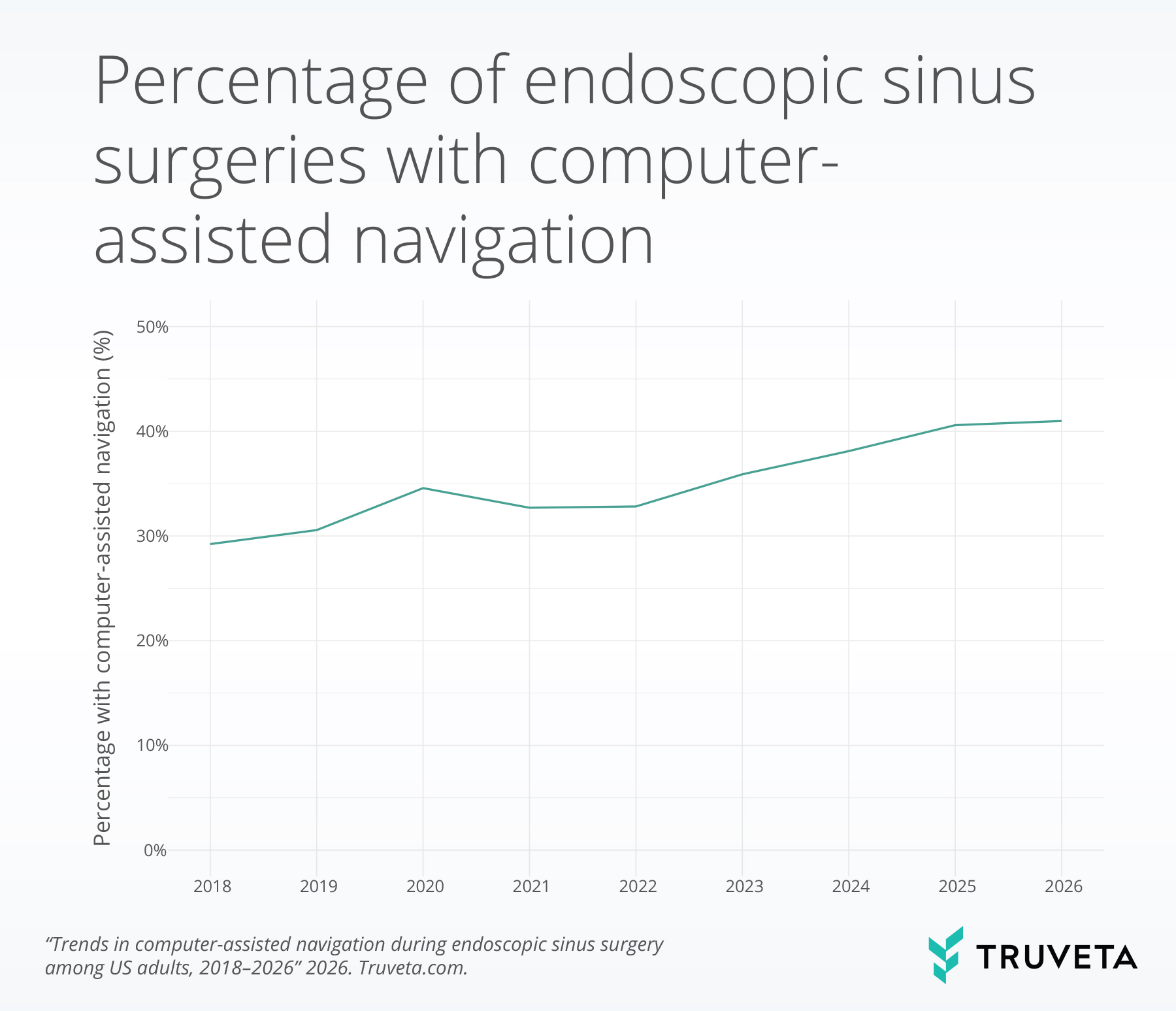
- Use of computer-assisted navigation in endoscopic sinus surgeries increased from 29.2% in 2018 to 41.0% in 2026.
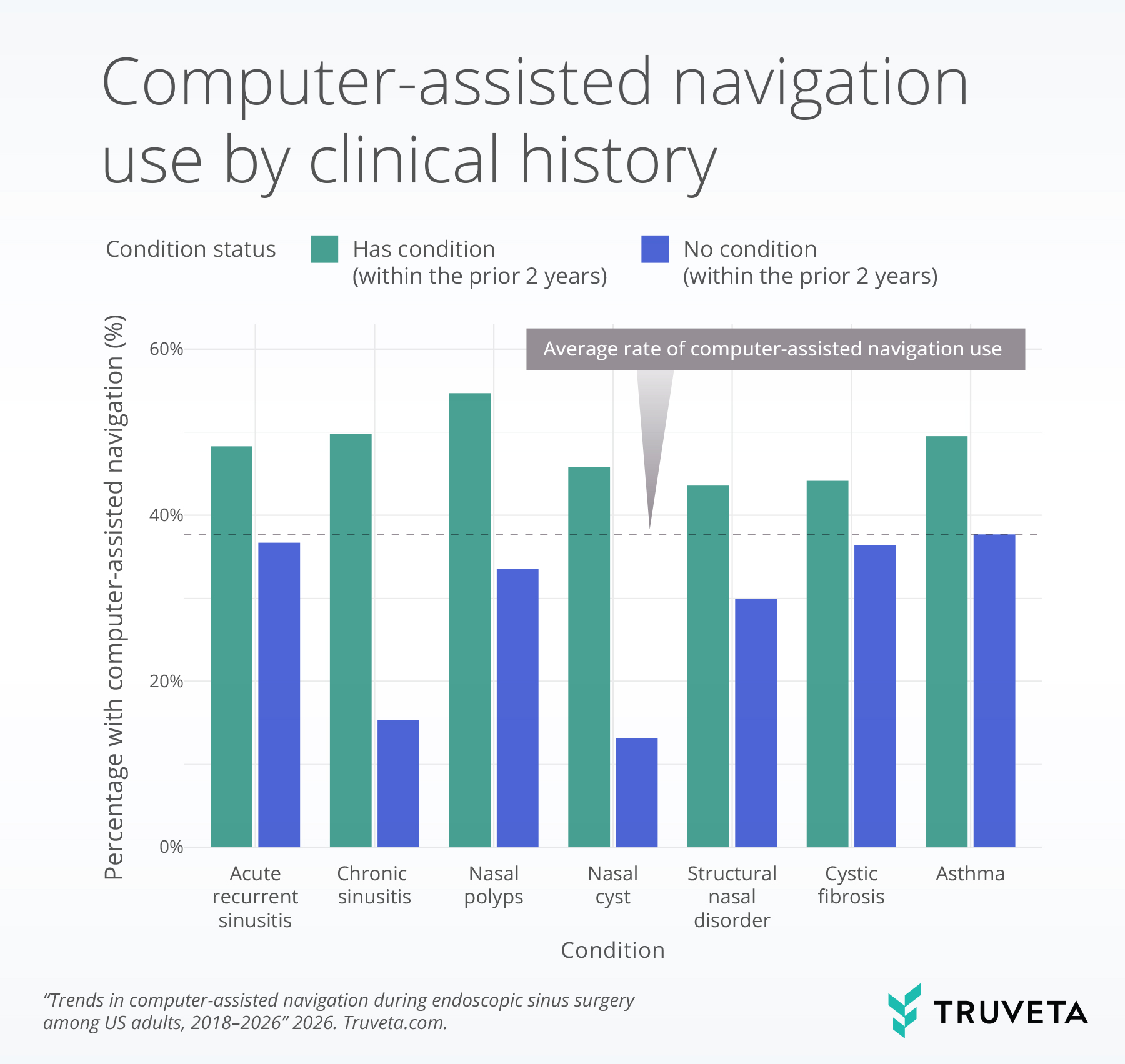
- Rate of computer-assisted navigation varied by demographic and clinical factors.
Endoscopic sinus surgery is a minimally invasive procedure that uses a small camera inserted through the nose to access and open blocked sinus passages, allowing the sinuses to drain and function properly (1, 2). It is commonly used to treat sinonasal disorders, such as chronic rhinosinusitis, recurrent acute sinusitis, nasal polyps, mucoceles, cysts, and structural abnormalities that interfere with airflow or mucus drainage (1). For patients who do not respond to treatments such as medications or saline rinses, this procedure can lead to significant symptom relief, reduce infections, and improve overall quality of life (1, 3).
Computer-assisted surgical navigation is often used to support endoscopic sinus surgery when the usual sinus structures are altered or difficult to identify, when the disease is extensive, or when the surgery is close to important areas like the eyes or skull base. This technology integrates preoperative CT imaging with real-time tracking of surgical instruments, essentially functioning like a GPS system to help guide the surgeon with greater precision and safety (4).
Studies evaluating computer-assisted navigation systems for endoscopic sinus surgery have generally shown high accuracy in identifying anatomic structures, although this reflects a broad range of technologies that have evolved over time (5–8). Research assessing their use in endoscopic sinus surgery has demonstrated mixed results, with some studies suggesting benefits, but others finding no meaningful differences in outcomes (7, 9–13). Major professional societies endorse the use of computer-assisted navigation in complex cases (14, 15). Surgeons performing endoscopic sinus surgery consistently report high satisfaction with computer-assisted navigation technologies, noting reductions in surgical stress (16, 17).
We examined trends in the use of computer-assisted navigation among adult patients undergoing endoscopic sinus surgery in Truveta Data.
Methods
Using a subset of Truveta Data, we identified adult patients who underwent endoscopic sinus surgery between January 1, 2018, and August 31, 2026. Endoscopic sinus surgery was defined using relevant procedure codes. Endoscopic sinus surgery–coded visits occurring within 90 days of a prior surgery code were grouped as a single surgery, using the earliest date in each 90-day window (18). If any visit in the window included a computer-assisted navigation code, the surgery was classified as using navigation on that first surgery date. Computer-assisted navigation was identified using a specific add-on CPT code.
We evaluated the rate in which computer-assisted navigation was used in endoscopic sinus surgeries over time and examined utilization across demographics. We also assessed differences for patients with clinical characteristics, comparing computer-assisted navigation use among patients with diagnoses of acute recurrent sinusitis, chronic sinusitis, nasal polyps, nasal cysts, structural sinonasal disorders, asthma, or cystic fibrosis in the two years prior to surgery.
You can view the complete study, including data definitions and code, directly in Truveta.
Results
Across all 98,971 endoscopic sinus surgeries, computer-assisted navigation was used in 35.5% of surgeries. Computer-assisted navigation use increased from 29.2% in 2018 to 41.0% in 2026, which represents a 40.4% relative increase over the study period.
Clinical characteristics
Computer-assisted navigation use was higher among patients who had specific sinonasal or respiratory conditions, including acute recurrent sinusitis, chronic sinusitis, nasal polyps, nasal cysts, structural sinonasal disorders, asthma, and cystic fibrosis, in the two years before surgery
Age group
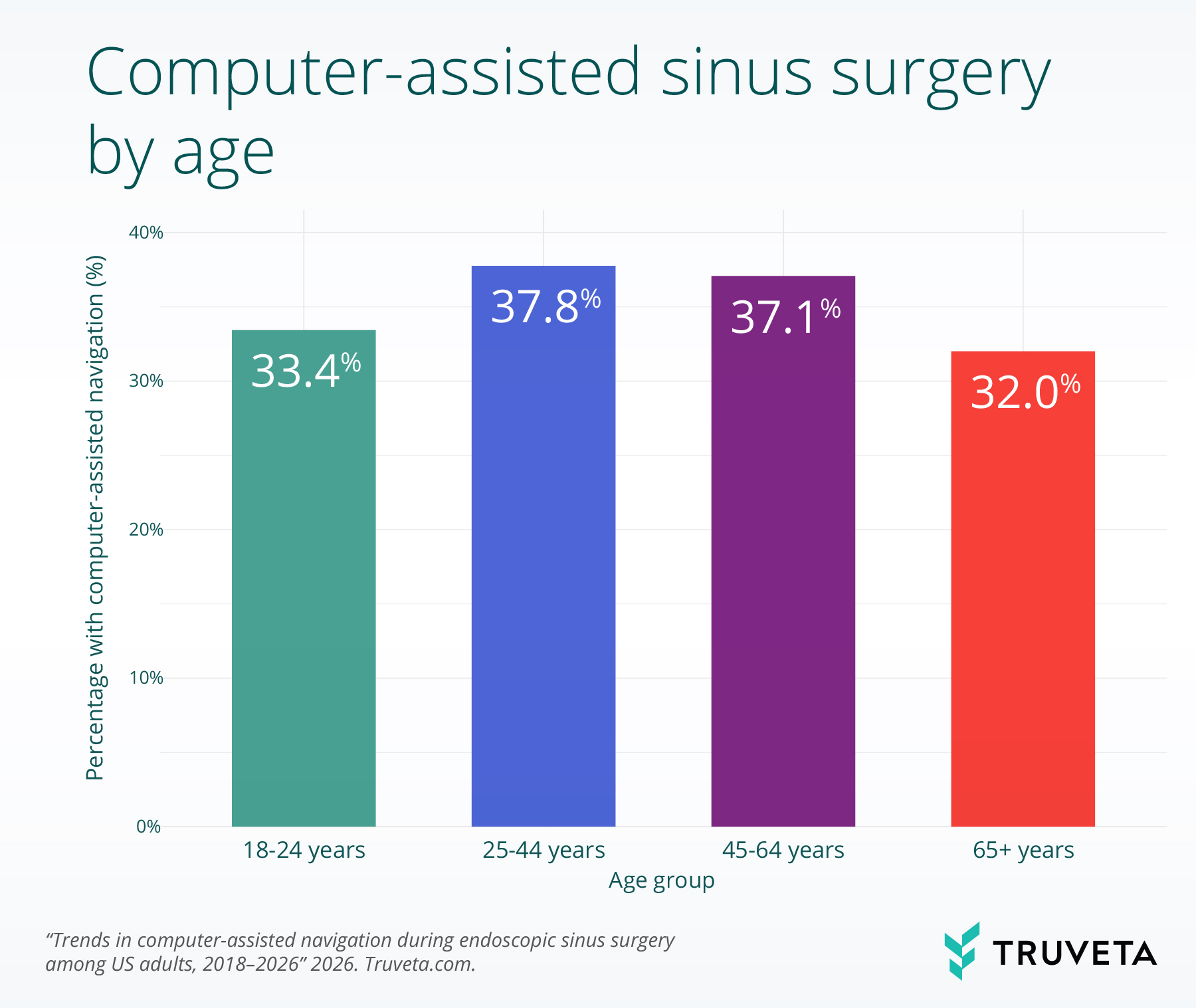
Computer-assisted navigation varied by age group. Computer-assisted navigation use was highest for patients aged 25-44 (37.8%) and those aged 45-64 (37.1%). It was lowest for the youngest (18-24 year-olds; 33.4%) and oldest age groups in our study (aged 65+; 32.0%).
Discussion
Computer-assisted navigation use increased steadily from 2018 to 2026, consistent with broader adoption of navigation technologies in surgical practice (19–22). Increased availability of computer-assisted navigation systems, surgeon training, and evolving clinical guidelines supporting computer-assisted navigation in complex or higher-risk cases may contribute to this trend (14, 23–25).
Higher use of computer-assisted navigation among patients with chronic sinusitis, nasal polyps, prior inflammation, or structural abnormalities aligns with common insurance authorization requirements and professional society guidelines, which often recommend that computer-assisted navigation is appropriate when a case is more complex (15, 26). Age-related differences may relate to disease presentation, insurance coverage patterns, or referral pathways (27).
As technology evolves, the use of computer-assisted navigation may continue to increase. Innovations such as augmented reality overlays, enhanced imaging integration, and early development of AI-assisted navigation have the potential to expand the capabilities of intraoperative guidance systems (1, 13).
There are a few limitations associated with this analysis. Identification of computer-assisted navigation relied on the CPT add-on code being documented. If this code is missing or inconsistently captured, the data may underestimate how often navigation is used. This analysis includes all computer-assisted navigational technologies and did not differentiate among specific platforms or levels of technological advancement, and computer-assisted navigation systems may vary substantially between sites of care. Lastly, we did not distinguish between whether patients obtained prior authorization or insurance approval for navigation, which could influence whether the add-on code was billed.
Together, these findings highlight how computer-assisted navigation is being incorporated into current surgical practice and offer a clear picture of how its use has evolved in recent years. This analysis offers a glimpse into how advanced technologies are being adopted in clinical care today, though it represents only one of many such innovations.
These are preliminary research findings and not peer reviewed. Data are constantly changing and updating. These findings are consistent with data accessed on September 8, 2026.
Citations
- S. Govindaraj, N. D. Adappa, D. W. Kennedy, Endoscopic sinus surgery: evolution and technical innovations. The Journal of Laryngology & Otology 124, 242–250 (2010).
- Endoscopic Sinus Surgery – A Patient’s Guide, Otolaryngology — Head & Neck Surgery. https://med.stanford.edu/ohns/OHNS-healthcare/sinuscenter/resources/sinus_guide.html.
- Z. M. Soler, T. L. Smith, Quality of Life Outcomes after Functional Endoscopic Sinus Surgery. Otolaryngol Clin North Am 43, 605–612 (2010).
- R. B. Bell, Computer planning and intraoperative navigation in cranio-maxillofacial surgery. Oral and Maxillofacial Surgery Clinics 22, 135–156 (2010).
- D. Z. Allen, J. Talmadge, M. J. Citardi, Semi-Quantitative Assessment of Surgical Navigation Accuracy During Endoscopic Sinus Surgery in a Real-World Environment. Ann Otol Rhinol Laryngol 134, 14–20 (2025).
- E. ten Dam, H. M. Helder, B. F. A. M. van der Laan, R. A. Feijen, A. G. W. Korsten-Meijer, The effect of three-dimensional visualisation on performance in endoscopic sinus surgery: A clinical training study using surgical navigation for movement analysis in a randomised crossover design. Clinical Otolaryngology 45, 211–220 (2020).
- A. Singh, R. Kumar, A. Thakar, S. C. Sharma, A. S. Bhalla, Role of Image Guided Navigation in Endoscopic Surgery of Paranasal Sinuses: A Comparative Study. Indian J Otolaryngol Head Neck Surg 72, 221–227 (2020).
- J. Ruthberg, N. Gunderson, P. Chen, G. Harris, H. Case, R. Bly, E. J. Seibel, W. M. Abuzeid, Vision-Guided Surgical Navigation Using Computer Vision for Dynamic Intraoperative Imaging Updates. International Forum of Allergy & Rhinology n/a (2025).
- B. Galletti, F. Gazia, F. Freni, F. Sireci, F. Galletti, Endoscopic sinus surgery with and without computer assisted navigation: A retrospective study. Auris Nasus Larynx 46, 520–525 (2019).
- M. D. Gibbons, C. G. Gunn, S. Niwas, M. J. Sillers, Cost Analysis of Computer-Aided Endoscopic Sinus Surgery. American Journal of Rhinology 15, 71–76 (2001).
- M. P. Fried, V. M. Moharir, J. Shin, M. Taylor-Becker, P. Morrison, D. W. Kennedy, Comparison of Endoscopic Sinus Surgery with and without Image Guidance. American Journal of Rhinology 16, 193–197 (2002).
- T. D. Vreugdenburg, R. S. Lambert, Y. N. Atukorale, A. L. Cameron, Stereotactic anatomical localization in complex sinus surgery: A systematic review and meta‐analysis. The Laryngoscope 126, 51–59 (2016).
- A. Paleri, R. Ramalingam, K. K. Ramalingam, S. Udupi, W. Khan, R. Harirajan, Utility of Navigation Technology in Functional Endoscopic Sinus Surgery. International Journal of Head and Neck Surgery 15, 8–13 (2024).
- Position Statement: Intra-Operative Use of Computer Aided Surgery – American Academy of Otolaryngology-Head and Neck Surgery (AAO-HNS), American Academy of Otolaryngology-Head and Neck Surgery (2023). https://www.entnet.org/resource/position-statement-intra-operative-use-of-computer-aided-surgery/.
- Criteria for Image Guided Surgery, American Rhinologic Soceity (2023). https://www.american-rhinologic.org/index.php?option=com_content&view=article&id=35:criteria-for-image-guided-surgery&catid=26:position-statements&Itemid=197.
- D. M. Beswick, V. R. Ramakrishnan, The Utility of Image Guidance in Endoscopic Sinus Surgery: A Narrative Review. JAMA Otolaryngol Head Neck Surg 146, 286–290 (2020).
- E. Vicaut, B. Bertrand, J.-L. Betton, A. Bizon, D. Briche, L. Castillo, J.-B. Lecanu, P. Lindas, B. Lombard, O. Malard, J.-C. Merol, P.-J. Monteyrol, T. Nasser, B. Navailles, V. Prulière-Escabasse, R. Stringini, B. Verillaud, Use of a navigation system in endonasal surgery: Impact on surgical strategy and surgeon satisfaction. A prospective multicenter study. Eur Ann Otorhinolaryngol Head Neck Dis 136, 461–464 (2019).
- S. Toppila-Salmi, A. Lyly, J. Simin, J. Aakko, H. H. Olsen, L. Lehtimäki, Predictors of revision endoscopic sinus surgery in Finnish patients with chronic rhinosinusitis with nasal polyps. Clinical and Translational Allergy 15, e70032 (2025).
- B. V. Kelley, P. P. Hsiue, A. M. Upfill-Brown, C. J. Chen, C. Villalpando, E. L. Lord, A. N. Shamie, A. I. Stavrakis, D. Y. Park, Utilization trends and outcomes of computer-assisted navigation in spine fusion in the United States. The Spine Journal 21, 1246–1255 (2021).
- C. L. Dominy, J. E. Tang, V. Arvind, B. H. Cho, S. Selverian, K. C. Shah, J. S. Kim, S. K. Cho, Trends in the Charges and Utilization of Computer-Assisted Navigation in Cervical and Thoracolumbar Spinal Surgery. Asian Spine J 16, 625–633 (2022).
- J. K. Antonios, S. Korber, L. Sivasundaram, C. Mayfield, H. P. Kang, D. A. Oakes, N. D. Heckmann, Trends in computer navigation and robotic assistance for total knee arthroplasty in the United States: an analysis of patient and hospital factors. Arthroplasty Today 5, 88–95 (2019).
- E. J. Hepworth, M. Bucknor, A. Patel, W. C. Vaughan, Nationwide Survey on the use of Image-Guided Functional Endoscopic Sinus Surgery. Otolaryngol Head Neck Surg 135, 68–75 (2006).
- D. J. Costa, R. Sindwani, Advances in Surgical Navigation. Otolaryngologic Clinics of North America 42, 799–811 (2009).
- L. Li, J. Yang, Y. Chu, W. Wu, J. Xue, P. Liang, L. Chen, A Novel Augmented Reality Navigation System for Endoscopic Sinus and Skull Base Surgery: A Feasibility Study. PLoS ONE 11, e0146996 (2016).
- I. L. Schmale, L. J. Vandelaar, A. U. Luong, M. J. Citardi, W. C. Yao, Image-Guided Surgery and Intraoperative Imaging in Rhinology: Clinical Update and Current State of the Art. Ear Nose Throat J 100, NP475–NP486 (2021).
- Sinus Surgeries – Medical Clinical Policy Bulletins | Aetna. https://www.aetna.com/cpb/medical/data/900_999/0937.html.
- S. A. Mueller, M. Caversaccio, Outcome of computer-assisted surgery in patients with chronic rhinosinusitis. J. Laryngol. Otol. 124, 500–504 (2010).