



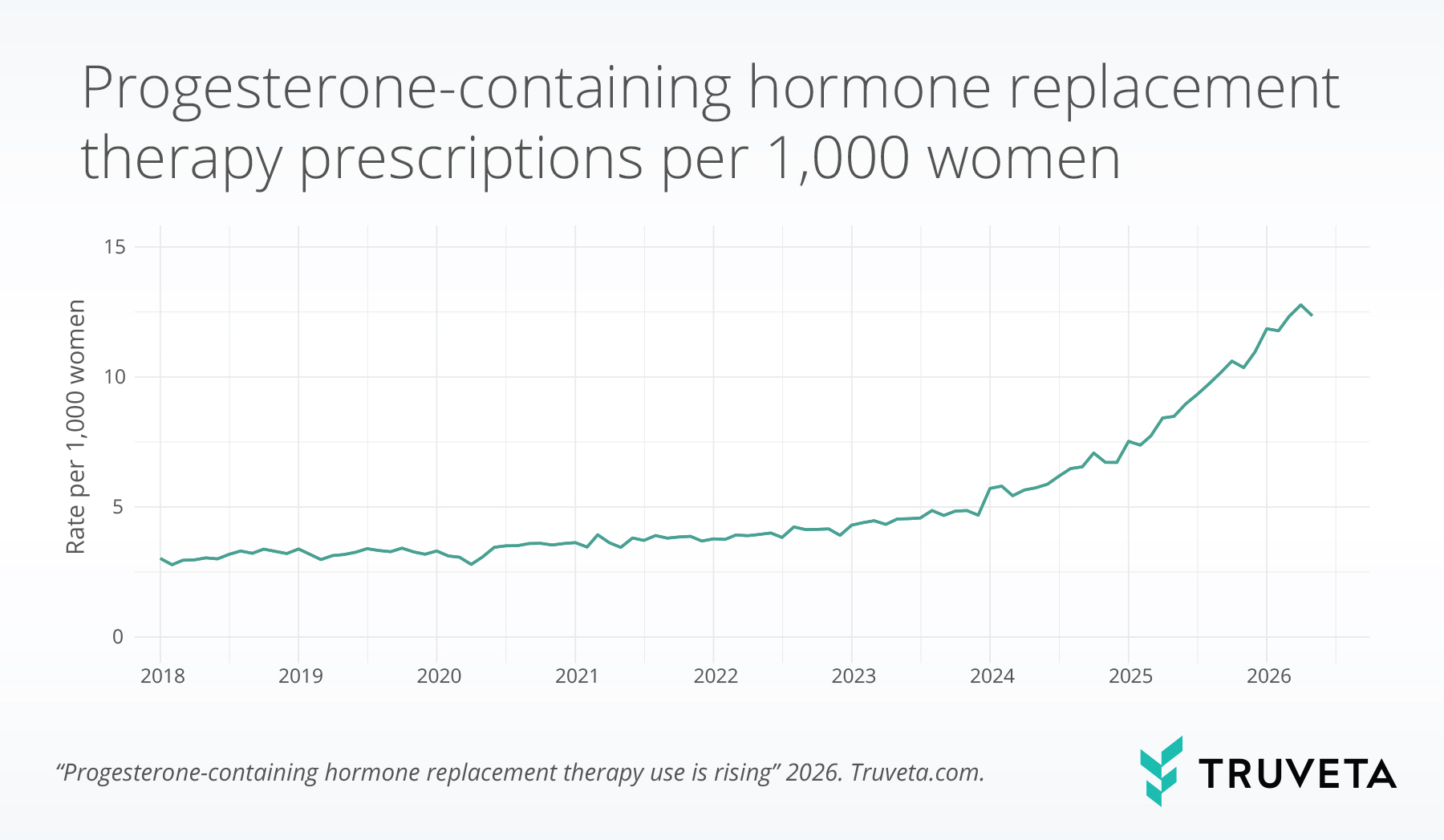
- Prescribing of progesterone-containing hormone replacement therapy (HRT) more than quadrupled between 2018 and 2026.
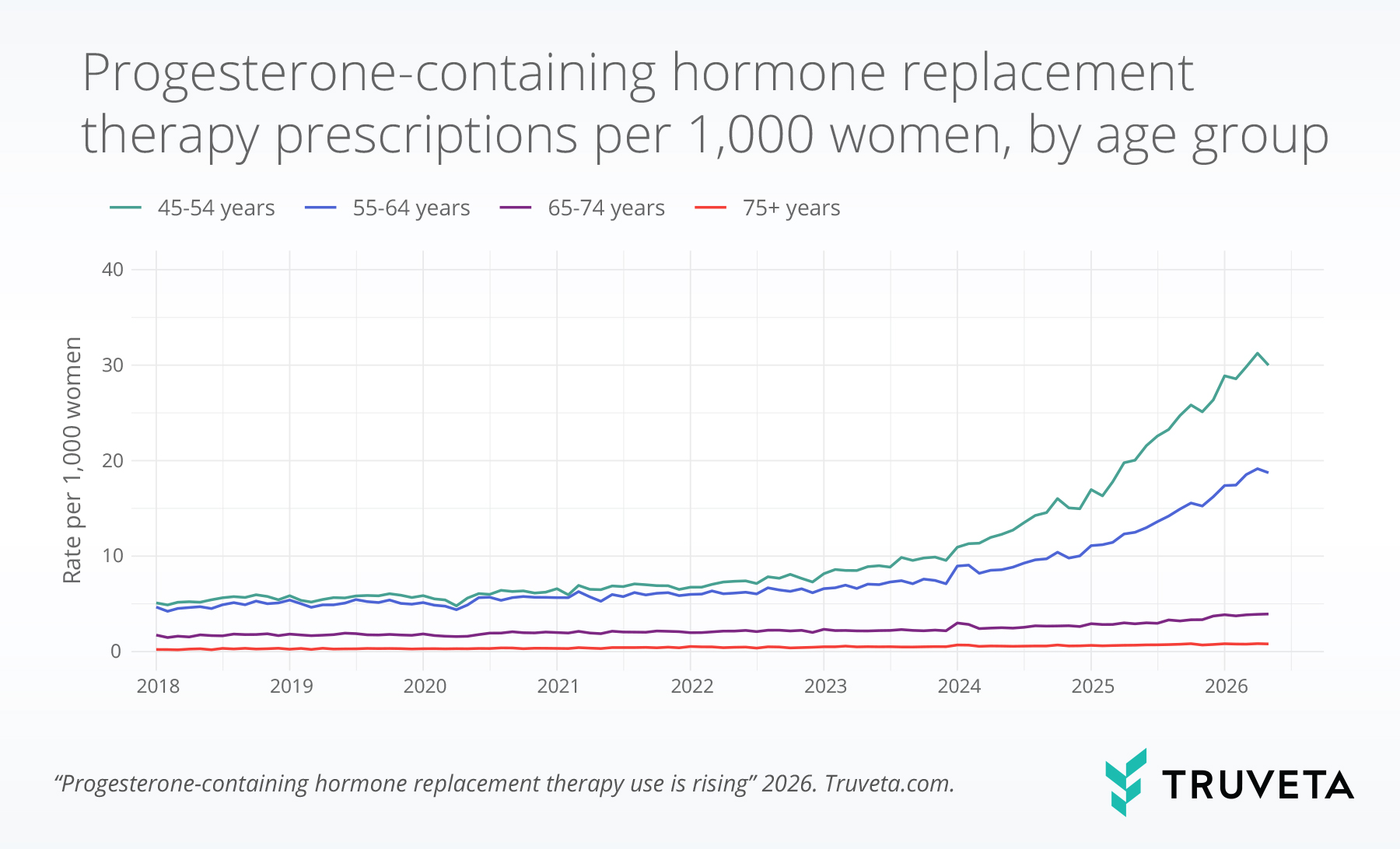
- Women aged 45–54 years experienced the largest increase in prescribing, with rates increasing 488% between 2018 and 2026.
- By May 2026, 3% of women aged 45-54 with prescription data had evidence of a progesterone-containing HRT prescription.
Menopause is a major life transition that can affect physical health, mental well-being, sleep, sexual health, and long-term cardiometabolic and bone health for millions of women (1–3). Hormone replacement therapy (HRT) remains one of the most effective treatment options for managing menopausal symptoms and improving quality of life during and after the menopausal transition (3–5).
Progesterone plays an important role in many hormone therapy regimens. Progesterone helps protect against changes in the uterine lining that can increase the risk of endometrial cancer (6–8). This protective effect is a cornerstone of modern menopause care, as unopposed estrogen substantially increases the risk of endometrial hyperplasia (6–8). Beyond its role in endometrial protection, prior research also suggests that progesterone and progestin formulations may improve symptoms such as hot flashes and sleep disturbances (9, 10). As a result, progesterone has become an increasingly important part of discussions surrounding individualized menopause management.
Use of hormone therapy declined sharply following publication of the Women’s Health Initiative (WHI) findings in 2002, which raised concerns about the risks and benefits of menopausal hormone therapy (1, 2). In recent years, however, public interest and clinician attention have grown again as new evidence, media coverage, evolving guidance, and regulatory actions, such as the FDA’s November 2025 removal of boxed warnings from several hormone therapies, have led to a more nuanced understanding of hormone therapy safety and use (11–15).
We recently examined trends in estrogen-based hormone replacement therapy (HRT) prescribing using a subset of Truveta Data. In that analysis, we found that estrogen-based HRT prescribing more than doubled between 2018 and early 2026 (16). We also observed notable shifts in the types of estrogen therapies being dispensed, highlighting how menopause care continues to evolve.
Building on this previous analysis of estrogen-based HRT, here we examine trends in progesterone-containing HRT prescribing among women aged 45 years and older. As progesterone is commonly used alongside estrogen therapy and has become an important part of menopause care, prescribing trends may provide additional insight into how hormone therapy is being used today in clinical practice.
Methods
Using a subset of Truveta Data, we identified women aged 45 years and older with prescription data between January 2018 and May 2026.
We examined prescribing rates of progesterone-containing hormone replacement therapy (HRT). Progesterone-containing therapies included both micronized progesterone and synthetic progestins commonly used as part of menopausal hormone therapy. Medications primarily used for non-menopausal indications (for example, Depo Provera, a contraceptive) were excluded from the analysis. Prescribing rates (reported per 1,000 women) were defined as the number of women with a progesterone-containing HRT prescription divided by all women aged 45 years and older with prescription data during a given month.
We evaluated prescribing trends over time and also stratified by age group (45–54, 55–64, 65–74, and 75 years and older). To assess changes in prescribing after the FDA’s November 2025 removal of boxed warnings from several hormone therapies, we also compared prescribing rates between November 2025 and May 2026.
You can view the complete study, including data definitions and code, directly in Truveta.
Results
In this study, we identified 598,797 women aged 45 and older with evidence of a progesterone-based HRT prescription from 2018-2026. Progesterone-containing HRT prescribing increased substantially over the study period. In January 2018, prescribing rates were 3.0 prescriptions per 1,000 women aged 45 years and older. In May 2026, rates had increased to 12.4 prescriptions per 1,000 women, representing a 308.7% increase.
Growth continued in recent months. Between November 2025 and May 2026, prescribing rates increased from 10.4 to 12.4 prescriptions per 1,000 women, a 19.3% increase over six months.
Trends by age group
Progesterone-containing HRT prescribing increased across all age groups studied, although rates remained highest among women most likely to be undergoing the menopausal transition.
Women aged 45–54 years had the highest prescribing rates throughout the study period. Rates increased from 5.1 prescriptions per 1,000 women in 2018 to 30.0 per 1,000 women in May 2026, a 488.0% increase. Rates have been steadily increasing in this age group since the end of 2025, with prescribing increasing 19.4% since November 2025.
Among women aged 55–64 years, prescribing rates increased from 4.7 to 18.7 prescriptions per 1,000 women between 2018 and 2026, a 301.3% increase. Smaller, but substantial increases were also observed among older women. Among women aged 65–74 years, prescribing rates increased from 1.7 to 3.9 prescriptions per 1,000 women, representing a 127.2% increase. Among women aged 75 years and older, rates increased from 0.2 to 0.8 prescriptions per 1,000 women, a 261.9% increase.
Discussion
In this analysis of women aged 45 years and older, prescribing of progesterone-containing hormone replacement therapy increased substantially between 2018 and 2026. Prescribing rates more than quadrupled during the study period, with the most pronounced increases occurring among women aged 45–54 years and 55–64 years. These findings mirror our previous analysis of estrogen-based HRT, which also demonstrated substantial growth in prescribing over the same period. Because progesterone is commonly prescribed alongside estrogen for women with an intact uterus, the increases observed in both analyses suggest broader changes in menopause care and hormone therapy use (1, 10).
Notably, prescribing rates began increasing rapidly in 2024 and continued to rise through 2026. This acceleration coincided with growing public and clinical attention to menopause care, including the publication of updated evidence on hormone therapy safety and benefits, increased media coverage, and high-profile public discussions of menopause by celebrities and advocacy groups (17–19). Prescribing has increased 19% between November 2025 and May 2026, coinciding with the FDA’s removal of black box warnings from certain hormone therapy products on November 10, 2025 (16).
The increase in progesterone-containing HRT prescribing is particularly notable given progesterone’s important role in menopause management. For women with an intact uterus receiving estrogen therapy, progesterone is recommended to provide endometrial protection and reduce the risk of endometrial hyperplasia and endometrial cancer associated with unopposed estrogen exposure (6–8, 20). Beyond this protective role, emerging evidence suggests that some progesterone formulations may also improve symptoms, such as hot flashes and sleep disturbances, contributing to growing interest in progesterone-containing therapies as part of individualized menopause care (10, 20).
By May 2026, 3% of women aged 45–54 years with any prescription in Truveta Data had evidence of a progesterone-containing HRT prescription. Substantial increases were also observed among women aged 55–64 years. Together, these findings show that the largest increases in progesterone-containing HRT use occurred among women in the age groups most likely to be seeking menopause-related care (1, 4).
This analysis has limitations. First, progesterone-containing medications may be prescribed for indications other than menopause, including abnormal uterine bleeding, fertility treatment, or other gynecological conditions. To better capture menopause-related use, we restricted the study population to women aged 45 years and older; however, some prescriptions may still have been written for non-menopausal indications. We did not evaluate the clinical indication associated with progesterone prescriptions and therefore could not determine whether each prescription was intended for menopause-related care. We also did not evaluate specific progesterone formulations or treatment duration, and prescription data do not confirm whether a medication was filled or taken. Finally, although we use the term progesterone-containing therapy throughout this report, the study included both natural progesterone and synthetic progestins used in hormone therapy regimens.
This study provides insight into real-world prescribing patterns for progesterone-containing hormone therapy across a large and geographically diverse population. The findings demonstrate a sustained increase in progesterone-containing HRT use since 2018, particularly among women aged 45–64 years and highlight the growing role of hormone therapy within contemporary menopause care.
These are preliminary research findings and not peer reviewed. Data are constantly changing and updating. These findings are consistent with data accessed on June 10, 2026.
Citations
- L. Cho, A. M. Kaunitz, S. S. Faubion, S. N. Hayes, E. S. Lau, N. Pristera, N. Scott, J. L. Shifren, C. L. Shufelt, C. A. Stuenkel, K. J. Lindley, for the ACC CVD in Women Committee, Rethinking Menopausal Hormone Therapy: For Whom, What, When, and How Long? Circulation 147, 597–610 (2023).
- R. Hess, R. C. Thurston, R. D. Hays, C.-C. H. Chang, S. N. Dillon, R. B. Ness, C. L. Bryce, W. N. Kapoor, K. A. Matthews, The impact of menopause on health-related quality of life: results from the STRIDE longitudinal study. Qual Life Res 21, 535–544 (2012).
- J. Whiteley, M. daCosta DiBonaventura, J.-S. Wagner, J. Alvir, S. Shah, The Impact of Menopausal Symptoms on Quality of Life, Productivity, and Economic Outcomes. J Womens Health (Larchmt) 22, 983–990 (2013).
- C. R. Cameron, S. Cohen, K. Sewell, M. Lee, The Art of Hormone Replacement Therapy (HRT) in Menopause Management. Journal of Pharmacy Practice 37, 736–740 (2024).
- Y. Tang, R. Ma, L. Zhang, X. Sun, Y. Wang, Effectiveness and safety of hormone replacement therapy in the treatment of menopausal syndrome: a meta-analysis. Am J Transl Res 17, 1–15 (2025).
- D. Kim, V. Jordan, F. Casciola, M. Ferguson, A. Humphries, M. B. Rodriguez, M. R. Wise, Hormone therapy in postmenopausal women and risk of endometrial hyperplasia or endometrial cancer. Cochrane Database of Systematic Reviews (2025).
- C. B. Tempfer, Z. Hilal, P. Kern, I. Juhasz-Boess, G. A. Rezniczek, Menopausal Hormone Therapy and Risk of Endometrial Cancer: A Systematic Review. Cancers 12 (2020).
- L. A. Brinton, A. S. Felix, Menopausal Hormone Therapy and Risk of Endometrial Cancer. J Steroid Biochem Mol Biol 142, 83–89 (2014).
- M. J. Spark, J. Willis, Systematic review of progesterone use by midlife and menopausal women. Maturitas 72, 192–202 (2012).
- J. C. Prior, Progesterone for treatment of symptomatic menopausal women. Climacteric 21, 358–365 (2018).
- S. M. Harman, Estrogen replacement in menopausal women: Recent and current prospective studies, the WHI and the KEEPS. Gender Medicine 3, 254–269 (2006).
- R. C. Chester, J. M. Kling, J. E. Manson, What the Women’s Health Initiative has taught us about menopausal hormone therapy. Clin Cardiol 41, 247–252 (2018).
- M. Hickey, J. Elliott, S. L. Davison, Hormone replacement therapy. BMJ 344, e763–e763 (2012).
- S. Palacios, Advances in hormone replacement therapy: making the menopause manageable. BMC Women’s Health 8, 22 (2008).
- R. D. Langer, H. N. Hodis, R. A. Lobo, M. A. Allison, Hormone replacement therapy – where are we now? Climacteric 24, 3–10 (2021).
- FDA, FACT SHEET: FDA Initiates Removal of “Black Box” Warnings from Menopausal Hormone Replacement Therapy Products (2025). https://www.hhs.gov/press-room/fact-sheet-fda-initiates-removal-of-black-box-warnings-from-menopausal-hormone-replacement-therapy-products.html.
- J. E. Manson, C. J. Crandall, J. E. Rossouw, R. T. Chlebowski, G. L. Anderson, M. L. Stefanick, A. K. Aragaki, J. A. Cauley, G. L. Wells, A. Z. LaCroix, The Women’s Health Initiative randomized trials and clinical practice: a review. JAMA 331, 1748–1760 (2024).
- 21 Celebs Get Personal With Their Perimenopause and Menopause Stories. https://www.theflowspace.com/lists/celebrities-perimenopause-menopause-stories/drew-barrymore-50/.
- S. Orgad, K. Gilchrist, C. Rottenberg, How to tame your hormones: menopause rage in media discourse. Feminist Media Studies, 1–20 (2024).
- C. J. Crandall, J. M. Mehta, J. E. Manson, Management of menopausal symptoms: a review. JAMA 329, 405–420 (2023).