


Authors: Karen Gilbert Farrar, PhD ⊕Truveta, Inc, Bellevue, WA, Duy Hoang, PhD ⊕Truveta, Inc, Bellevue, WA, Nina B Masters, PhD, MPH ⊕Truveta, Inc, Bellevue, WA, Brianna M Cartwright, MS ⊕Truveta, Inc, Bellevue, WA

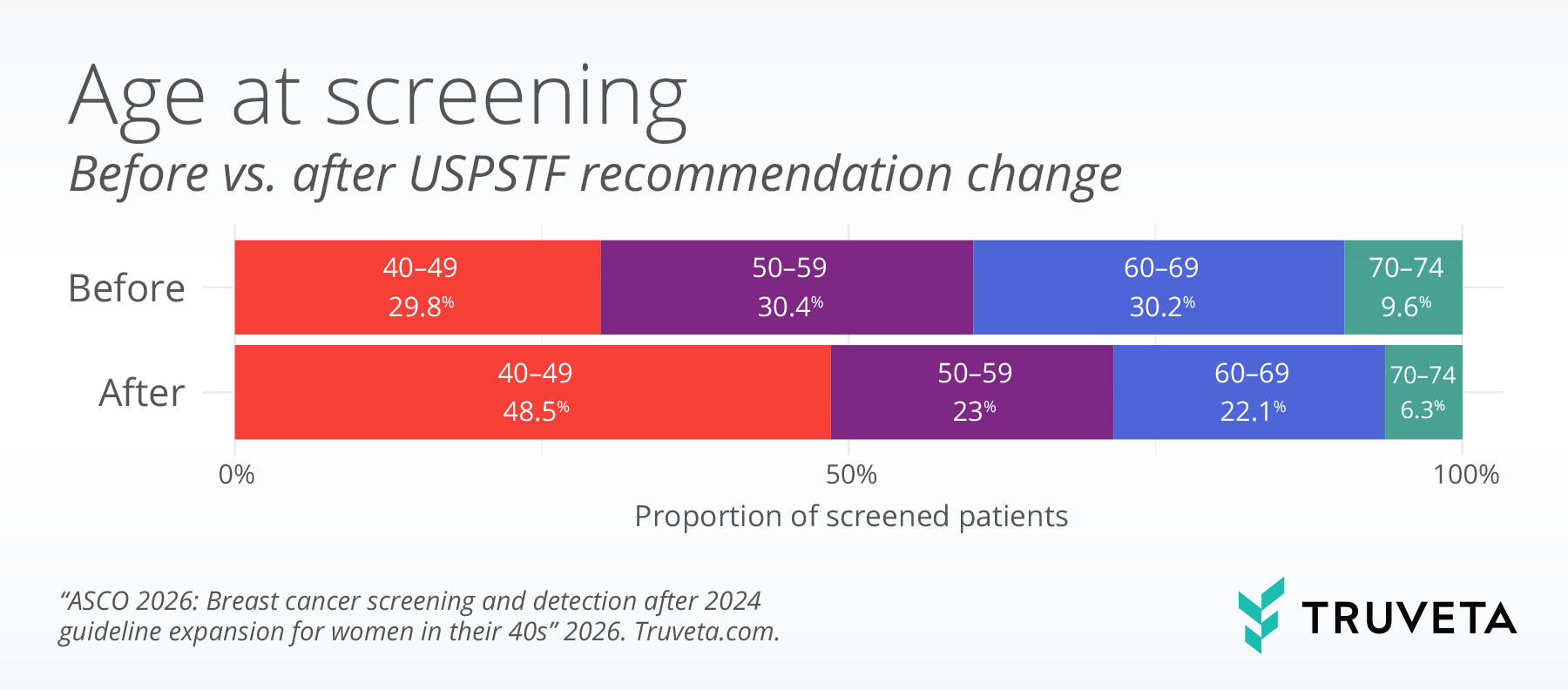
- Following the April 2024 USPSTF guideline expansion, screening mammogram rate among women aged 40-49 increased from 29.8% of mammograms before the guideline to 48.5% after.
- Likelihood of a breast cancer diagnosis within 180 days did not differ significantly before vs. after the guideline change.
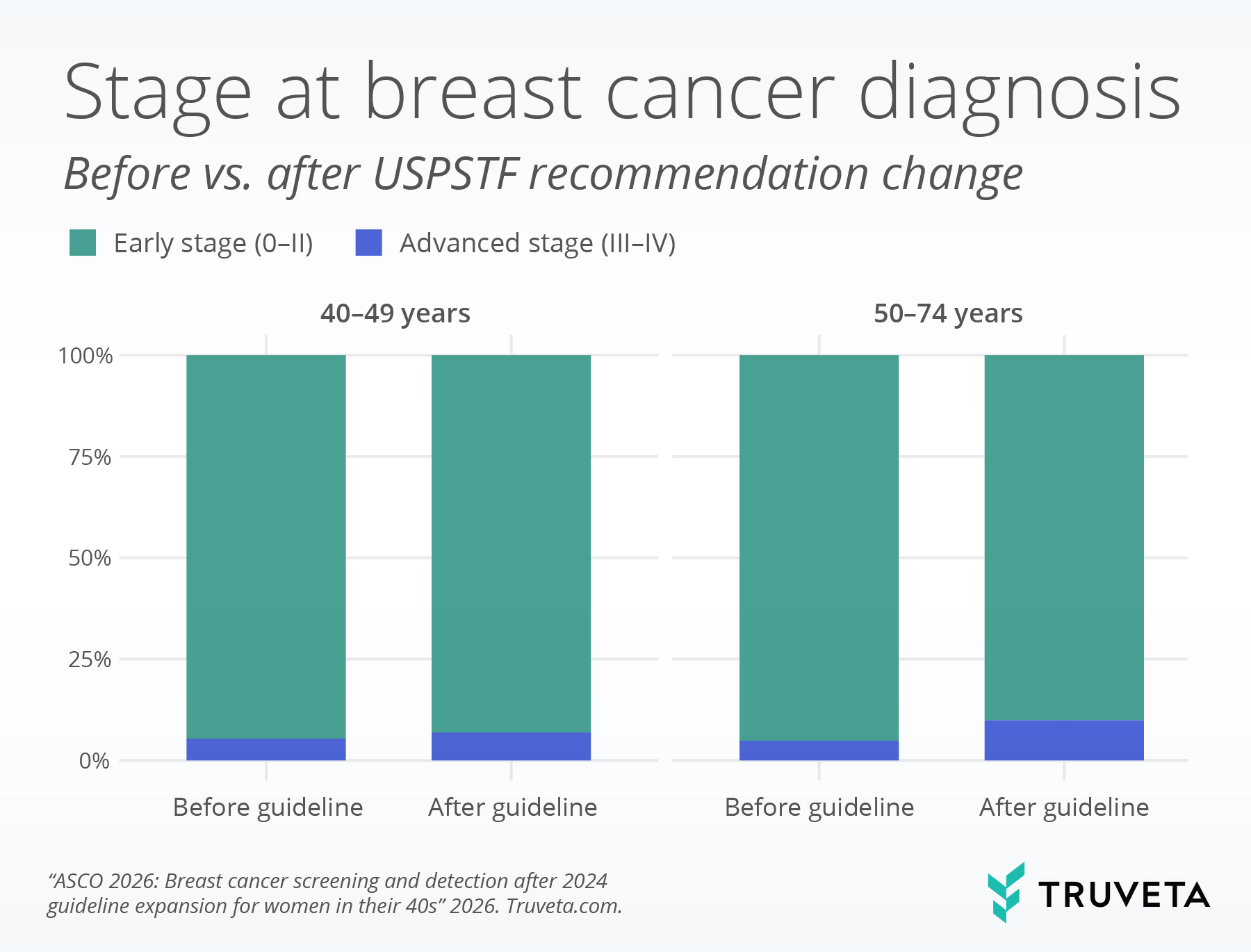
- Stage at diagnosis did not differ significantly after the guideline change.
- Longer follow-up is needed to assess the impact on outcomes such as stage distribution and survival.
This report is an extension of our poster presented at ASCO, titled Breast cancer screening and detection after the 2024 USPSTF recommendation for women aged 40–49.
Breast cancer remains one of the most common cancers among women in the United States and a leading cause of cancer-related mortality (1–3). Early detection through screening mammography has been shown to reduce breast cancer mortality and is a key strategy for identifying breast cancer at earlier, more treatable stages (4, 5). However, evolving trends have raised new considerations for screening. While breast cancer is more common in older women, recent evidence suggests that breast cancer incidence is rising nearly twice as fast among women under age 50 (1.4% annually) compared to women aged 50 and older (0.7%). This is especially concerning as breast cancer in younger women is more likely to be aggressive and diagnosed at later stages than older women (6, 7).
The US Preventive Services Task Force (USPSTF) is an independent panel of experts that issues evidence-based recommendations on preventive services, including cancer screening (8). Prior to the 2024 update, the USPSTF recommended screening mammography for women aged 50–74 every two years, while screening for women aged 40–49 was based on individual decision-making between patients and clinicians (9). In April 2024, the USPSTF updated its guidance to recommend screening mammography every two years beginning at age 40 (Grade B), reflecting rising incidence and the potential benefits of earlier detection in younger women (6, 10). USPSTF Grade A and B recommendations are required to be covered by most insurance plans at no cost to patients, which can make it easier for more people to get screened (8).
However, it remains unclear how quickly such guideline changes influence real-world clinical practice and whether they lead to measurable differences in cancer detection and stage at diagnosis.
To address this gap, we examined changes in screening uptake, breast cancer detection, and stage at diagnosis before and after the 2024 USPSTF recommendation using real-world data from a large, diverse population. Specifically, we examined how the guideline expansion impacted screening patterns among women aged 40–49, and whether there were early signals of changes in cancer detection or stage at diagnosis.
Methods
We used a subset of Truveta Data to identify women aged 40–74 who underwent screening mammography between 2018 and 2025. Patients were required to have no prior breast cancer diagnosis and evidence of outpatient care 6–18 months before and 1–12 months after screening. For patients with multiple eligible screenings, only the first was included.
We evaluated the impact of the April 2024 USPSTF update recommending screening beginning at age 40, by defining pre- and post-guideline periods using an April 30, 2024 cutoff date.
We evaluated three primary outcomes: (1) screening distribution by age group, (2) breast cancer diagnoses within 180 days of screening, and (3) stage at diagnosis, categorized as early stage (AJCC 0–II) or advanced stage (III–IV). Diagnosis and stage were derived from clinical notes.
We used logistic regression to estimate the likelihood of diagnosis and stage at diagnosis, while adjusting for differences in patient characteristics, including race, ethnicity, rural–urban residence, and family of breast cancer. Results are reported as odds ratios (ORs), where values above 1 indicate higher likelihood, values below 1 indicate lower likelihood, and values near 1 suggest no meaningful difference between groups.
Results
Screening uptake increased among women aged 40–49
We identified 985,687 women aged 40–74 who received screening mammography between 2018 and 2025. The majority (89.3%) of mammograms occurred before the guideline update and 10.7% occurred after.
After the recommendation change, women aged 40–49 represented a substantially larger proportion of screening exams, increasing from 29.8% before the guideline to 48.5% after.
Likelihood of breast cancer diagnosis within 180 days
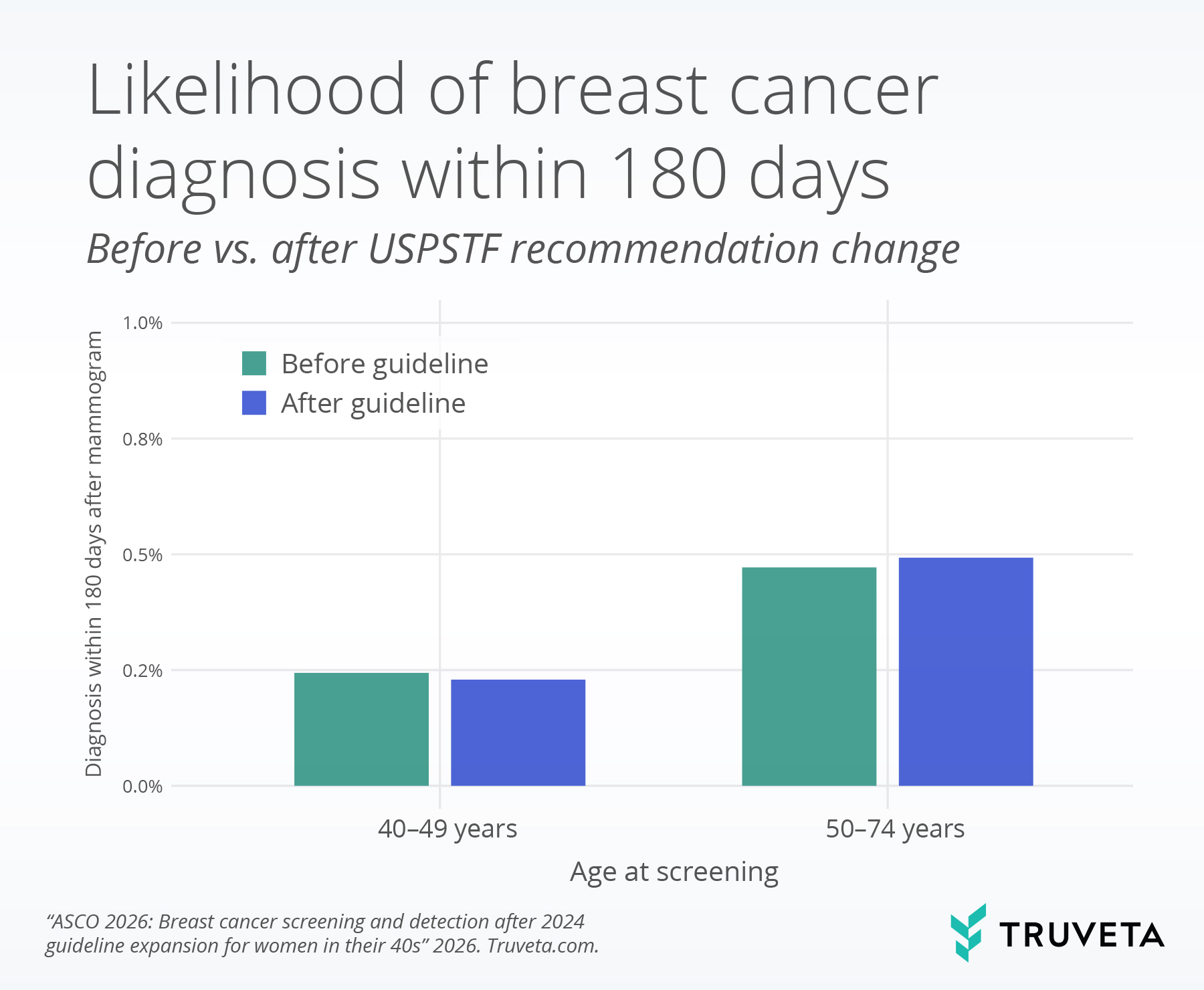
Despite increased screening in women aged 40–49, the likelihood of a breast cancer diagnosis within 180 days of screening did not significantly differ before vs. after the guideline change.
Among women aged 40–49, the odds of diagnosis remained stable (OR 1.03, 95% CI 0.79–1.34), with 0.2% diagnosed within 180 days after screening both before and after the guideline change. Similarly, no significant change was observed among women aged 50–74 (OR 0.87, 95% CI 0.75–1.01), with 0.5% diagnosed within 180 days after screening both before and after the guideline change.
Stage at diagnosis
women diagnosed with breast cancer within 180 days of screening and with available staging the distribution of stage at diagnosis did not significantly differ before vs. after the guideline change for women aged 40–49 (OR 1.26, 95% CI 0.72–2.21; 82.5% early-stage before vs. 83.1% after), or 50–74 (OR 0.91, 95% CI 0.67–1.24; 83.1% before vs. 79.7% after).
Discussion
In this large real-world analysis of nearly one million women, we found that the 2024 USPSTF recommendation to begin screening at age 40 was rapidly adopted in clinical practice, with a substantial increase in screening among women aged 40–49. This finding underscores how guideline changes can quickly influence care delivery at scale.
Despite this increase in screening, we did not observe short-term changes in breast cancer detection rates or stage at diagnosis. This is not unexpected given the recency of the guideline update. Prior research has detected initial updates in screening utilizations within 12–20 months of follow-up, while outcomes such as diagnosis and survival may need several years of follow-up to observe downstream effects (11–13). The absence of immediate changes in detection or stage should not be interpreted as a lack of benefit but rather as an indication that longer-term evaluation is needed.
This study has several limitations. First, the post-guideline period is relatively short, limiting our ability to detect longer-term changes in outcomes such as detection rate or stage at diagnosis. Second, our analysis may not capture all factors that influence breast cancer risk and diagnosis, such as BRCA mutation status, breast density, and reproductive history. These unmeasured factors may influence both screening patterns and likelihood of diagnosis, which could impact our findings, and will be especially important to consider in future research evaluating longer-term outcomes such as stage at diagnosis and survival.
Despite these limitations, this study provides early insight into how guideline changes are translating into real-world care. The rapid increase in screening among women aged 40–49 demonstrates strong uptake of the updated recommendation, while the absence of short-term changes in detection and stage highlights the importance of continued monitoring.
These findings are consistent with data accessed on January 19, 2026.
Citations
- W. F. Anderson, H. A. Katki, P. S. Rosenberg, Incidence of Breast Cancer in the United States: Current and Future Trends. J Natl Cancer Inst 103, 1397–1402 (2011).
- A. Goding Sauer, R. L. Siegel, A. Jemal, S. A. Fedewa, Current Prevalence of Major Cancer Risk Factors and Screening Test Use in the United States: Disparities by Education and Race/Ethnicity. Cancer Epidemiol Biomarkers Prev 28, 629–642 (2019).
- F. Bray, M. Laversanne, H. Sung, J. Ferlay, R. L. Siegel, I. Soerjomataram, A. Jemal, Global cancer statistics 2022: GLOBOCAN estimates of incidence and mortality worldwide for 36 cancers in 185 countries. CA A Cancer J Clinicians 74, 229–263 (2024).
- J. G. Elmore, K. Armstrong, C. D. Lehman, S. W. Fletcher, Screening for Breast Cancer. JAMA 293, 1245–1256 (2005).
- J. L. Caswell-Jin, L. P. Sun, D. Munoz, Y. Lu, Y. Li, H. Huang, J. M. Hampton, J. Song, J. Jayasekera, C. Schechter, O. Alagoz, N. K. Stout, A. Trentham-Dietz, S. J. Lee, X. Huang, J. S. Mandelblatt, D. A. Berry, A. W. Kurian, S. K. Plevritis, Analysis of Breast Cancer Mortality in the US—1975 to 2019. JAMA 331, 233–241 (2024).
- A. N. Giaquinto, H. Sung, L. A. Newman, R. A. Freedman, R. A. Smith, J. Star, A. Jemal, R. L. Siegel, Breast cancer statistics 2024. CA: A Cancer Journal for Clinicians 74, 477–495 (2024).
- J. K. Plichta, S. M. Thomas, R. Vernon, O. M. Fayanju, L. H. Rosenberger, T. Hyslop, E. S. Hwang, R. A. Greenup, Breast cancer tumor histopathology, stage at presentation, and treatment in the extremes of age. Breast Cancer Res Treat 180, 227–235 (2020).
- K. D. Young, The USPSTF: What you need to know about its role in health care, The Journalist’s Resource (2025). https://journalistsresource.org/home/the-us-preventive-services-task-force-what-to-know-about-this-influential-panel-of-health-care-experts/.
- N. Calonge, D. B. Petitti, T. G. DeWitt, A. J. Dietrich, K. D. Gregory, D. Grossman, G. Isham, M. L. LeFevre, R. M. Leipzig, L. N. Marion, B. Melnyk, V. A. Moyer, J. K. Ockene, G. F. Sawaya, J. S. Schwartz, T. Wilt, Screening for breast cancer: U.S. preventive services task force recommendation statement. Annals of internal medicine 151, 716–726 (2009).
- US Preventive Services Task Force, Screening for Breast Cancer: US Preventive Services Task Force Recommendation Statement. JAMA 331, 1918–1930 (2024).
- N. Gray, G. Picone, The Effect of the 2009 U.S. Preventive Services Task Force Breast Cancer Screening Recommendations on Mammography Rates. Health Services Research 51, 1533–1545 (2016).
- B. Mensah, A. E. Orhin, N. A. Akoto, S. Han, R. Vasireddy, R. A. Boateng, A. Metri, K. Eid, S. Singh, P. Kanth, Early Detection of Colorectal Cancer Following Changes to Screening Guidelines: A Population-Based Analysis of Adults Aged 45 to 49. American Journal of Clinical Oncology, 10–1097 (2025).