



- Over half (55.3%) of patients had evidence of PSA screening prior to diagnosis.
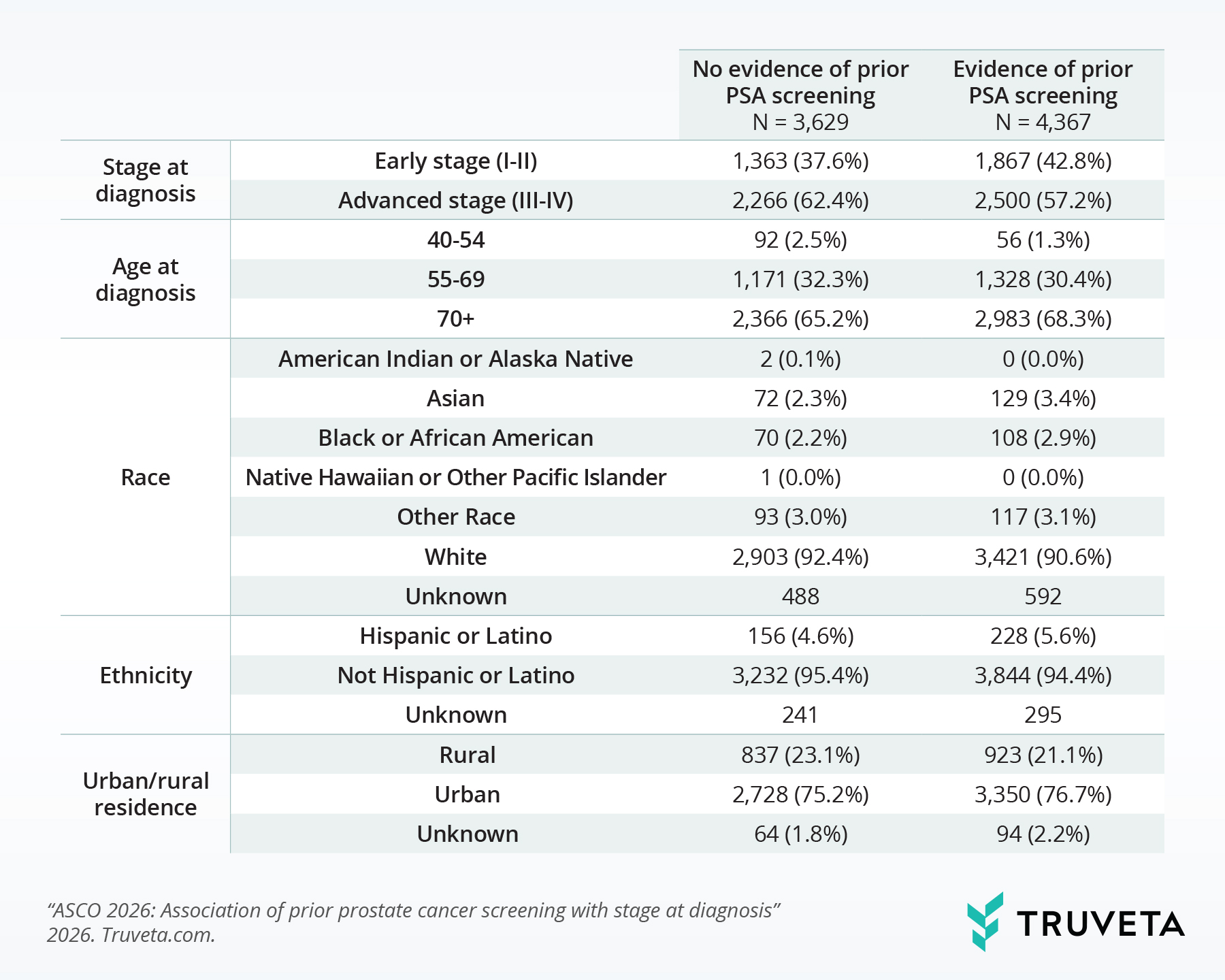
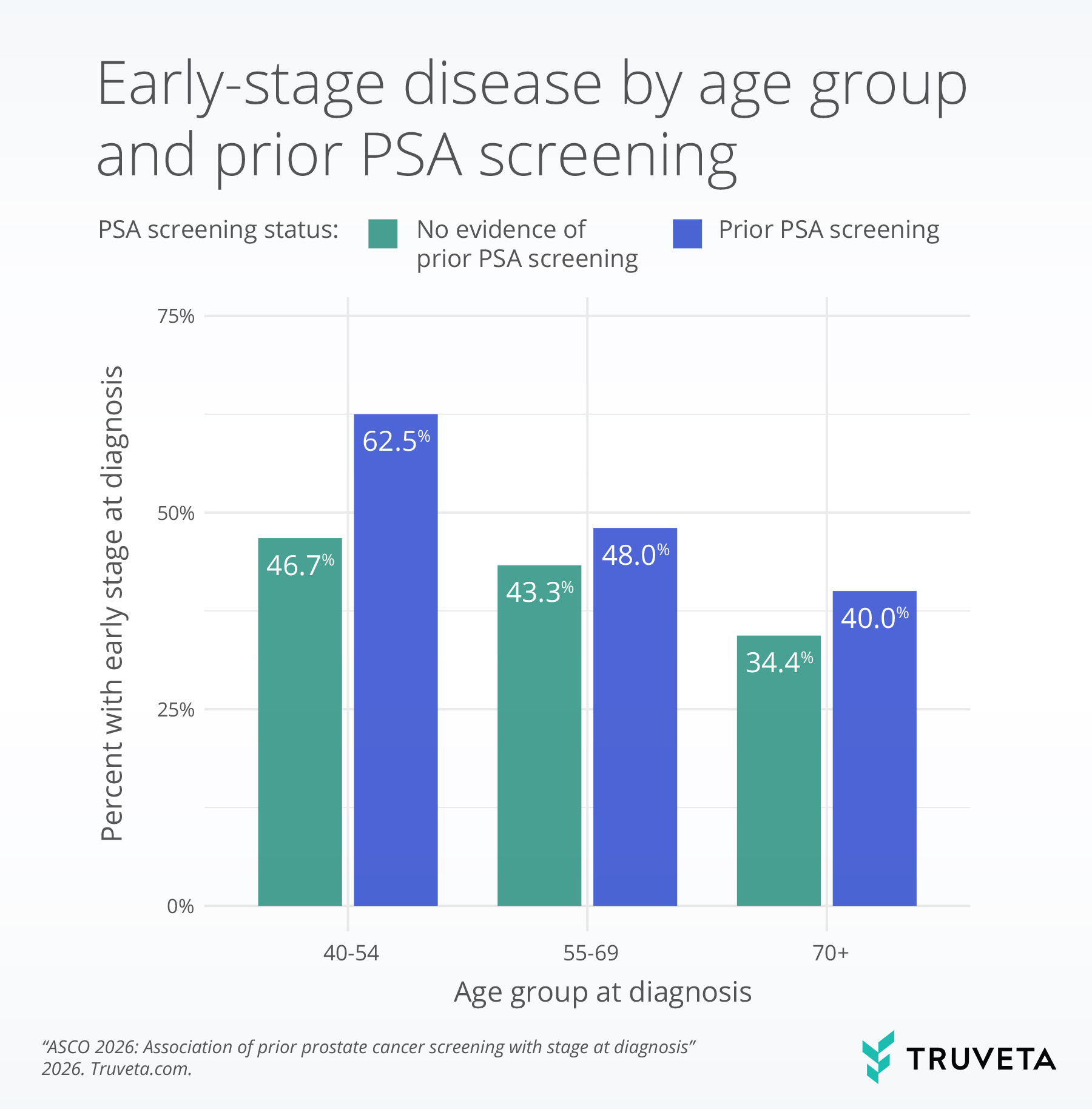
- Patients with prior PSA screening were more likely to be diagnosed at an early stage compared to those without prior screening (42.8% vs 37.6%). This was consistent across all age groups, including those outside routine screening recommendations.
Prostate-specific antigen (PSA) screening sits at the center of one of the most nuanced debates in preventive care: what is the correct balance of the potential benefit of detecting cancer early with the risks of overdiagnosis and overtreatment? While PSA screening has been shown to reduce prostate cancer mortality, it also increases the detection of low-risk cancers that may never progress, exposing patients to unnecessary biopsies and treatment-related complications (1–5). As a result, modern screening recommendations emphasize a shared decision-making approach, where patients should consult with their doctors to navigate the consideration and tradeoffs of both benefits and harms (6–8).
The US Preventive Services Task Force (USPSTF) previously recommended against PSA screening for all men in 2012, before updating its guidance in 2018 to support shared decision-making for men aged 55–69 years while continuing to recommend against routine screening in men aged 70 years or older (6, 7). Meanwhile, the American Cancer Society suggests that discussions about screening may begin at age 40 for individuals at higher risk of developing prostate cancer (8).
Prior research found that PSA screening rates declined following the 2012 USPSTF recommendations, and correspondingly, advanced-stage prostate cancer diagnoses increased relative to early-stage diagnoses (9, 10). More recent evidence suggests that PSA screening began to increase again after the 2018 USPSTF recommendations supporting shared decision-making, reversing prior downward trends (11, 12). However, less is known about how prior PSA screening relates to stage at diagnosis following these more recent changes in screening practices.
In this study, we used Truveta Data to evaluate whether prior PSA screening is associated with earlier stage at first prostate cancer diagnosis. We also examined whether this relationship differed across age groups, including those for whom routine screening is not generally recommended.
Methods
We conducted a retrospective cohort study using a subset of Truveta Data, identifying adults aged 40 years and older with a first recorded prostate cancer diagnosis between 2018 and 2025. We required patients to have at least one outpatient visit in the year prior to the diagnosis date, and in years two or three prior to ensure sufficient longitudinal data. We excluded patients with evidence of any cancer diagnosis or treatment prior to their prostate cancer diagnosis.
Stage at diagnosis was extracted from clinical notes within 90 days of the first prostate cancer diagnosis date and categorized as early stage (I–II) or advanced stage (III–IV). Prior PSA screening was defined as any PSA test recorded between three years and six months before diagnosis, a window selected to distinguish routine screening from diagnostic workup related to the diagnosis.
We compared the distribution of stage at diagnosis between patients with and without prior PSA screening, both overall and by age group (40–54, 55–69, and ≥70 years). We used a logistic regression to examine the odds of being diagnosed at an earlier stage based on whether patients had prior PSA screening, while accounting for other factors, including age, race, ethnicity, rural versus urban residence, comorbidity burden (Elixhauser index), and year of diagnosis. In this context, an odds ratio (OR) greater than 1 indicates a higher likelihood of early-stage diagnosis.
Results
Study population
This study evaluated an analytic cohort of 7,996 patients selected from more than 1.2 million men with a prostate cancer diagnosis in Truveta. Overall, 54.6% of patients had evidence of prior PSA screening between three years and six months before diagnosis.
Forty percent of patients (n =3,230 patients) had an early-stage diagnosis within 90 days of diagnosis, compared to 59.6% (4,766 patients) with advanced-stage disease.
Prior PSA screening and stage at diagnosis
Patients with evidence of prior PSA screening were significantly more likely to be diagnosed at an early stage compared to those without prior screening (42.8% vs 37.6%; OR 1.52, 95% confidence interval [CI] 1.37–1.68), even when accounting for demographic and clinical characteristics.
Prior PSA screening and stage at diagnosis by age
The association between prior PSA screening and earlier-stage diagnosis was consistent across age groups; early-stage disease was more common in those with prior PSA screening, though this was only statistically significant in patients aged 55-69 and 70+ years:
- Among patients aged 55–69 years, the group for whom shared decision-making is recommended: OR 1.43, 95% CI 1.19–1.71).
- Among patients aged 70 years and older, where routine screening is generally discouraged: OR 1.55, 95% CI 1.36–1.76).
Discussion
In this large real-world analysis, prior PSA screening was associated with a higher likelihood of early-stage prostate cancer diagnosis compared to advanced-stage. This association was observed within the guideline-supported age range of 55–69 years and among older adults aged 70 years and above (2). Although a similar pattern was observed in younger patients aged 40–54 years, the results were not statistically significant, likely due to smaller sample size.
These findings are important in the context of PSA screening practices. After screening rates declined following the 2012 USPSTF recommendations, PSA screening rates have increased in recent years after the shift toward shared decision-making in 2018 (9–12). While prior studies have described these population-level changes in screening, less is known about how screening relates to stage at diagnosis in this more recent period. Our results extend these observations by demonstrating that, at the patient level, individuals with prior PSA screening are more likely to be diagnosed at an earlier stage.
Stage at diagnosis is clinically important, as earlier-stage cancers are more likely to be localized and easier to treat, while later-stage disease is associated with more intensive treatment and worse outcomes . Our findings suggest that prior screening may influence when prostate cancer is detected.
results should be considered alongside the known tradeoffs of PSA screening. While screening may detect cancer earlier, it can also identify slower-growing tumors that may not cause harm (4, 5). PSA levels can also rise for reasons other than cancer, including common prostate conditions or temporary changes, so an elevated result alone may not always indicate the presence of cancer (14). Additionally, patients who undergo screening may differ in healthcare engagement, which could influence both screening and diagnosis.
This study has several limitations. First, we did not evaluate downstream outcomes such as overdiagnosis or overtreatment following prostate cancer diagnosis. Second, PSA screening may not be fully captured if performed outside participating health systems. Third, we did not assess how frequently PSA screening occurred, which may influence the likelihood and timing of detection. However, this study also has several strengths, including leveraging a large, diverse dataset with detailed clinical information, including stage derived from clinical notes. By linking prior screening history to stage at diagnosis, our findings provide real-world evidence that complements population-level trends and helps inform ongoing discussions about prostate cancer screening.
These findings are consistent with data accessed on March 4, 2026.
Citations
- M. J. Roobol, I. I. De Vos, M. Månsson, R. A. Godtman, K. M. Talala, E. Den Hond, V. Nelen, A. Villers, G. Poinas, M. Kwiatkowski, S. Wyler, F. Recker, D. Puliti, G. Gorini, M. Zappa, A. Paez, M. Lujan, C. H. Bangma, T. Tammela, F. H. Schröder, S. Remmers, J. Hugosson, A. Auvinen, European Study of Prostate Cancer Screening — 23-Year Follow-up. N Engl J Med 393, 1669–1680 (2025).
- J. J. Fenton, M. S. Weyrich, S. Durbin, Y. Liu, H. Bang, J. Melnikow, Prostate-Specific Antigen–Based Screening for Prostate Cancer: Evidence Report and Systematic Review for the US Preventive Services Task Force. JAMA 319, 1914–1931 (2018).
- P. F. Pinsky, H. Parnes, Screening for Prostate Cancer. New England Journal of Medicine 388, 1405–1414 (2023).
- C. Oh, H. Kang, The Effectiveness and Harms of PSA-Based Prostate Cancer Screening: A Systematic Review. Healthcare 13 (2025).
- D. Ilic, M. Djulbegovic, J. H. Jung, E. C. Hwang, Q. Zhou, A. Cleves, T. Agoritsas, P. Dahm, Prostate cancer screening with prostate-specific antigen (PSA) test: a systematic review and meta-analysis. BMJ, k3519 (2018).
- U. P. S. T. Force, Screening for prostate cancer: US Preventive Services Task Force recommendation statement. Jama 319, 1901–1913 (2018).
- V. A. Moyer, U.S. Preventive Services Task Force, Screening for prostate cancer: U.S. Preventive Services Task Force recommendation statement. Ann Intern Med 157, 120–134 (2012).
- American Cancer Society Recommendations for Prostate Cancer Early Detection. https://www.cancer.org/cancer/types/prostate-cancer/detection-diagnosis-staging/acs-recommendations.html.
- A. Jemal, M. B. Culp, J. Ma, F. Islami, S. A. Fedewa, Prostate Cancer Incidence 5 Years After US Preventive Services Task Force Recommendations Against Screening. J Natl Cancer Inst 113, 64–71 (2020).
- C. J. Magnani, K. Li, T. Seto, K. M. McDonald, D. W. Blayney, J. D. Brooks, T. Hernandez-Boussard, PSA testing use and prostate cancer diagnostic stage after the 2012 US Preventive Services Task Force guideline changes. Journal of the National Comprehensive Cancer Network 17, 795–803 (2019).
- M. S. Leapman, R. Wang, H. Park, J. B. Yu, P. C. Sprenkle, M. R. Cooperberg, C. P. Gross, X. Ma, Changes in Prostate-Specific Antigen Testing Relative to the Revised US Preventive Services Task Force Recommendation on Prostate Cancer Screening. JAMA Oncol 8, 41–47 (2022).
- Z. Qian, X. Chen, A. P. Cole, F. Abdollah, T. K. Choueiri, A. S. Kibel, S. R. Lipsitz, H. S. Iyer, Q.-D. Trinh, Changes in Prostate-specific Antigen Screening after the 2018 United States Preventive Services Task Force Recommendations and Through the COVID-19 Pandemic. European Urology Oncology 7, 151–154 (2024).
- R. Raychaudhuri, D. W. Lin, R. B. Montgomery, Prostate cancer: a review. Jama 333, 1433–1446 (2025).
- R. B. Nadler, P. A. Humphrey, D. S. Smith, W. J. Catalona, T. L. * Ratliff, Effect of Inflammation and Benign Prostatic Hyperplasia on Elevated Serum Prostate Specific Antigen Levels. Journal of Urology 154, 407–413 (1995).