


By Emma Holler, PhD, MPH, Sr. Applied Research Scientist at Truveta
I’m excited to share new research from our team examining whether newer GLP-1 receptor agonists may be associated with fewer alcohol-related hospital visits among people with alcohol use disorder (AUD).
Interest in the potential effects of GLP-1 medications on alcohol use has grown rapidly, but rigorous evidence is still limited. When we began this work, only one randomized clinical trial had evaluated semaglutide use among people with alcohol use disorder. That early-phase study included 48 participants followed for nine weeks, highlighting the need for larger studies with longer follow-up (1).
In our study, we asked a complementary real-world question: among adults with alcohol use disorder and either type 2 diabetes or obesity, was starting semaglutide or tirzepatide associated with a lower likelihood of an alcohol-related emergency department visit or hospitalization?
Emulating clinical trials with real-world data
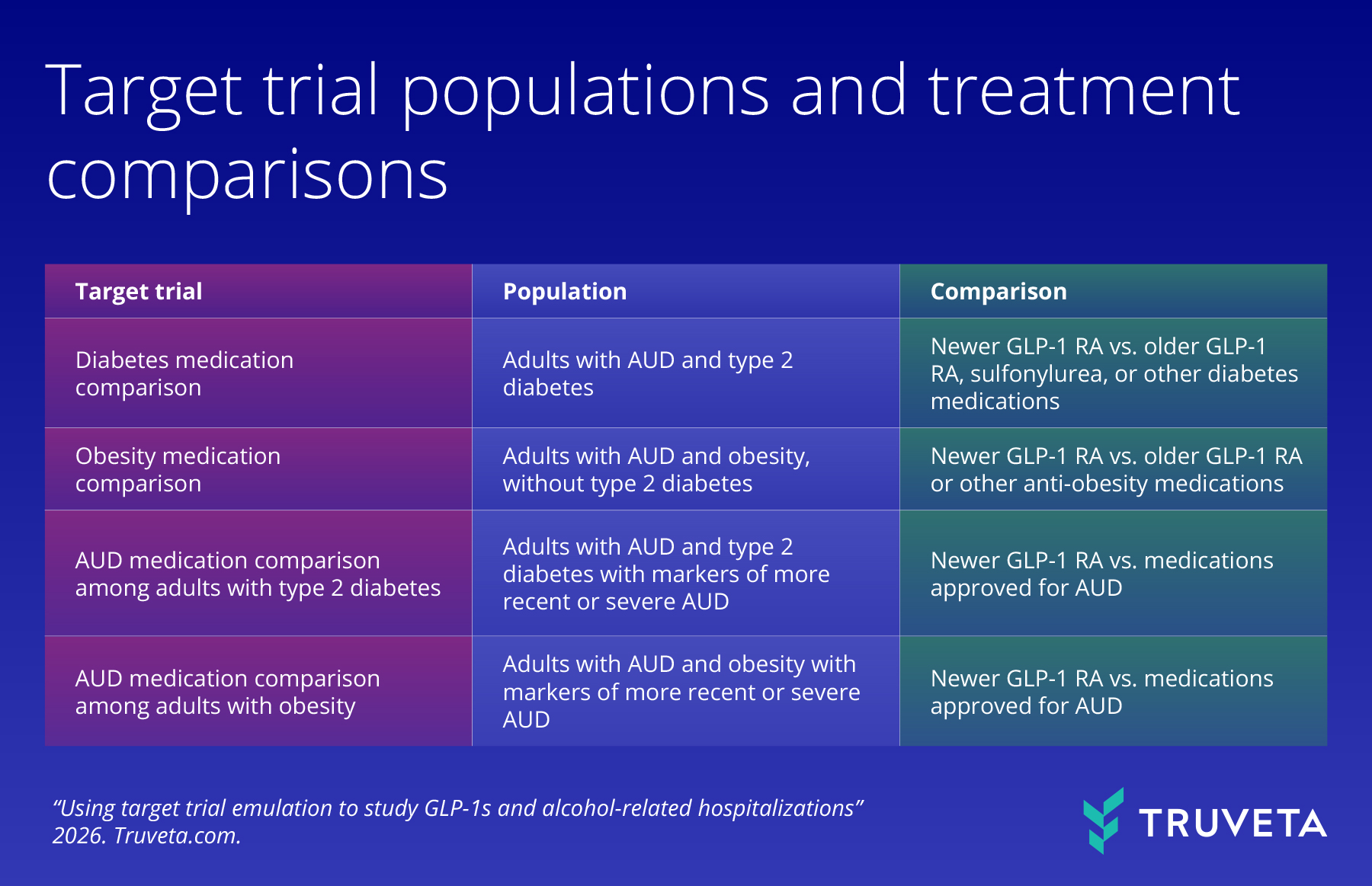
Using electronic health record (EHR) data, we emulated four target trials involving more than 40,000 US adults (2). Target trial emulation defines the randomized trial researchers would ideally conduct—including eligibility, treatments, follow-up, and outcomes—and applies that framework to observational data.
All four trials used an active-comparator, new-user design, allowing us to compare patients starting semaglutide or tirzepatide with patients starting another medication in a similar clinical context. Two trials compared these newer GLP-1 medications with other treatments for type 2 diabetes or obesity. The other two focused on adults with markers of more recent or severe alcohol use disorder and compared semaglutide or tirzepatide with medications approved for AUD: naltrexone, acamprosate, and disulfiram.
Across the trials, we used propensity score methods to balance measured differences between groups. We also used inverse probability of censoring weights to account for potentially informative censoring.
What we found
Compared with other diabetes and obesity medications, starting semaglutide or tirzepatide was associated with a 22% to 32% lower rate of alcohol-related hospitalization during the following year.
We also compared these medications with treatments approved for alcohol use disorder. Those analyses showed larger associations, but they also showed an association with our negative control outcome, which we would not expect if the results reflected a true treatment effect alone. This suggests that unmeasured differences between the treatment groups may have influenced the findings, so we interpret those estimates with caution.
This is an important reminder that observational findings should not be judged by effect size alone. Negative control outcomes can help reveal when an apparently strong association may reflect differences between treatment groups that the available data do not fully capture.
Why the study design matters
To me, one of the most important aspects of this work is the rigor that target trial emulation brings to observational research.
By aligning eligibility, treatment initiation, and the start of follow-up, this approach helps avoid common design problems that can bias retrospective studies. It also makes the question being studied more explicit and transparent by tying the analysis to a clearly defined hypothetical trial.
Target trial emulation cannot, however, create randomization or eliminate all unmeasured confounding. Our findings therefore show associations, not proof that GLP-1 medications prevent alcohol-related hospitalizations.
How Truveta enabled this research
Research of this complexity requires more than a large number of records. It requires clinically rich, longitudinal data that can support a careful study design.
Truveta Data enabled us to combine diagnoses, encounters, laboratory results, and medication dispensing data across healthcare systems. These data helped us identify treatment initiation, measure potential confounders, follow patients over time, and capture alcohol-related emergency department visits and hospitalizations. Notably, we identified treatment initiation using medication dispenses, indicating that patients filled the prescription rather than simply receiving an order.
The scale of the data was equally valuable. The previous randomized trial included 48 participants followed for nine weeks. Our study included more than 40,000 adults followed for up to 12 months, allowing us to examine a less common but clinically important outcome in a much larger and more diverse real-world population.
Although observational studies do not replace randomized trials, studying patients across multiple US healthcare systems may make the findings more relevant to the range of people seen in routine clinical practice.
Together, the scale, longitudinal follow-up, and depth of clinical information made a rigorous target trial emulation possible. While the evidence base is still developing, thoughtfully designed real-world data studies like this can help bridge the gap between early signals and the randomized trials needed to guide clinical care.
Citations:
- Hendershot CS, Bremmer MP, Paladino MB, et al. Once-Weekly Semaglutide in Adults With Alcohol Use Disorder: A Randomized Clinical Trial. JAMA Psychiatry. 2025;82(4):395–405. doi:10.1001/jamapsychiatry.2024.4789
- Rodriguez PJ, Lusk JB, Mehta HB, et al. Association between GLP-1 receptor agonists and alcohol-related hospitalisations among adults with alcohol use disorder: multi-target trial emulation study. BMJ Open 2026;16:e109259. doi: 10.1136/bmjopen-2025-109259