


Authors: Claire Campbell, PhD ⊕, Truveta, Inc, Bellevue, WA, USA Sarah Eng, MPH ⊕, Truveta, Inc, Bellevue, WA, USA Jeffrey Ratto, PhD ⊕, Truveta, Inc, Bellevue, WA, USA Katie Gilbert, MPH ⊕, Truveta, Inc, Bellevue, WA, USA Amy Austin, MHI ⊕, Truveta, Inc, Bellevue, WA, USA Ekaterina Khlystova, PhD ⊕, Truveta, Inc, Bellevue, WA, USA Sunny Guin, PhD ⊕, Truveta, Inc, Bellevue, WA, USA Vidya Venkataraman, MPH, PhD ⊕Truveta, Inc, Bellevue, WA, USA
- Adults with obesity and depression who started a GLP-1 receptor agonist had a slightly larger decrease in depression severity (PHQ-9 score) over about six months than those who started a non-GLP-1 anti-obesity medication.
- The difference between groups was statistically significant but small, and unlikely to be clinically meaningful. Longer follow-up and studies of patients with more severe baseline symptoms are needed.
This report summarizes our poster presented at ISPOR Europe 2026, titled Depression severity change following initiation of GLP-1 versus non-GLP-1 anti-obesity medications using real-world data.
GLP-1 receptor agonists are increasingly prescribed for obesity, which has raised interest in their effects on mood. Prior findings are mixed (1): some studies report a lower risk of suicidal ideation (2), while others report possible safety signals (3). Less is known about how the severity of depressive symptoms changes after patients start these medications. Electronic health record (EHR) data that include repeated Patient Health Questionnaire-9 (PHQ-9) scores make it possible to track depression severity in routine care while adjusting for clinical, mental health, and demographic factors.
Using a subset of Truveta Data, we compared the change in PHQ-9 scores among adults with obesity and depression who started GLP-1 versus non-GLP-1 anti-obesity medications.
Methods
Study design
We conducted a retrospective observational cohort study using de-identified EHR data from US health systems.
Study population
We included adults (18 years or older) who started a GLP-1 or non-GLP-1 anti-obesity medication between 2022 and 2024 and had not used either class in the prior 365 days. The date of medication initiation was the index date.
Eligibility
Patients needed an obesity diagnosis or a BMI of at least 30 kg/m² within 180 days before index and a depression diagnosis within 365 days before index. They also needed a baseline PHQ-9 score within 180 days before index and a follow-up PHQ-9 score 120–270 days after index (the score closest to day 180 was used).
We excluded patients with diabetes or pregnancy before index or during follow-up, and patients who switched treatment groups during follow-up.
Outcome
The primary outcome was change in PHQ-9 score (follow-up minus baseline), where negative values indicate improvement.
Analysis
We used multivariable linear regression to estimate the adjusted difference between groups. The model adjusted for:
- demographics, year of initiation, and Census division
- baseline PHQ-9 score, days between PHQ-9 scores, and baseline BMI
- mental health conditions and psychiatric medications
- healthcare use and other clinical conditions
In a sensitivity analysis, we excluded influential observations.
Results
Depression severity decreased modestly in both groups
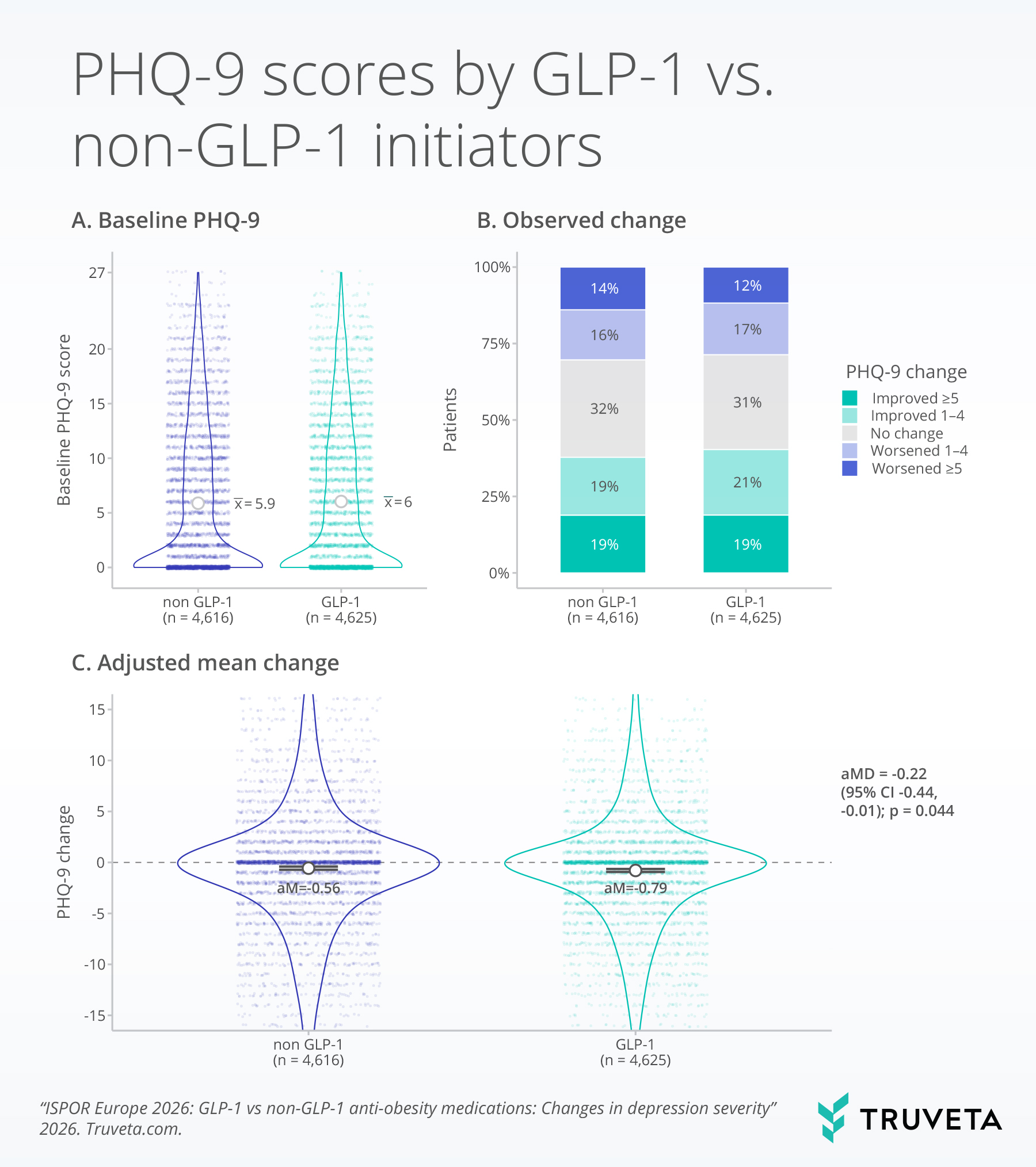
The final population included 9,241 patients: 4,625 GLP-1 initiators and 4,616 non-GLP-1 initiators. Mean age was 48.6 years among GLP-1 initiators and 45.7 years among non-GLP-1 initiators. Most patients were female (85.7% and 91.2%, respectively). Mean baseline BMI was 39.6 and 38.2 kg/m². Mean baseline PHQ-9 scores were similar across groups (6.0 and 5.9). This indicates mild depressive symptoms, which left limited room for improvement.
After adjustment, mean PHQ-9 scores decreased by 0.79 points among GLP-1 initiators (95% CI: −0.93, −0.64) and by 0.56 points among non-GLP-1 initiators (95% CI: −0.72, −0.41).
Observed changes were broadly similar across groups, as shown in Figure 1 of the poster:
- About 40% of GLP-1 initiators and 38% of non-GLP-1 initiators improved by at least one point
- 31% and 32% had no change
- 29% and 30% worsened
PHQ-9 scores decreased slightly more among GLP-1 initiators
Starting a GLP-1 was associated with a 0.22-point greater decrease in PHQ-9 score compared with starting a non-GLP-1 medication (95% CI: −0.44, −0.01; p = 0.044). The difference was statistically significant but well below a clinically meaningful change on the PHQ-9 scale (4).
After we excluded 594 influential observations, the difference was smaller (−0.17 points) but remained statistically significant (95% CI: −0.33, −0.001; p = 0.048).
Discussion
In this real-world cohort of adults with obesity and depression, depression severity decreased modestly over about six months after patients started either a GLP-1 or a non-GLP-1 anti-obesity medication. GLP-1 initiators had a slightly greater decrease in PHQ-9 score. However, the difference was small, became smaller when influential observations were excluded, and was unlikely to be clinically meaningful. Because patients had mild symptoms at baseline, there was limited room for improvement.
Future research should focus on patients with more severe depressive symptoms at baseline and use longer follow-up. This would help show whether these modest differences persist or lead to clinically meaningful improvements over time.
Data are constantly changing and updating. These findings are consistent with data analyzed for the ISPOR 2026 study.
A note on terminology: We use the term “obesity” because it is the field’s standard clinical term, applied in person-first form per NIH guidelines; we acknowledge that this language can be experienced as stigmatizing and that terminology around body weight continues to evolve (5).
Citations
- Sa, A. Maristany, A. Subramaniam, et al., Psychiatric effects of GLP-1 receptor agonists: a systematic review of emerging evidence. Diabetes Obes Metab. 28, 50–59 (2026).
- Wang, N. D. Volkow, N. A. Berger, P. B. Davis, D. C. Kaelber, R. Xu, Association of semaglutide with risk of suicidal ideation in a real-world cohort. Nat Med. 30, 168–176 (2024).
- Schoretsanitis, S. Weiler, C. Barbui, E. Raschi, C. Gastaldon, Disproportionality analysis from World Health Organization data on semaglutide, liraglutide, and suicidality. JAMA Netw Open 7, e2423385 (2024).
- Kroenke, Enhancing the clinical utility of depression screening. CMAJ 184, 281–282 (2012).
- National Institutes of Health, Obesity and People with Higher Weight. NIH Style Guide (2025). https://www.nih.gov/nih-style-guide/obesity-people-higher-weight.