


- Syntactic and semantic normalization are essential for aggregating and analyzing cancer staging data for research purposes.
- Using large-scale, real-world cancer staging data extracted from clinical notes by a large language model, we demonstrate our process for making these data available for health system, academic, government, and life science researchers in a consistent and research-ready format.
This report is an extension of our poster presented at AMIA 2026, titled Syntactic and Semantic Normalization of 2.5M Cancer Staging Records.
Patient clinical notes contain a wealth of oncology data, including cancer staging, that is increasingly accessible via large language models (LLMs). However, such data must be syntactically and semantically normalized to enable aggregation with data from structured sources and large-scale analysis. Here we describe our approach for normalizing cancer staging data extracted by our internal LLM, TLM-Oncology (1), for a subset of oncology patients within Truveta Data (2). For this subset, TLM-Oncology extracted cancer staging data across all solid tumors with a precision of 0.94 to 0.99 and recall of 0.73 to 0.92 (depending on attribute), after which extracted representations underwent syntactic and semantic normalization.
Syntactic normalization
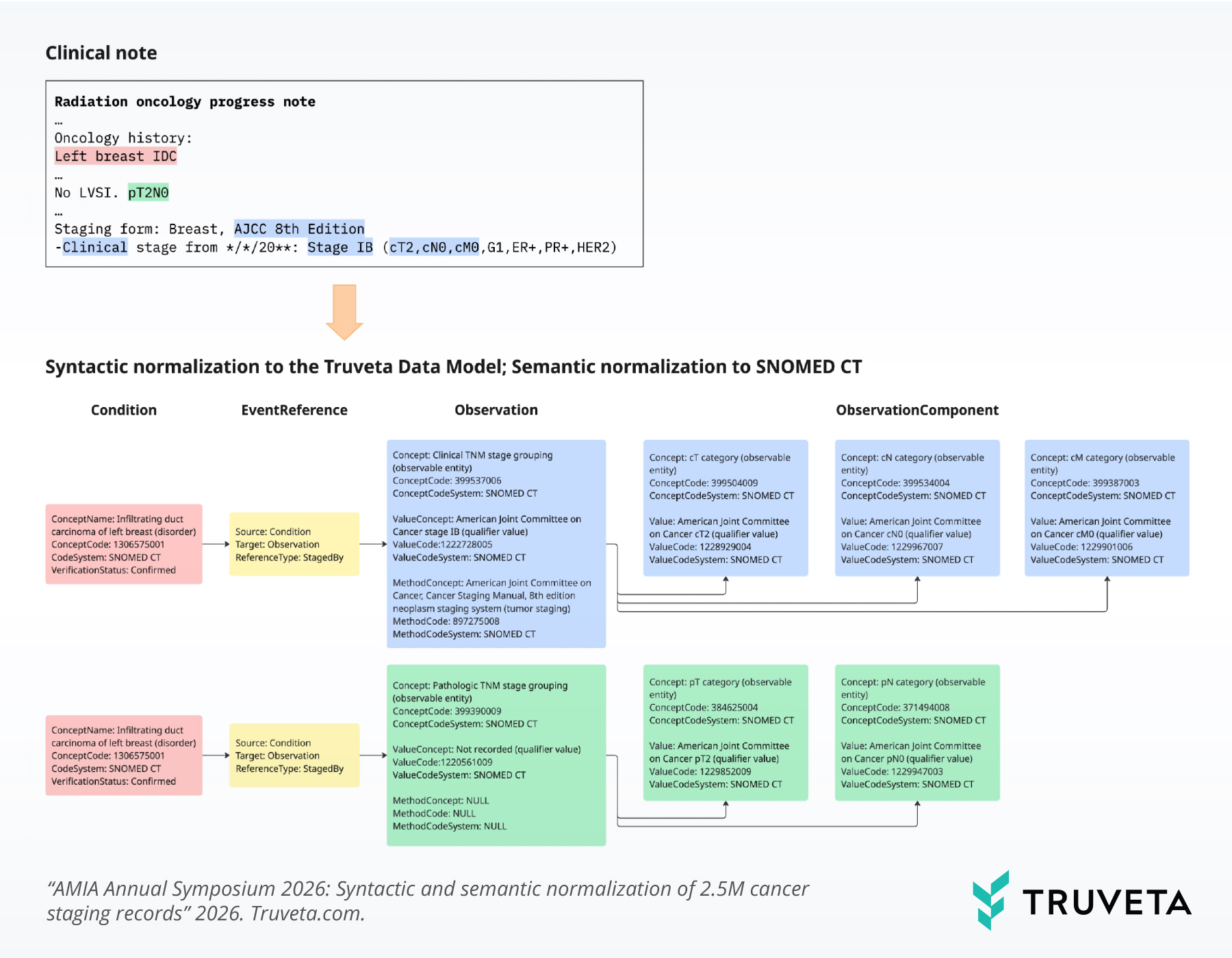
The Truveta Data Model (TDM) is based on the HL7 FHIR (3) and OMOP (4) common data models. Like FHIR, TDM contains multiple resources, such as Condition, Observation, and Observation Component. For staging, we developed a syntactic model based on the mCODE framework (5). Each staging-related attribute, including overall stage, T, N, and M values, and the associated cancer condition, is stored independently but linked together to retain the full meaning.
Semantic normalization
The extracted data were semantically normalized to SNOMED CT concepts (6). Cancer conditions were primarily normalized to disorder concepts; overall stage and T, N, and M type to observable entity concepts; and their corresponding values to qualifier concepts. Different observable entity and qualifier concepts were used depending on whether the staging system (e.g., AJCC) and/or type (e.g., clinical) were available and extracted from the text. We normalized to the most specific standard code concepts available based on the information extracted. Figure 1 illustrates an end-to-end example of fully normalized staging data extracted from text.
Results
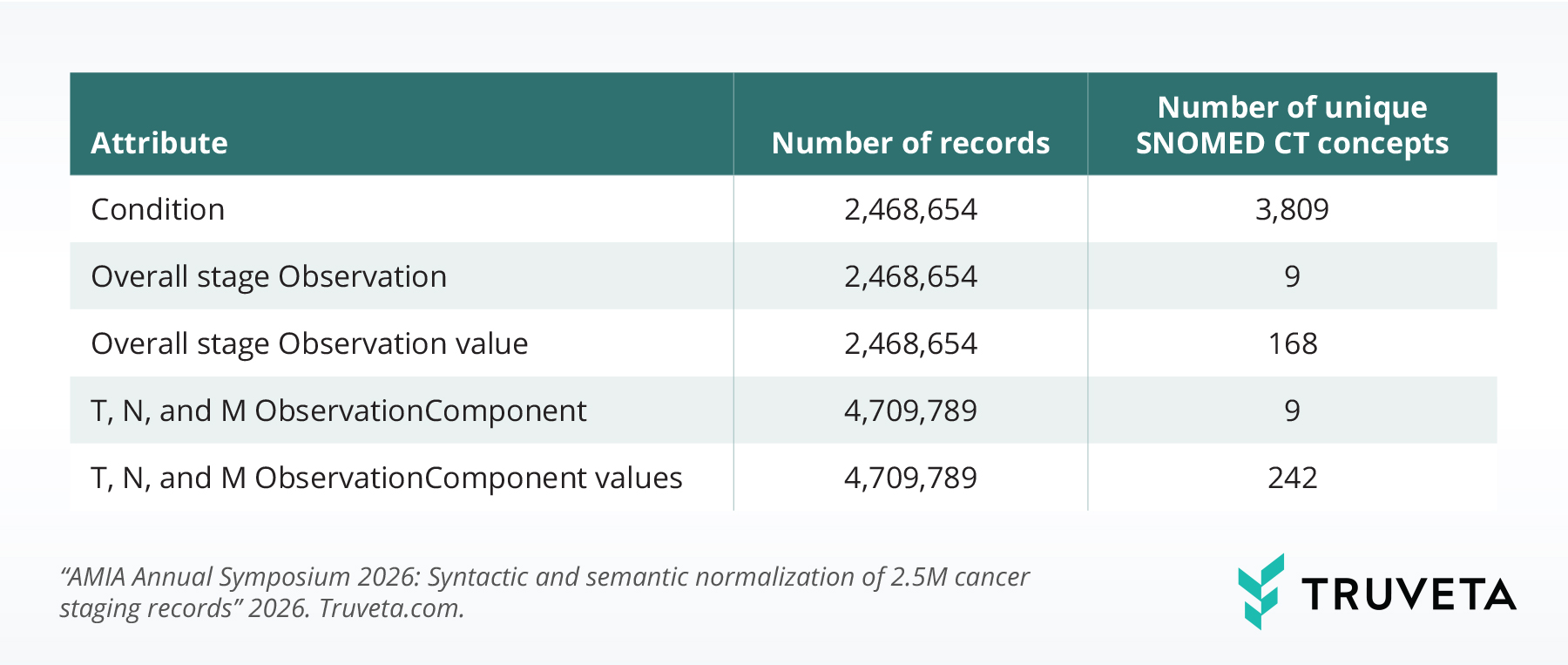
We normalized 2,468,654 unique cancer staging records extracted from 1,943,794 notes across 211,884 patients, representing a subset of Truveta’s oncology population. This corresponded to an average of approximately 11.7 staging records and 9.2 notes per patient. The table below shows the record count for each attribute and the corresponding number of unique SNOMED CT concepts. The data demonstrated considerable clinical and terminological diversity, spanning 3,809 unique condition concepts and 410 distinct staging values, including 168 overall stage values and 242 T, N, and M values.
Discussion
We built a fully normalized cancer staging data set consisting of ~2.5 million records extracted from nearly two million clinical notes using TLM-Oncology. Using federal health IT industry standards, we demonstrated a successful approach for syntactic and semantic normalization of staging data extracted from unstructured notes for use in clinical research. We are now expanding this work to additional oncology concepts, including metastasis, tumor grade, tumor markers, treatments, and response to treatment, to create a more comprehensive set of research-ready cancer variables.
Citations
- Truveta, Inc. Truveta Data: Powering real-time insights [Internet]. Bellevue, Washington; c2025 [cited 2025 Dec 15]. Available from: https://www.truveta.com/truveta-data
- Abhyankar S et al. Large language models to extract cancer staging data from clinical documentation at scale. JCO Clin Cancer Inform. 2026;10:e2500388. doi:10.1200/CCI-25-00388
- Health Level Seven (HL7). HL7 Fast Healthcare Interoperability Resources (FHIR) [Internet]. Ann Arbor (MI): HL7; 2025 [cited 2026 Mar 5]. Available from: https://www.hl7.org/fhir/
- Observational Health Data Sciences and Informatics (OHDSI). OMOP Common Data Model [Internet]. New York (NY): OHDSI; [cited 2026 Mar 5]. Available from: https://ohdsi.github.io/CommonDataModel/
- Health Level Seven International. mCODE: Minimal Common Oncology Data Elements Implementation Guide [Internet]. Ann Arbor (MI): HL7; 2025 [cited 2026 Mar 5]. Available from: https://hl7.org/fhir/us/mcode/
- U.S. National Library of Medicine. SNOMED CT US Edition [Internet]. Bethesda (MD): National Library of Medicine; 2025 [cited 2026 Mar 5]. Available from: https://www.nlm.nih.gov/healthit/snomedct/us_edition.html