


Approval is one of the most important milestones for a new drug or device, but it’s only the beginning of the story. What happens next, including who starts it, who stays on it, what drives patient behavior, and how practice shifts in real time as guidelines, labels, and evidence evolve, continuously plays out in everyday care. Billing-derived sources can capture some of that insight, but often months later and without the clinical detail behind it.
With daily updated EHR data, including labs, vitals, dispense, device records, and more, along with visibility into de-identified clinical notes, Truveta helps teams see what’s changing now and understand why. This roundup highlights recent research using Truveta Data to observe how drugs, devices, and guidelines are adopted in clinical practice, from before launch to early uptake and ongoing use.
Plan: Size the opportunity before launch
Before a launch, teams need to know how large the clinically relevant population really is, how it’s treated today, and which early signals point to demand.
Robotic-assisted knee replacement: Seeing the true size of a market
Use of robotic assistance in knee replacement nearly tripled between 2018 and 2026, rising from 12.4% of procedures to 36.1%. Many studies rely on billing codes to identify robotic surgery, but those codes miss a meaningful share of procedures. Because Truveta Data includes device documentation recorded during surgery, researchers could see robotic procedures that billing codes alone would not capture. Billing codes missed about two in five of the robotic-assisted procedures identified in Truveta Data. For device teams, relying on billing codes alone would substantially understate the size of the market.
Launch: Monitor uptake as it unfolds
The first months after approval are when teams have the most room to shape a launch. With data available within days of encounters, they don’t have to wait for lagging reports or billing-derived sources to understand trends.
The Wegovy pill: An early read on who a new therapy is reaching
When the FDA approved the Wegovy pill for obesity in December 2025, a key question was whether it would bring new patients into treatment or mostly move existing patients off injections. Within seven weeks, Truveta Research had an early answer. More than a third of patients starting the pill had never taken a GLP-1, and most of the rest had switched from injectables such as Wegovy and Zepbound. When the Foundayo pill followed in April 2026, the same analysis showed a similar pattern. More than 2 in 5 patients were new to GLP-1s, and more than 90% of prescriptions came from primary care.
→ Read the Wegovy pill uptake report · Read the Foundayo pill uptake report
Reach: See where early use is happening
A single adoption rate rarely tells the whole story. Breaking prescriptions and dispensing down by region, clinician type, or precise patient population often shows teams a more accurate picture of where to focus next.
Rituximab biosimilars: Same therapy, very different regional uptake
Rituximab biosimilars have steadily gained ground since their introduction. Using Truveta Data, researchers found that by 2025, three in four patients received biosimilars exclusively, compared with just over half in 2021. Adoption was far from even across the country, however. Biosimilar-only use reached 82% in both the Midwest and West by 2025 but remained at 55% in the Northeast. For biosimilar manufacturers, gaps like this show where the opportunity remains.
→ Read the rituximab biosimilar study
IUD pain management: How new guidance reaches practice
In August 2024, the CDC began recommending lidocaine for pain relief during IUD insertion. In a study of more than 286,000 IUD insertions published in Contraception, Truveta Research found that the odds of receiving lidocaine rose 18% after the guidance. Even so, 95% of patients had no documented pain medication on the day of the procedure in 2025. Practice also varied by clinician. Procedures performed by male providers were associated with a 10% lower likelihood of documented pain relief. Details like these help medical affairs teams see where education could make the biggest difference.
Persistence: Understand why patients stop, start, or stay
Starting a therapy is only one decision. Whether patients stay on it depends on side effects, cost, coverage, the logistics of care, or other environmental factors, and those reasons rarely show up in prescription or billing data alone.
GLP-1s: What clinical notes add
GLP-1 medications are among the most widely prescribed drugs in the country, yet many patients don’t stay on them. A study published in JAMA Network Open found that about half of patients with type 2 diabetes and nearly two-thirds of those without it stopped their GLP-1 within a year. Many later restarted. Patients who lost more weight were more likely to stay on treatment, while those with serious gastrointestinal side effects were more likely to stop.
Combining dispensing data, weight measurements, and de-identified clinical notes made it possible to see not just who stopped, but why. The figure below highlights reasons for stopping GLP-1 medications, as documented in clinical notes. Side effects and cost were the most common reasons, and the mix of reasons differed between patients with and without type 2 diabetes.
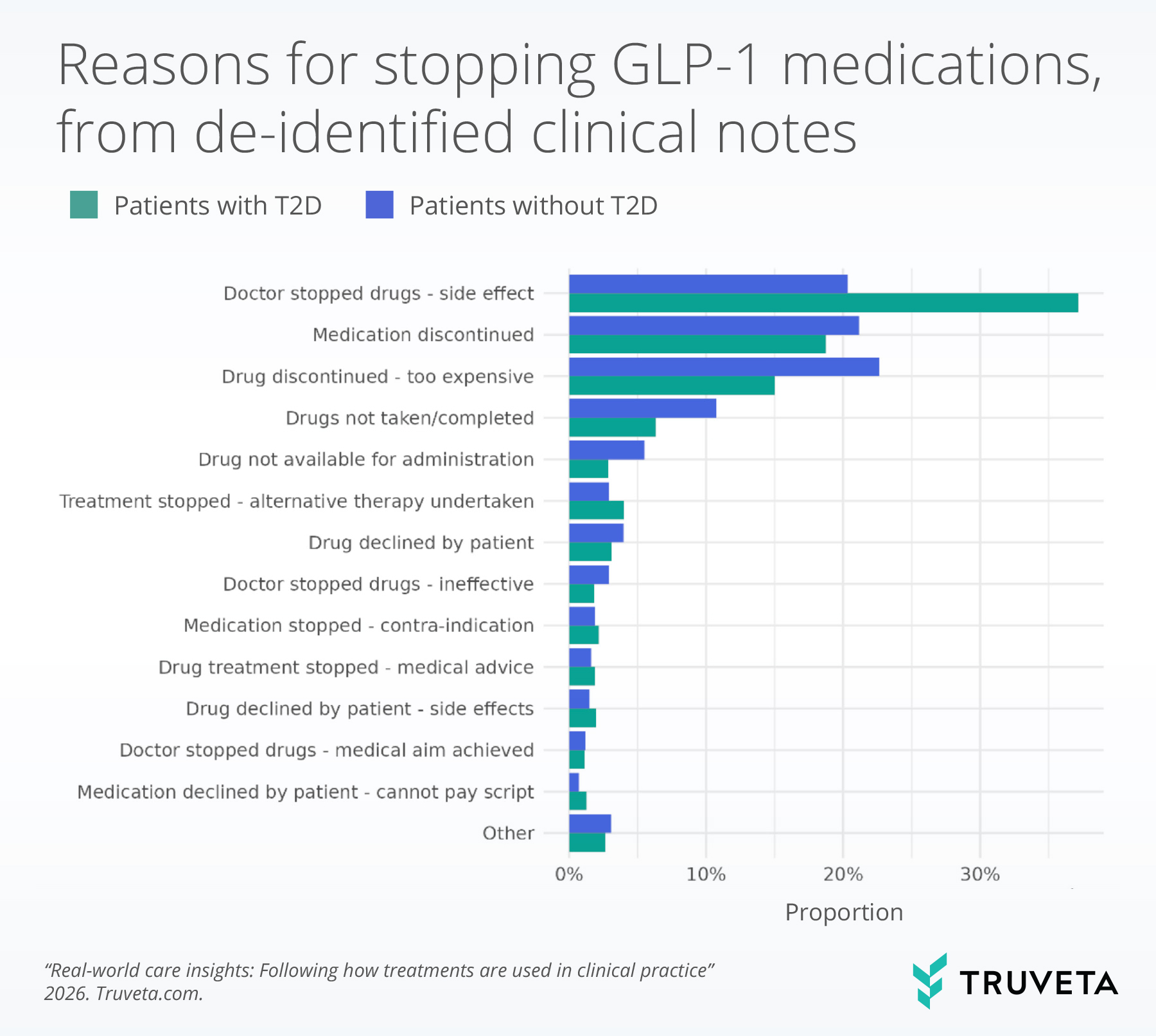
Adapted from Rodriguez et al., JAMA Network Open, 2025.
Lecanemab: Staying on treatment as care teams gain experience
Lecanemab, approved in 2023, was among the first Alzheimer’s therapies shown to slow cognitive decline. It also requires infusions every two weeks and regular MRI monitoring, raising early questions about whether patients could stay on it. Truveta Research found that adherence improved as care teams gained experience, rising from 16.7% of patients who started treatment in 2023 to 64.5% in 2025.
Earlier Truveta research also saw signs of demand before prescribing took off, as APOE genetic testing—recommended before starting lecanemab—rose sharply after approval.
→ Read the lecanemab adherence and MRI monitoring report · Read the APOE testing report
Practice change: See how care shifts as evidence evolves
New trial results, label updates, and guidelines can all change how a therapy should be used. Real-world data show how quickly that change happens in practice, and for which patients.
HeartMate 3 and aspirin: Tracking a label change
After the ARIES-HM3 trial showed that aspirin could be safely omitted for patients with the HeartMate 3 heart pump, the FDA updated the label in 2024. A study published in the Journal of Cardiac Failure showed that aspirin use fell from about 90% of patients in 2023 to about 53% in 2025, and clinicians were more likely to keep it for patients with established vascular disease.
→ Read the PRAISE HM3 study in the Journal of Cardiac Failure
Hormone therapy: Prescribing rises as the label changes
Hormone therapy for menopause fell out of favor in the early 2000s amid safety concerns. As the evidence evolved, the FDA removed black box warnings from certain hormone therapy products in November 2025. Truveta Research found that estrogen-based prescribing more than doubled from 2018 to 2026, with the largest growth among women aged 45–54. The way it’s prescribed is changing, too. Patches and vaginal creams are increasingly favored over pills.
Gain care insights as they happen
Understanding drug, device, or guideline usage is most useful when you can also see why it’s happening. If you’re planning a launch, a biosimilar transition, or a label change, Truveta can help you follow your therapy in real-world care from day one.
Explore the new care insights solution ⋅ Request a feasibility assessment
Some findings in this roundup are preliminary research findings and have not been peer reviewed. Data are regularly updating.