



- Testosterone prescribing increased steadily from 2018 to 2026 across all age groups, with the highest rates among adults aged 45–54.
- Younger adults experienced the largest relative increase: testosterone prescribing among adults aged 18–34 more than doubled from 2018 to 2026.
- Injectable testosterone dispensing increased 88% from 2018 to 2026, compared with a 27% increase in topical testosterone.
Testosterone is a sex hormone that plays an important role in sexual and reproductive function, bone health, muscle mass, and body composition. In men, testosterone therapy is recommended for the treatment of hypogonadism when testosterone deficiency is accompanied by relevant signs or symptoms (1). Clinical guidelines recommend confirming low testosterone with repeat morning measurements and evaluating patients to determine the underlying cause before initiating treatment (1, 2). Guidelines also recommend against routinely prescribing testosterone to all older men with low testosterone concentrations (3). However, in real-world practice testosterone may be prescribed in patients without a confirmed hypogonadism diagnosis (4).
Testosterone use in the United States has changed considerably over the past two decades. Prescribing increased sharply during the 2000s and early 2010s, alongside “low T” awareness campaigns and the growing availability of convenient topical testosterone formulations (5–7). In 2015, the U.S. Food and Drug Administration (FDA) required labeling changes cautioning against testosterone use for low testosterone attributed solely to aging and warning of a possible increased risk of heart attack and stroke; testosterone prescribing subsequently declined (8, 9). More recently, evidence surrounding cardiovascular safety has evolved. The 2023 TRAVERSE trial found that testosterone therapy was not associated with an increased risk of major adverse cardiovascular events compared with placebo among men with hypogonadism and preexisting or elevated cardiovascular risk (10). Based on these and other data, the FDA removed the boxed cardiovascular warning from testosterone products in 2025 (11).
Testosterone may also be used in women, including for hypoactive sexual desire disorder in appropriately assessed postmenopausal women (12, 13). This use is particularly interesting in the context of changing hormone therapy patterns among women: our prior research has found substantial recent increases in estrogen- and progesterone-based prescribing among women of menopause age following guidance changes.
Against this changing clinical landscape, it is important to understand how testosterone use has evolved in recent years. Using a subset of Truveta Data, we examined contemporary testosterone medication trends from 2018 through 2026. We evaluated how prescribing has changed over time and by age and sex and whether dispensing trends differ between injectable and topical formulations.
Methods
Using a subset of Truveta Data, we evaluated trends in testosterone medications using two complementary cohorts.
Prescribing trends
We examined monthly prescribing rates of testosterone among patients aged 18 years and older with available prescription data from 2018 to July 2026. Testosterone prescribing rates were defined as the number of people with a testosterone prescription per 1,000 people with prescription data. We also examined rates by age group and sex. Men and women were defined as identified on their electronic health record and could refer to either gender identity or sex assigned at birth.
Dispensing trends by route of administration
We examined monthly dispensing rates of testosterone by route of administration among patients aged 18 years and older with available dispensing data from 2018 to May 2026. Dispensing rates were defined as the number of people with a dispensed testosterone medication (indicating the prescription was filled at a pharmacy) per 1,000 people with dispensing data, stratified by formulation type (injectable vs. topical).
Results
Prescribing trends by age
Testosterone prescribing rates increased across age groups between 2018 and 2026, although both the magnitude of use and relative increase varied by age. Rates were consistently highest among patients aged 45–54, followed by those aged 55-64 and 35-44.
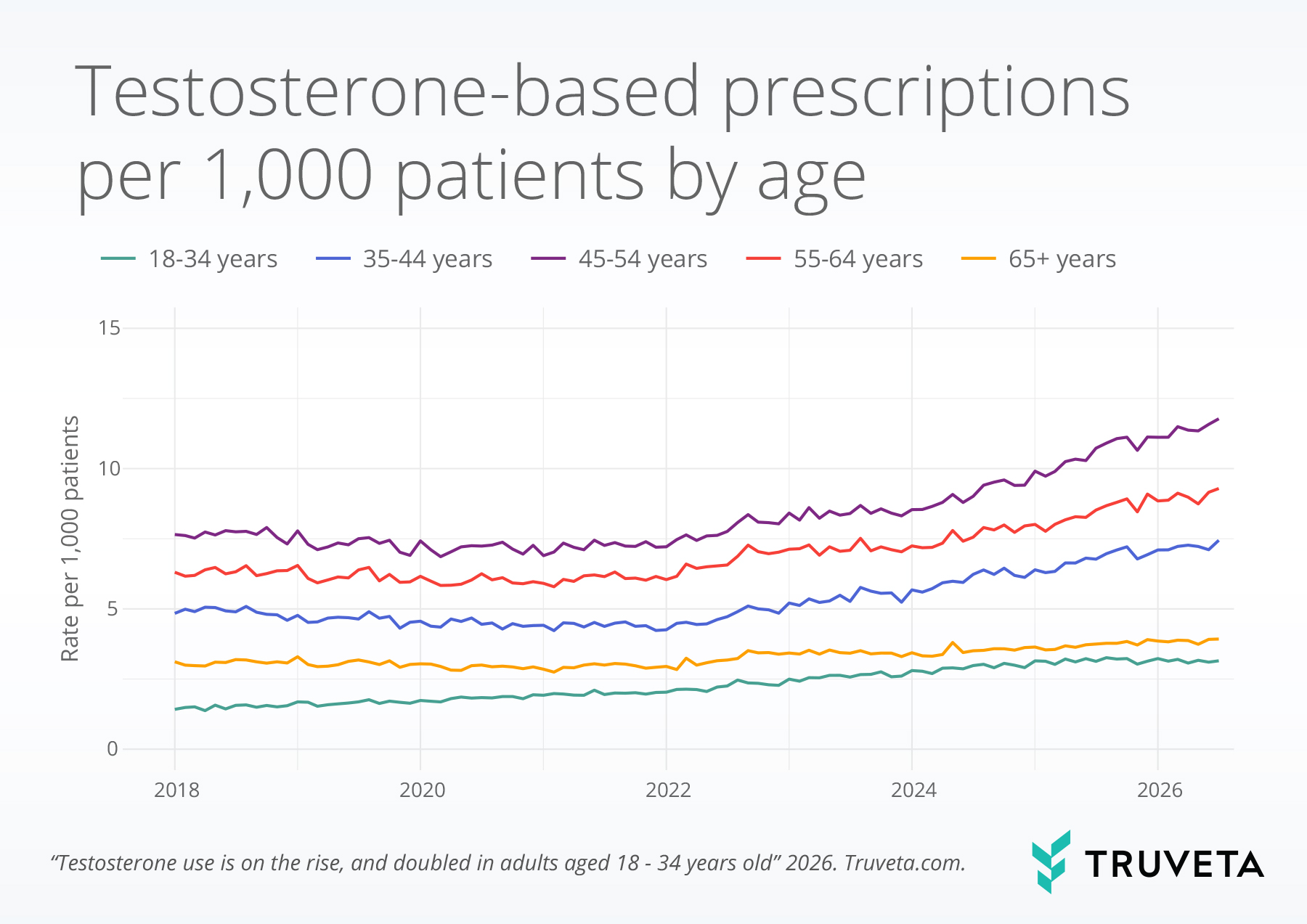
In July 2026, the prescribing rate among patients ages 45-54 was 11.8 per 1,000 patients, a 53.9% increase from 7.6 per 1,000 in January 2018. Among patients aged 55-64, the rate increased 47.3%, from 6.3 to 9.3 per 1,000. Among patients aged 35-44, the rate increased 53.8%, from 4.8 to 7.4 per 1,000.
The largest relative increase occurred among younger adults. Among patients aged 18–34, the rate increased from 1.4 per 1,000 in January 2018 to 3.2 per 1,000 in July 2026, a 121.8% increase.
Compared with July 2025, prescribing rates were relatively stable among patients aged 18–34, changing by just 0.6%. Rates increased slightly among the other age groups, with increases ranging from 4.8% among patients aged 65 and older to 9.9% among those aged 35–44.
Prescribing trends by sex
Testosterone prescribing was substantially more common among men than women throughout the study period. In July 2026, the rate among men was 13.2 per 1,000 patients, compared with 1.8 per 1,000 among women.
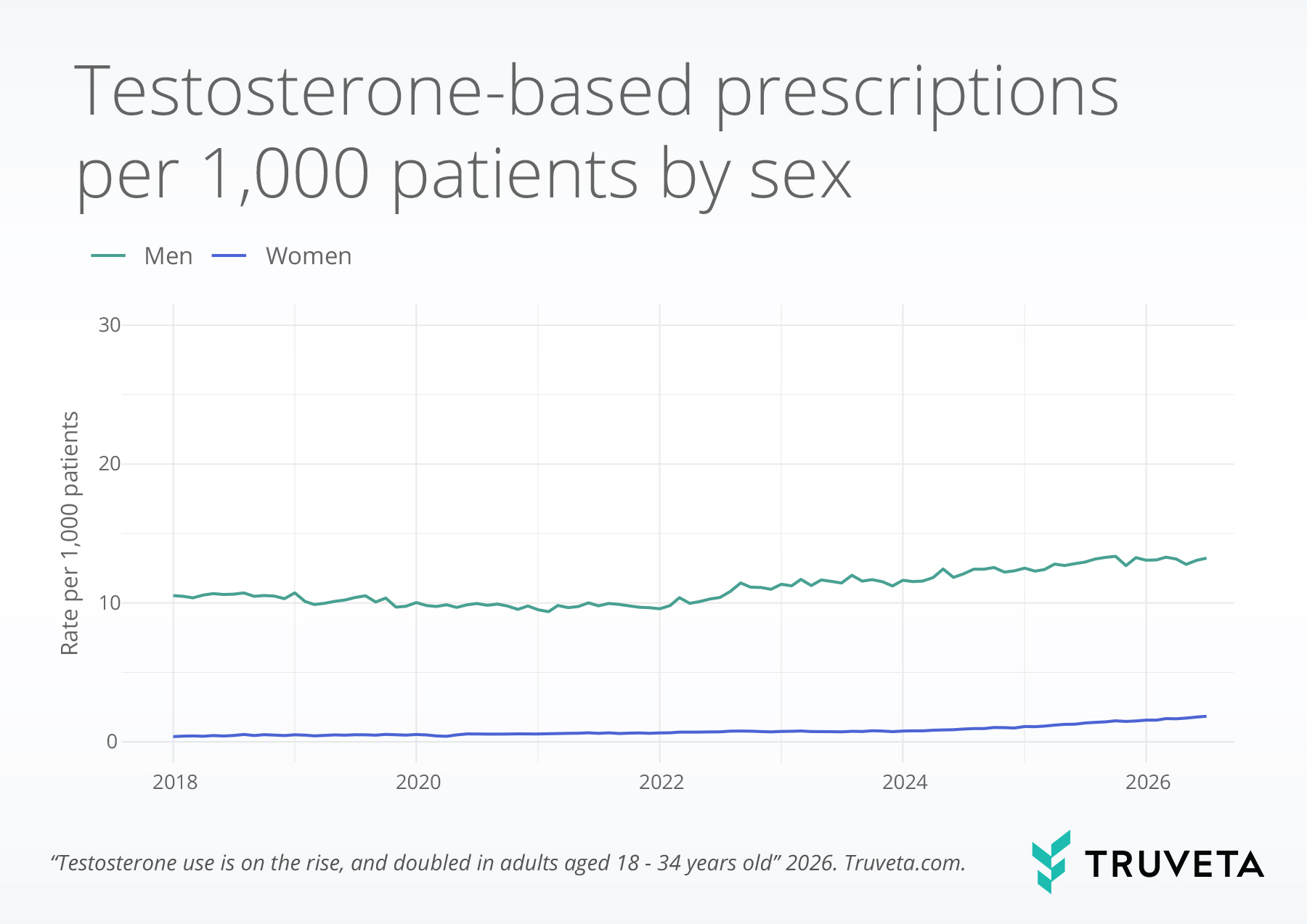
Rates increased in both groups. Among men, the prescribing rate increased from 10.5 per 1,000 in January 2018 to 13.2 per 1,000 in July 2026, a 25.6% increase. Among women, the rate increased from 0.4 to 1.8 per 1,000 over the same period, a 389.6% increase. Although the relative increase among women was substantially larger, it was driven in part by a very low starting rate; in absolute terms, prescribing increased by 1.4 per 1,000 women versus 2.7 per 1,000 men.
Dispensing trends by route of administration
Injectable testosterone had consistently higher dispensing rates than topical testosterone throughout the study period. In 2018, injectable testosterone was dispensed at a rate of 3.3 per 1,000 patients with dispensing data. By May 2026, that rate had increased to 6.2 per 1,000, an 88.0% increase.
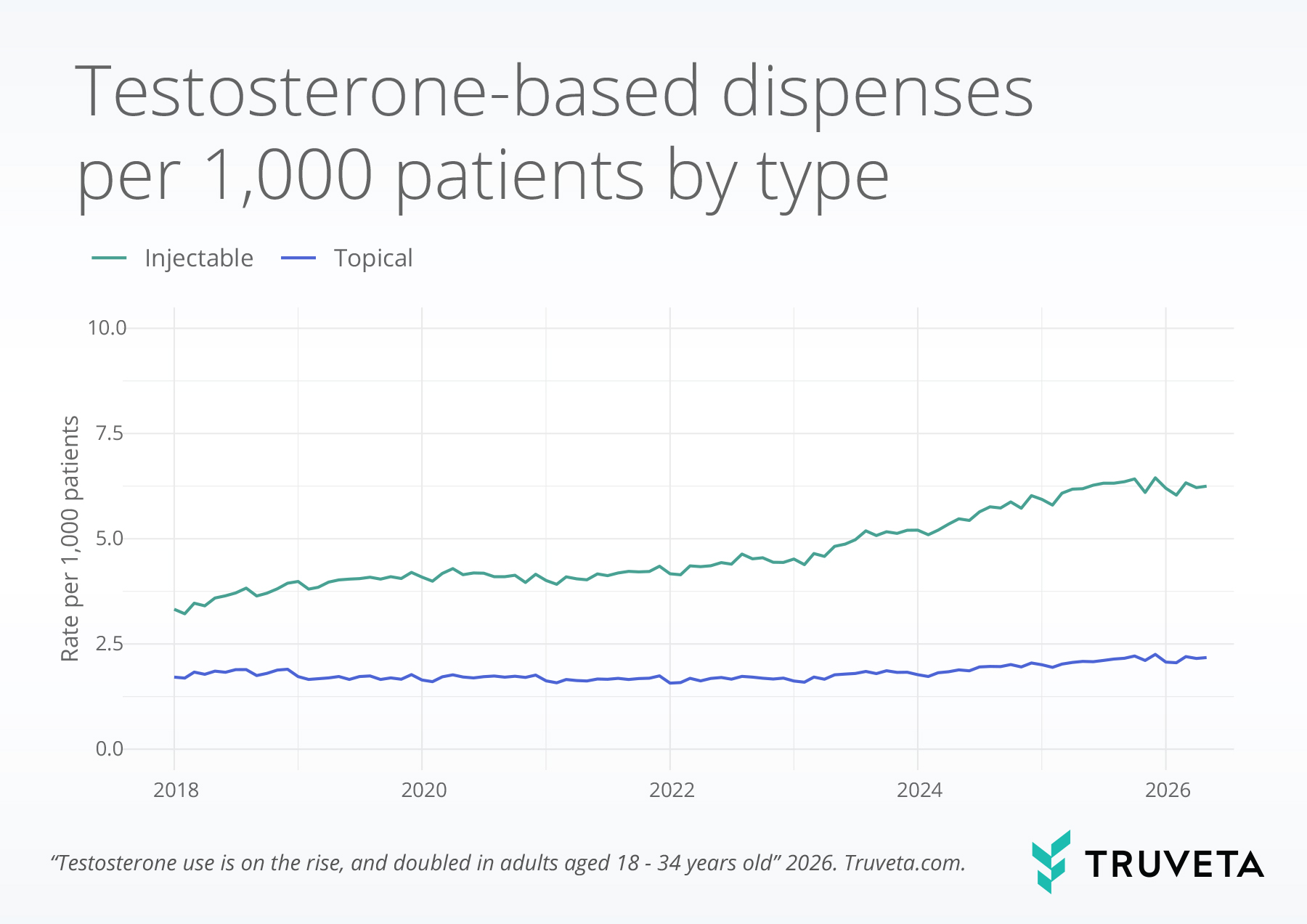
Topical testosterone dispensing changed more modestly. Rates increased from 1.7 per 1,000 patients in 2018 to 2.2 per 1,000 in May 2026, a 27.2% increase. From May 2025 to May 2026, injectable dispensing remained stable, while topical dispensing increased slightly by 4.4%.
Discussion
In this analysis of testosterone medication use between 2018 and 2026, we observed a consistent overall pattern: testosterone use has steadily increased over time. This increase was evident across age groups, among both men and women, and in both injectable and topical formulations.
These trends occurred during a period of substantial change in the testosterone treatment landscape. Following the declines in prescribing observed after FDA safety communications in the mid-2010s, accumulating evidence and regulatory actions have generally moved toward a less restrictive environment for testosterone prescribing (9). The TRAVERSE trial found no increased risk of major adverse cardiovascular events among men with hypogonadism and elevated cardiovascular risk receiving testosterone therapy, and subsequent FDA labeling updates removed both the boxed cardiovascular warning and the limitation-of-use language regarding age-related hypogonadism (10, 11, 14). More recently, the FDA proposed additional labeling revisions that could further broaden access to testosterone therapy (14). While testosterone has been shown to improve sexual function and certain quality-of-life measures among appropriately selected patients with low testosterone levels, evidence of benefit for many other age-related symptoms remains less consistent (3). Testosterone therapy also requires ongoing monitoring because treatment may increase hematocrit levels, contribute to erythrocytosis, and necessitate surveillance of prostate health through PSA testing and assessment of urinary or prostate-related symptoms (15). Although our study was not designed to evaluate the impact of specific policy or evidence changes, the timing of these developments coincides with the renewed growth in testosterone use observed across demographic groups.
The age patterns are particularly notable. Although testosterone prescribing was highest among middle-aged adults, patients ages 18–34 experienced the largest relative increase over the study period. This suggests that the contemporary growth in testosterone use extends beyond the older populations traditionally associated with declining testosterone levels. Continued monitoring of this younger population will be important, particularly because treatment decisions in younger men may involve additional considerations such as fertility and long-term exposure to therapy (2, 16, 17). Testosterone therapy can reduce sperm production and may impair fertility, making it an important consideration for men who may wish to have biological children in the future (16, 17). In addition, younger patients may remain on treatment for many years, highlighting the need for continued evaluation of the long-term benefits and risks of therapy.
We also observed an increase in testosterone prescribing among women. Although absolute rates remained markedly lower than among men, prescribing among women increased between 2018 and 2026. Testosterone may be used in women in selected circumstances, including treatment of hypoactive sexual desire disorder in appropriately assessed postmenopausal women (12, 13). This increase also occurs during a period when hormone therapy use among women appears to be changing more broadly; our prior Truveta research has identified substantial recent increases in estrogen- and progesterone-based prescribing among women of menopause age. Together, these trends highlight the value of continued monitoring of hormone therapy use among women.
Changes in formulation also provide important context. Injectable testosterone was dispensed considerably more often than topical testosterone and showed substantially greater growth. Injectable dispensing increased 88.0% between 2018 and May 2026, compared with a 27.2% increase for topical testosterone. The American College of Physicians recommends considering intramuscular rather than transdermal testosterone when initiating treatment to improve sexual function in men with age-related low testosterone, given similar clinical effectiveness and harms but substantially lower costs (3). Our findings suggest that injectable formulations are playing an increasingly large role in contemporary testosterone use among patients receiving treatment through the healthcare system.
This study has several limitations. First, we did not evaluate the clinical reason for testosterone use. Our findings therefore describe trends in prescribing and dispensing but did not determine whether testosterone was prescribed for confirmed hypogonadism, age-associated symptoms, or other reasons, or whether patients met guideline-supported criteria for treatment. Second, these data may not capture testosterone obtained entirely outside of a traditional healthcare system, including through direct-to-consumer or online prescribing and fulfillment services. Therefore, our findings may underestimate overall testosterone use. Finally, medication dispenses are incorporated into EHRs following a triggering event (e.g., a healthcare encounter or patient interaction) and may be delayed or missed if no such event occurs. Therefore, recent dispensing data may be less complete and will continue to update as additional patient interactions occur.
Despite these limitations, our findings show a clear shift in testosterone use in recent years. Testosterone prescribing has increased steadily since 2018 across age groups, including substantial relative growth among younger adults and women, while injectable formulations have experienced particularly strong growth. These findings provide an updated view of a treatment landscape that has changed considerably over the past two decades and highlight the importance of continued monitoring as clinical evidence, regulatory guidance, formulations, and pathways for accessing testosterone continue to evolve.
These are preliminary research findings and not peer reviewed. Data are regularly updating. These findings are consistent with data accessed on August 10, 2026.
Citations
- Testosterone Therapy for Hypogonadism Guideline Resources. https://www.endocrine.org/clinical-practice-guidelines/testosterone-therapy.
- Testosterone Deficiency Guideline – American Urological Association. https://www.auanet.org/guidelines-and-quality/guidelines/testosterone-deficiency-guideline.
- A. Qaseem, C. A. Horwitch, S. Vijan, I.Etxeandia-Ikobaltzeta, D. Kansagara, for the Clinical Guidelines Committee of the American College of Physicians*, Testosterone Treatment in Adult Men With Age-Related Low Testosterone: A Clinical Guideline From the American College of Physicians. Ann Intern Med 172, 126–133 (2020).
- R. D. Malik, C. E. Wang, B. Lapin, J. C. Lakeman, B. T. Helfand, Characteristics of men undergoing testosterone replacement therapy and adherence to follow-up recommendations in metropolitan multicenter health care system.Urology 85, 1382–1388 (2015).
- J. Baillargeon, R. J. Urban, K. J. Ottenbacher, K. S. Pierson, J. S. Goodwin, Trends in Androgen Prescribing in the United States, 2001 to 2011.JAMA Intern Med 173, 1465–1466 (2013).
- J. B. Layton, D. Li, C. R. Meier, J. L. Sharpless, T. Stürmer, S. S. Jick, M. A. Brookhart, Testosterone lab testing and initiation in the United Kingdom and the United States, 2000 to 2011.The Journal of Clinical Endocrinology & Metabolism 99, 835–842 (2014).
- J. B. Layton, Y. Kim, G. C. Alexander, S. L. Emery, Association between direct-to-consumer advertising and testosterone testing and initiation in the United States, 2009-2013.Jama 317, 1159–1166 (2017).
- R. A. Kloner, C. Carson, A. Dobs, S. Kopecky, E. R. Mohler, Testosterone and Cardiovascular Disease.Journal of the American College of Cardiology 67, 545–557 (2016).
- J. Baillargeon, Y.-F. Kuo, J. R. Westra, R. J. Urban, J. S. Goodwin, Testosterone Prescribing in the United States, 2002-2016.JAMA 320, 200–202 (2018).
- B. D. Anawalt, The TRAVERSE trial: cardiovascular safety of testosterone therapy for older men.The Lancet Diabetes & Endocrinology 11, 714–716 (2023).
- FDA, FDA issues class-wide labeling changes for testosterone products.FDA (2026).
- R. M. Islam, R. J. Bell, S. Green, M. J. Page, S. R. Davis,Safety and efficacy of testosterone for women: a systematic review and meta-analysis of randomised controlled trial data. The lancet Diabetes & endocrinology 7, 754–766 (2019).
- S. Bolour, G. Braunstein, Testosterone therapy in women: a review.International journal of impotence research 17, 399–408 (2005).
- O. of the Commissioner, FDA Takes Step Forward on Testosterone Therapy for Men,FDA (2026). https://www.fda.gov/news-events/press-announcements/fda-takes-step-forward-testosterone-therapy-men.
- M. Zitzmann, G. Rastrelli, R. D. Murray, D. Edwards, Y. Reisman, P. M. Rao, A. Sahi, T. H. Jones, A. Ferlin, E. Armeni, E. Corpas, J.-F. Cremers, J. David, S.Arver, L. Antonio, G. Corona, Cardiovascular safety of testosterone therapy—Insights from the TRAVERSE trial and beyond: A position statement of the European Expert Panel for Testosterone Research. Andrology 14, 294–302 (2026).
- A. S. Patel, J. Y. Leong, L. Ramos, R. Ramasamy, Testosterone is a contraceptive and should not be used in men whodesire fertility. The world journal of men’s health 37, 45–54 (2019).
- S.-H. Song, S. Sung, Y. S. Her, M. Oh, D. H. Shin, J. Lee, J. Baek, W. S. Lee, D. S. Kim, Misuse of testosterone replacement therapy in men in infertile couples and its influence on infertility treatment.Clinical and Experimental Reproductive Medicine 46, 173 (2019).