



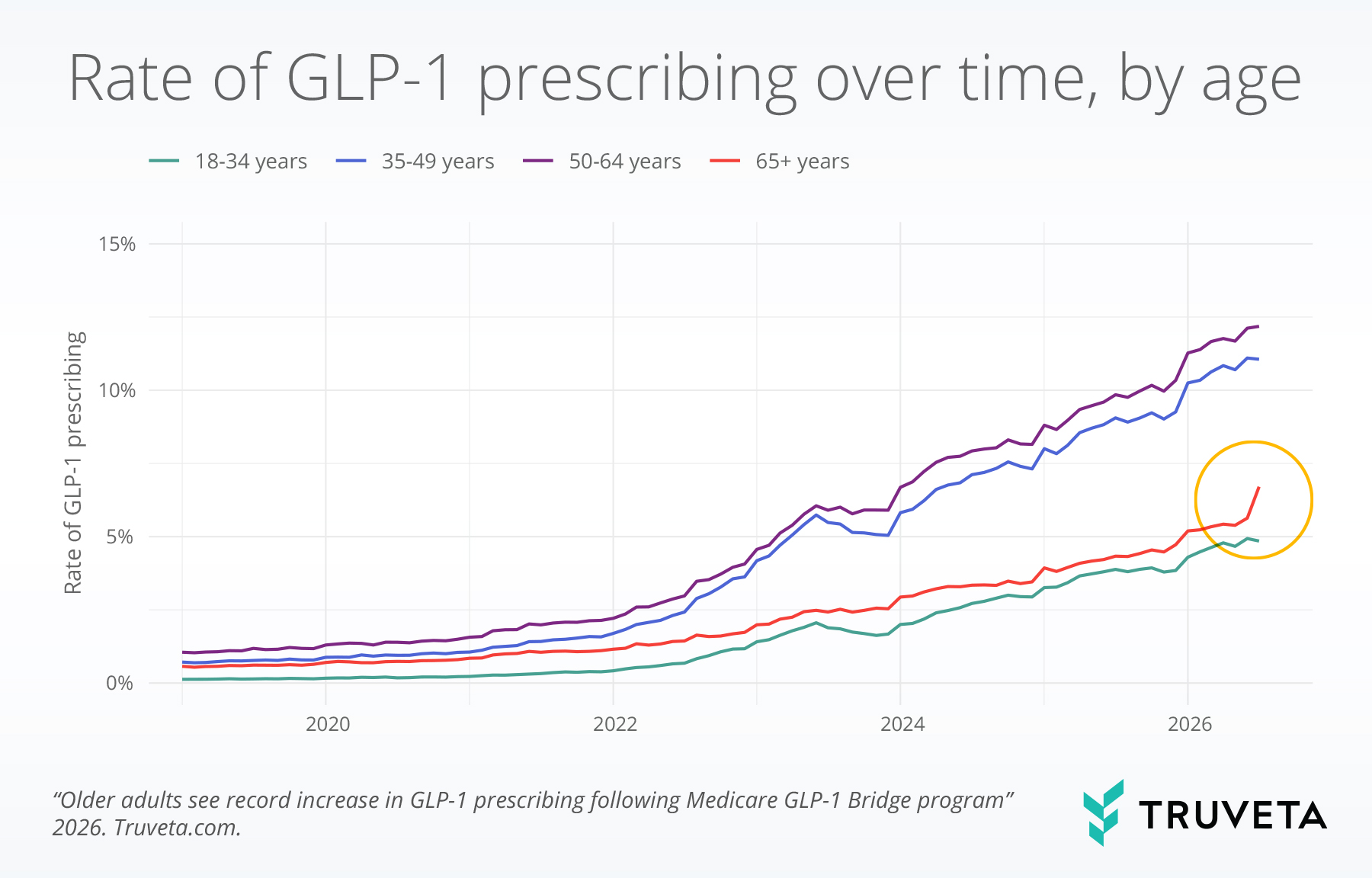
- July 2026 marked the largest month-to-month increase in GLP-1 prescribing among adults aged 65 years and older observed during the study period.
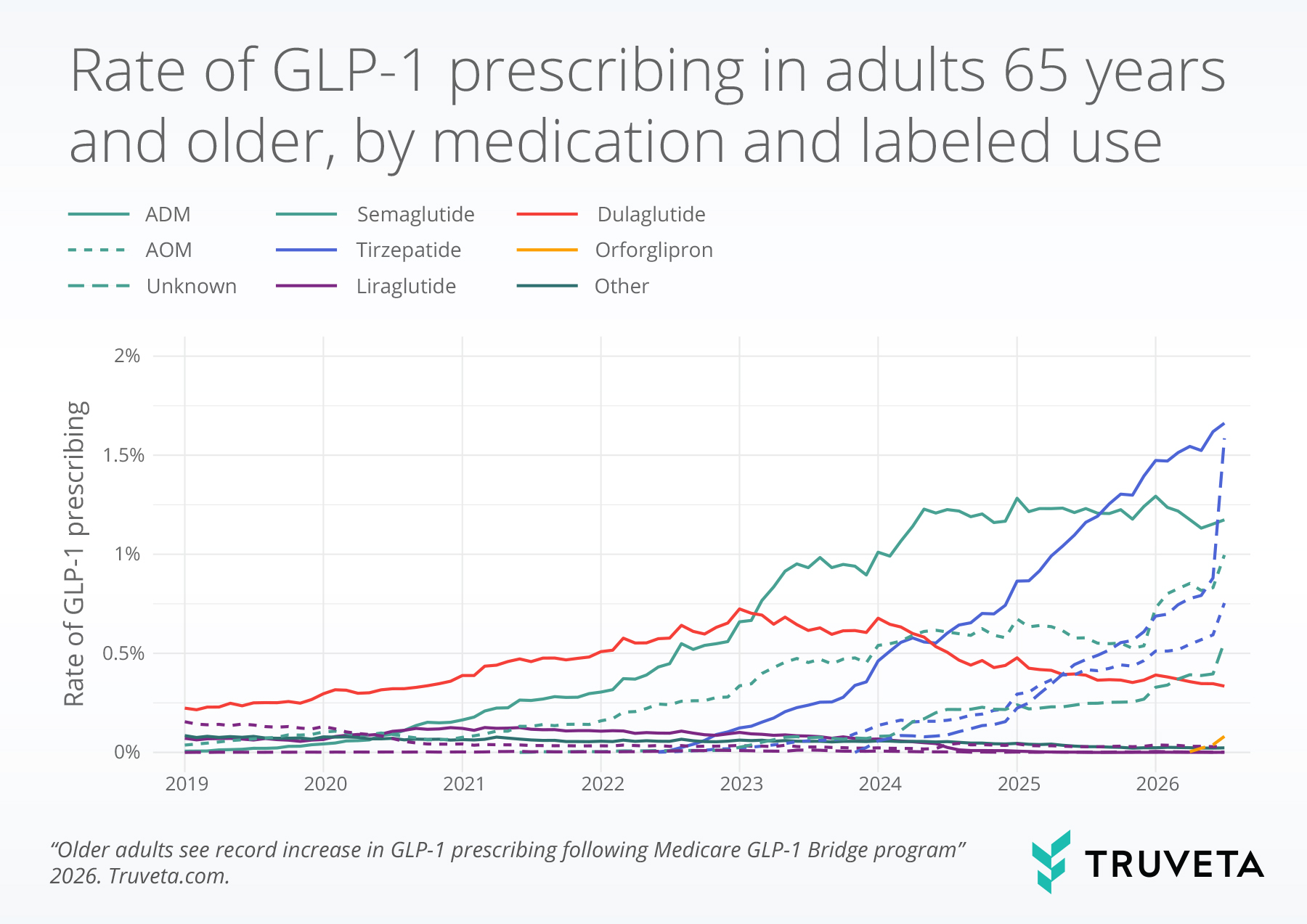
- AOM tirzepatide and AOM semaglutide showed the largest gains following launch of the Medicare GLP-1 Bridge, increasing 80.1% and 40.9%, respectively.
Glucagon-like peptide-1 receptor agonists (GLP-1s) have transformed treatment for type 2 diabetes and obesity. In addition to improving glycemic control, newer GLP-1 medications can produce substantial weight loss and have demonstrated benefits for several obesity-related health outcomes (1–3). As use has expanded, access to these medications has been shaped not only by clinical indications but also largely by insurance coverage, affordability, and changes in payer policies (4, 5). Previous Truveta research has demonstrated how changes in coverage can quickly coincide with shifts in both GLP-1 prescribing and the medications patients receive.
Previous research suggests that GLP-1 medications for weight management have been challenging to access for Medicare-aged patients because Medicare Part D generally excluded coverage of medications prescribed solely for obesity (6, 7). Although some GLP-1 medications became eligible for coverage for specific cardiovascular indications in 2024, access to anti-obesity medications remained limited for many older adults, with out-of-potentially exceeding $1,000 per month (8, 9). On July 1, 2026, the Centers for Medicare & Medicaid Services (CMS) launched the Medicare GLP-1 Bridge, a new program designed to expand access to specific GLP-1 medications for weight management among eligible Medicare Part D beneficiaries, potentially expanding access to weight-management GLP-1 medications for nearly 4 million older adults (10, 11). The program currently includes select GLP-1 medications approved for weight management, including orforglipron (Foundayo), semaglutide AOM (Wegovy), and eligible formulations of tirzepatide AOM (Zepbound) (12). Eligible beneficiaries pay $50 for a monthly supply, and the program is scheduled to operate through December 31, 2027 (10).
The launch of the Medicare GLP-1 Bridge program provides an opportunity to examine how prescribing changed following a major expansion in access to weight management medications among patients eligible for Medicare. Using a subset of Truveta Data, we examined GLP-1 prescribing from January 2019 through July 2026 by age group and, among adults aged 65 years and older, evaluated patterns of use by medication following the July 1 launch of the Medicare GLP-1 Bridge.
Methods
Using a subset of Truveta Data, we examined monthly GLP-1 prescribing from January 2019 through July 2026 across four age groups (18-34, 35-49, 50-64, and ≥65 years). Prescribing rates were calculated as the proportion of patients with any prescription who had a GLP-1 prescription. Among adults aged 65 years and older, we further examined prescribing by individual GLP-1 medication and labeled use, distinguishing anti-obesity medication (AOM) and anti-diabetes medication (ADM) formulations using medication brand names, to understand which medications contributed to changes observed following the July 1 launch of the Medicare GLP-1 Bridge.
Results
GLP-1 prescribing by age group
GLP-1 prescribing increased substantially across all age groups between 2019 and 2026, although rates differed by age. Among adults with a prescription, the proportion with a GLP-1 prescription 12.2% among adults aged 50-64 years and 11.1% among adults aged 35-49 years by July 2026. Rates remained lower among adults aged 65 years and older and adults aged 18–34 years, at 6.7% and 4.9%, respectively.
Between June and July 2026, GLP-1 prescribing increased 19.0% among adults aged 65 years and older, rising from 5.6% to 6.7%. In contrast, prescribing remained relatively stable among adults aged 18–34 years (-1.7%), 35–49 years (-0.4%), and 50–64 years (+0.5%).
GLP-1 prescribing among older adults
Among adults aged 65 years and older, changes in GLP-1 prescribing between June and July 2026 varied by medication and labeled use. AOM tirzepatide showed the largest increase, rising from 0.9% to 1.6% of adults with a prescription, an 80.1% relative increase. AOM semaglutide also increased substantially, from 0.4% to 0.6% of adults with a prescription, a 40.9% relative increase.
In contrast, prescribing remained relatively stable for the corresponding ADM formulations. ADM tirzepatide accounted for 1.6% of adults with a prescription in June and 1.7% in July (+2.6%), while ADM semaglutide accounted for approximately 1.2% in both months (+1.8%). AOM orforglipron also emerged during this period, accounting for approximately 0.1% of adults with a prescription in July 2026.
Discussion
In this analysis of GLP-1 prescribing between 2019 and July 2026, we observed a striking increase among adults aged 65 years and older immediately following the launch of the Medicare GLP-1 Bridge. GLP-1 prescribing in this age group increased 19.0% from June to July 2026, the largest single month-to-month increase observed over more than seven years of data. In contrast, prescribing changed little among younger age groups, suggesting that the increase was concentrated among the population most likely to be affected by the Medicare GLP-1 Bridge.
The largest increases among adults aged 65 years and older were observed for AOM tirzepatide and AOM semaglutide, which increased 80.1% and 40.9%, respectively. In comparison, ADM tirzepatide and semaglutide remained relatively stable. This pattern is consistent with the type of access expanded by the Medicare GLP-1 Bridge, which was designed to improve access to weight-management medications rather than indications already covered through traditional Part D pathways (10, 12). Taken together, these findings suggest that insurance coverage and out-of-pocket costs may play a major role in determining access to GLP-1 medications among older adults. The rapid increase in prescribing following program implementation underscores how policy changes that reduce financial barriers can have an immediate impact on medication access.
There are several important limitations to this analysis. Most importantly, we looked at de-identified data for patients aged 65 years and older to examine the population most likely to be affected by Medicare policy. However, not all adults aged 65 years and older are enrolled in Medicare Part D.
We also did not identify which individual patients met the Medicare GLP-1 Bridge eligibility requirements or whether prescriptions were covered through the program. Therefore, while the timing and medication-specific patterns are consistent with a potential impact of the Medicare GLP-1 Bridge, these results cannot establish that the program caused the observed increase.
Despite these limitations, several aspects of the July increase are notable. The increase was concentrated among adults aged 65 years and older, occurred immediately following launch of the Medicare GLP-1 Bridge, and was driven primarily by weight-management formulations included in the program. After years of gradual growth in GLP-1 use among older adults, July 2026 represented the largest month-to-month increase observed in the seven-year study period. Continued monitoring will be important to determine whether these early changes are sustained over time.
These are preliminary research findings and are not peer reviewed. Data are regularly updating. These findings are consistent with data accessed on August 14, 2026.
Citations
- P. J. Rodriguez, B. M. G. Cartwright, S. Gratzl, R. Brar, C. Baker, T. J. Gluckman, N. L. Stucky, Semaglutide vs tirzepatide for weight loss in adults with overweight or obesity. JAMA internal medicine 184, 1056–1064 (2024).
- D. J. Drucker, Efficacy and safety of GLP-1 medicines for type 2 diabetes and obesity. Diabetes Care 47, 1873–1888 (2024).
- E. D. Michos, F. Lopez‐Jimenez, M. Gulati, Role of Glucagon‐Like Peptide‐1 Receptor Agonists in Achieving Weight Loss and Improving Cardiovascular Outcomes in People With Overweight and Obesity. JAHA 12, e029282 (2023).
- S. Gratzl, K. Farrar, E. Holler, M. Vachon, N. Masters, B. Cartwright, Monitoring Report: GLP-1 RA Prescribing Trends – March 2026 Data | medRxiv (2026). https://www.medrxiv.org/content/10.1101/2025.03.06.25323524v6.
- B. Cartwright, P. J. Rodriguez, D. Do, N. Stucky, EPH85 Real-World Temporal and Indication-Specific Variation in Drivers of GLP-1 RA Discontinuation. Value in Health 28, S175 (2025).
- P. J. Rodriguez, V. Zhang, S. Gratzl, B. M. G. Cartwright, D. Do, N. Stucky, E. J. Emanuel, Access to Anti-Obesity GLP-1s for Medicare-Aged Adults. medRxiv, 2024–03 (2024).
- L. Oshman, Views on Medications for Weight Management, Institute for healthcare policy and innovation (2023). https://ihpi.umich.edu/national-poll-healthy-aging/national-findings/views-medications-weight-management.
- B. R. [R-O.-2 Rep. Wenstrup, Actions – H.R.4818 – 118th Congress (2023-2024): Treat and Reduce Obesity Act of 2023 (2024). https://www.congress.gov/bill/118th-congress/house-bill/4818/all-actions.
- GLP-1 Costs: Semaglutide, Tirzepatide and Compounded GLP-1s Prices, Forbes Health (2026). https://www.forbes.com/health/weight-loss/glp-1-costs/.
- CMS Launches Medicare GLP-1 Bridge, Expanding Access to GLP-1 Medications | CMS. https://www.cms.gov/newsroom/press-releases/cms-launches-medicare-glp-1-bridge-expanding-access-glp-1-medications.
- J. Cubanski, N. Sroczynski, Nearly Four Million Medicare Beneficiaries Met the Eligibility Criteria in 2023 for the Medicare GLP-1 Bridge, KFF (2026). https://www.kff.org/medicare/nearly-four-million-medicare-beneficiaries-met-the-eligibility-criteria-in-2023-for-the-medicare-glp-1-bridge/.
- Weight loss drugs, Medicare. https://www.medicare.gov/coverage/weight-loss-drugs.